In This Guide
The last tour bus pulls out of the Petra parking lot around 4:30 p.m. By 5:15, the Siq goes quiet enough that you can hear your own breathing bounce off the sandstone walls. This is when Petra becomes worth the 50 JD entry fee — or, more precisely, when it stops being a place you share with two thousand strangers carrying selfie sticks.
I first walked into the Treasury clearing after dark during a Petra by Night session in 2019, and the candlelit silence almost made me forget I'd spent the afternoon dodging camel operators and overpriced souvenir hawkers along the colonnaded street. But Petra by Night is only part of the equation. The real draw after sundown is what's happening in the Bedouin camps behind the ridge: zarb pits dug into the sand, lamb and chicken slow-cooking underground for hours, and tea brewed on coals by families who've been here longer than the tourism ministry.
1. What zarb actually is (and why your hotel buffet version doesn't count)
Zarb is underground barbecue — meat, vegetables, and rice layered on metal racks, lowered into a sand pit over hot coals, then buried and left to cook for three to four hours. Bedouin families across southern Jordan still use it for celebrations, though the tourist-facing version has been streamlined into something more predictable.
The hotel restaurants in Wadi Musa serve what they call zarb. Skip it. It's reheated meat with cumin-heavy rice, and the theatrics of pulling it from a pit in the hotel courtyard don't disguise the fact that it sat in a warming tray. The real thing happens in the camps run by local Bdoul and Ammarin Bedouin families, where the lamb fat renders into the rice below and the whole thing tastes like smoke.
Several families operate informal dinner camps near Little Petra (Siq al-Barid), about 9 km north of the main Petra site. Expect to pay 15-25 JD per person for a full zarb dinner with tea, flatbread, and salads. You won't find these on Google Maps with star ratings — you book through your guesthouse or by asking around in Wadi Musa. The Ammarin Bedouin Camp, near Little Petra, offers a more organized version at roughly 20 JD per person including the zarb meal.
Pro tip: Ask specifically for zarb cooked with jameed (dried fermented yogurt). It gives the rice a sour tang that cuts through the lamb fat. Not every camp does it, but the ones that do are serving the version their grandmothers would recognize.
2. Petra by Night is overrated — go anyway, but know why
Here's my contrarian position: Petra by Night, the official Monday-Wednesday-Thursday candlelit event (17 JD, starts at 8:30 p.m., runs about two hours), is one of the most overhyped experiences in Jordan. The walk through the Siq is atmospheric, but once you reach the Treasury, you sit on the ground with a hundred other people while a Bedouin musician plays a couple of songs and someone narrates a history you already read on the plane. The candles photograph well. The experience itself is oddly passive.
Go anyway. Not for the program, but because the walk back is the real payoff. After the performance ends around 10:30, the crowd thins fast. If you linger, you'll have stretches of the Siq nearly to yourself. The sandstone walls absorb and release the day's heat, and in summer the temperature finally drops to something tolerable. The security guards let you take your time walking out — they're not rushing anyone.
Pro tip: Bring a headlamp but keep it off during the walk in. Your eyes adjust. The candle-lit Siq is worth the stumbling.
Stay in Petra
Top-rated hotels near Petra
Best locations · Verified reviews · Free cancellation
View deals
Expedia →3. The Treasury at 6 a.m. versus the Treasury at noon
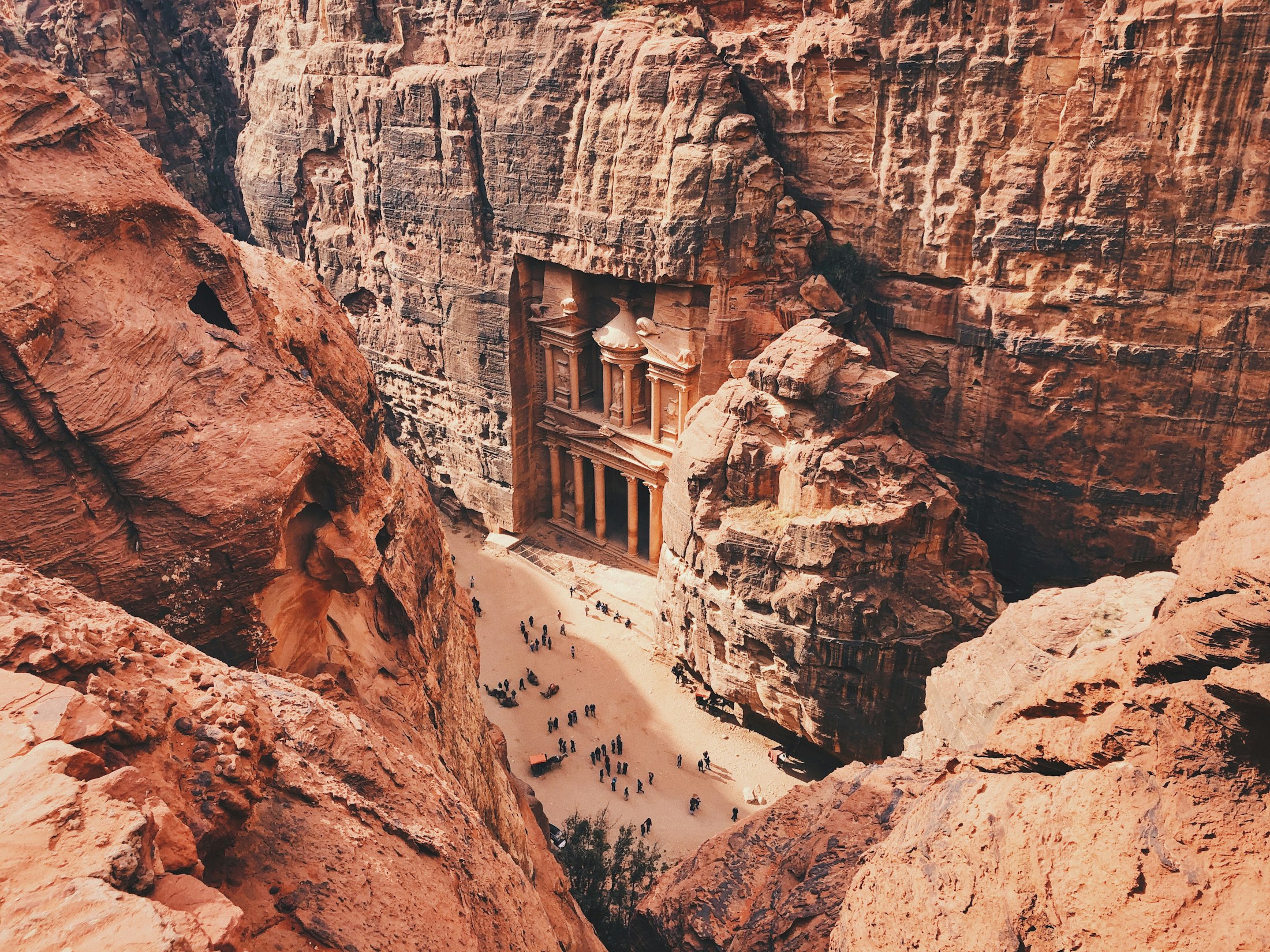
Most visitors reach the Treasury (Al-Khazneh) between 10 a.m. and 2 p.m. During those hours it's a bottleneck — camel drivers, donkey operators, tour groups with matching lanyards, and an echo chamber of competing guides all narrating the same Nabataean tomb theory at different volumes.
Gates open at 6 a.m. Get there at opening. In the early morning, the sun hits the upper columns first and moves down the façade over about forty minutes. The sandstone shifts from grey-pink to copper. You might share the clearing with five other people.
I made the mistake of arriving at noon on my first visit, in July, and spent twenty minutes trying to get a photo without a camel's rear end in it. The heat at midday in summer reaches 40°C in the canyon, and there's no shade in the Treasury clearing. Morning or late afternoon. That's it.
4. The camps behind the ridge: tea, tobacco, and no Wi-Fi
Behind the Royal Tombs, past the Urn Tomb and up a goat trail that the Bdoul families know by muscle memory, a handful of informal Bedouin tent camps operate in the evenings. These are not tourist installations. They're where local families gather, smoke, drink tea, and sometimes host visitors who've been invited or who stumble up the path with the right attitude.
You cannot book these. No website, no QR code. Ask at a guesthouse in Wadi Musa — Rocky Mountain Hotel on King Hussein Street is reliably connected — or talk to one of the Bdoul vendors inside the site during the day. The etiquette is straightforward: accept tea (always), remove your shoes if entering a tent, don't photograph people without asking, and bring your own tobacco if you want to smoke the argileh.
The tea alone is worth the walk. Bedouin tea in this region is brewed dense with sage (maramiyyeh) and sugar, boiled directly in a small steel pot over coals. No teabags, no infusers. Sage smoke against cold sandstone.
Pro tip:If someone offers you mansaf (the yogurt-and-lamb dish eaten communally with the right hand), say yes. Eat with your right hand only, roll the rice into a ball against the side of the tray, and don't use your left hand for anything food-related.
5. Little Petra at night is the thing nobody talks about
Little Petra (Siq al-Barid), the smaller Nabataean site 9 km north, has no entry fee and no closing time. Read that again. No entry fee, no closing time. After dark, the short siq is empty and the carved triclinium dining rooms feel appropriately ancient instead of like a photo backdrop.
The Painted Biclinium, a small chamber about 400 meters into the site, still has fragments of first-century frescoes on its ceiling: grapevines, birds, cupids. During the day, you jostle to peer inside. At 9 p.m., you stand alone with a flashlight and the frescoes are right there, the pigment still holding after two thousand years.
Combine this with a zarb dinner at one of the nearby camps. Drive or arrange a taxi from Wadi Musa — expect to pay about 7-10 JD each way.
Pro tip: Bring a proper flashlight, not just your phone. The Painted Biclinium ceiling is about 3 meters up, and phone flashlights wash out the faded reds and greens.
Stay in Petra
Top-rated hotels near Petra
Best locations · Verified reviews · Free cancellation
View deals
Expedia →Essential tips
Wear shoes with actual grip — the sandstone paths inside Petra are polished smooth by foot traffic and get slippery after rare rain. Trail runners beat hiking boots for the combination of grip and ankle mobility on the goat trails behind the Royal Tombs.
The only water refill station inside the main Petra site is near the Basin Restaurant, past the colonnaded street. Bring at least 2 liters if you're entering at 6 a.m. — the Bdoul-run stalls don't open until around 8.
Petra's 50 JD single-day entry fee (as of 2024) drops to 55 JD for two days and 60 JD for three — the marginal cost of extra days is absurdly low. Buy the multi-day pass. You need it.
Summer afternoon temperatures inside the Siq and Treasury clearing regularly exceed 40°C. Plan any serious hiking — the Monastery climb, the High Place of Sacrifice — for before 9 a.m. or after 4 p.m.
Ready to visit Petra?
Book your hotel, flights, and activities through our Expedia-powered search.


