In This Guide
- 1.Starting the Back Trail from Wadi Turkmaniyeh
- 2.The Oleander Gorge and Why May Changes Everything
- 3.Bedouin Tea at Um Sayhoun Camp Kitchen
- 4.The Hidden Nabataean Cisterns Above the Monastery
- 5.Lunch at Al-Arabi Restaurant in Wadi Musa
- 6.Sunset From the High Place of Sacrifice Without the Crowds
- 7.What to Pack and How to Prepare Your Body
The oleander is blooming in Wadi Siyagh when you arrive at dawn, fuchsia clusters erupting from crevices in the sandstone like signals marking a path most visitors never find. You've bypassed the main Siq entirely, ducking behind the Basin Restaurant toward a goat trail that the Bdoul Bedouin have walked for centuries. The air smells of wild thyme and warm rock, and the only sound is a black wheatear calling from a ledge above the Monastery stairs.
This guide maps Petra's lesser-known back trail — a route that threads through oleander-lined wadis, Nabataean cisterns, and Bedouin camp kitchens during May, the single best month to attempt it. You'll learn exactly where the trail starts, who to hire as a guide, what to carry, and where to sit cross-legged on a kilim rug while a third-generation Bdoul woman brews sage-sweetened tea over juniper coals. It matters because Petra is being loved to death along its main corridor, and this route offers something rarer: silence, trust, and flowers.
1. Starting the Back Trail from Wadi Turkmaniyeh
The back trail begins not at the Visitor Centre but at the unmarked trailhead behind the Turkmaniyeh Tomb, roughly 800 metres north of the main entrance along a gravel service road. You'll recognise it by a faded blue paint blaze on a boulder and a metal water pipe running uphill. Arrive before 6:30 a.m. to beat both heat and park rangers who occasionally redirect tourists.
From Turkmaniyeh, the path climbs steeply through a narrow gorge where Nabataean water channels are still visible, carved in clean right angles into the cliff face. In May, pools linger here from late spring rain, attracting Sinai rosefinches that flash crimson against the pale sandstone. The footing is loose gravel over bedrock — walking poles help considerably.
Your first landmark is a collapsed cistern roughly forty minutes in, recognisable by a lone Atlantic pistachio tree growing from its centre. This is where you'll want your first water break. The elevation gain to this point is approximately 180 metres, and the trail levels off briefly before the next climb toward Jabal Haroun's western ridge.
Avoid the unmarked fork bearing left at the cistern — it dead-ends at a sheer drop-off above Wadi Araba. Instead, follow the faint cairns trending right, which the Bdoul refresh seasonally. If you lose the cairns, backtrack. The rock here is Umm Ishrin sandstone, brittle and unreliable for scrambling.
Pro tip: Hire Mohammed al-Bdoul (ask at the Petra Moon Hotel front desk in Wadi Musa) as your trail guide. He charges 45 JOD for the full back-trail loop and knows every water source and shortcut intimately.
2. The Oleander Gorge and Why May Changes Everything
Roughly ninety minutes into the hike, the trail drops into a sheltered gorge the Bdoul call Siq al-Ward — the Rose Canyon. In May, Nerium oleander bushes explode along its seasonal stream bed in dense thickets of pink and white, creating a corridor of flowers between sandstone walls barely three metres apart. The effect is hallucinatory: colour saturating a landscape you expected to be monochrome.
Oleander blooms peak between May 5 and May 25 in a typical year, triggered by the last rains of April and sustained by underground seepage. By June, the flowers are spent and the leaves turn dusty. Visit during this narrow window and you'll photograph something genuinely rare — a desert gorge functioning as a garden, with butterflies and painted lady moths thick in the still air.
The gorge runs for approximately 600 metres before opening onto a high plateau with sweeping views toward Jabal Haroun. Pause here. The sight of Aaron's Tomb floating above pink desert haze, framed by oleander at your feet, is one of Jordan's most underappreciated panoramas. No tour bus reaches this angle.
Be aware that oleander is toxic — every part of the plant. Don't chew stems, burn branches for campfire kindling, or let the sap contact open cuts. The Bdoul know this instinctively and will steer you clear, another reason a local guide is not optional but essential.
Pro tip: Bring a macro lens or clip-on macro attachment for your phone. The oleander petals catch backlighting beautifully at mid-morning, and the striped sandstone behind them creates natural studio backdrops no filter can replicate.
Stay in Petra
Top-rated hotels near Petra
Best locations · Verified reviews · Free cancellation
View deals
Expedia →3. Bedouin Tea at Um Sayhoun Camp Kitchen
The trail descends from the plateau toward Um Sayhoun, the Bdoul resettlement village perched above Petra's northern boundary. On the village's eastern edge, Um Khalil runs an informal camp kitchen from her family courtyard — look for the blue metal gate with a painted teapot on the wall, roughly 200 metres past the village mosque. She serves tea to hikers who know to ask.
The tea itself is a ceremony compressed into a blackened finjan pot. Um Khalil uses loose Ceylon black tea — never bags — simmered with fresh sage from her garden and sweetened with a staggering amount of sugar. She adds a pinch of dried maramiyya and sometimes habaq, a local wild basil, depending on what she picked that morning. You drink it from small glass cups, scalding hot, in three rounds.
Accepting fewer than three cups is considered impolite, so pace yourself. Between rounds, Um Khalil often serves fresh taboon bread torn from a round she baked that morning in the clay oven behind the house. She may offer labaneh drizzled with olive oil and za'atar from a neighbour's press. Expect to pay 3-5 JOD as a voluntary contribution; she will not name a price.
This stop is about more than refreshment. The Bdoul were forcibly relocated from Petra's caves in 1985, and their relationship to the site is layered with displacement and pride. Um Khalil's mother was born in a cave behind the Royal Tombs. Listening here teaches you something no museum panel conveys.
Pro tip:Bring a small gift — a bag of good coffee, fresh fruit from Wadi Musa's Friday market, or school supplies if she mentions her grandchildren. Cash tips are appreciated but a thoughtful gift earns a warmer welcome and sometimes a second bread round.
4. The Hidden Nabataean Cisterns Above the Monastery
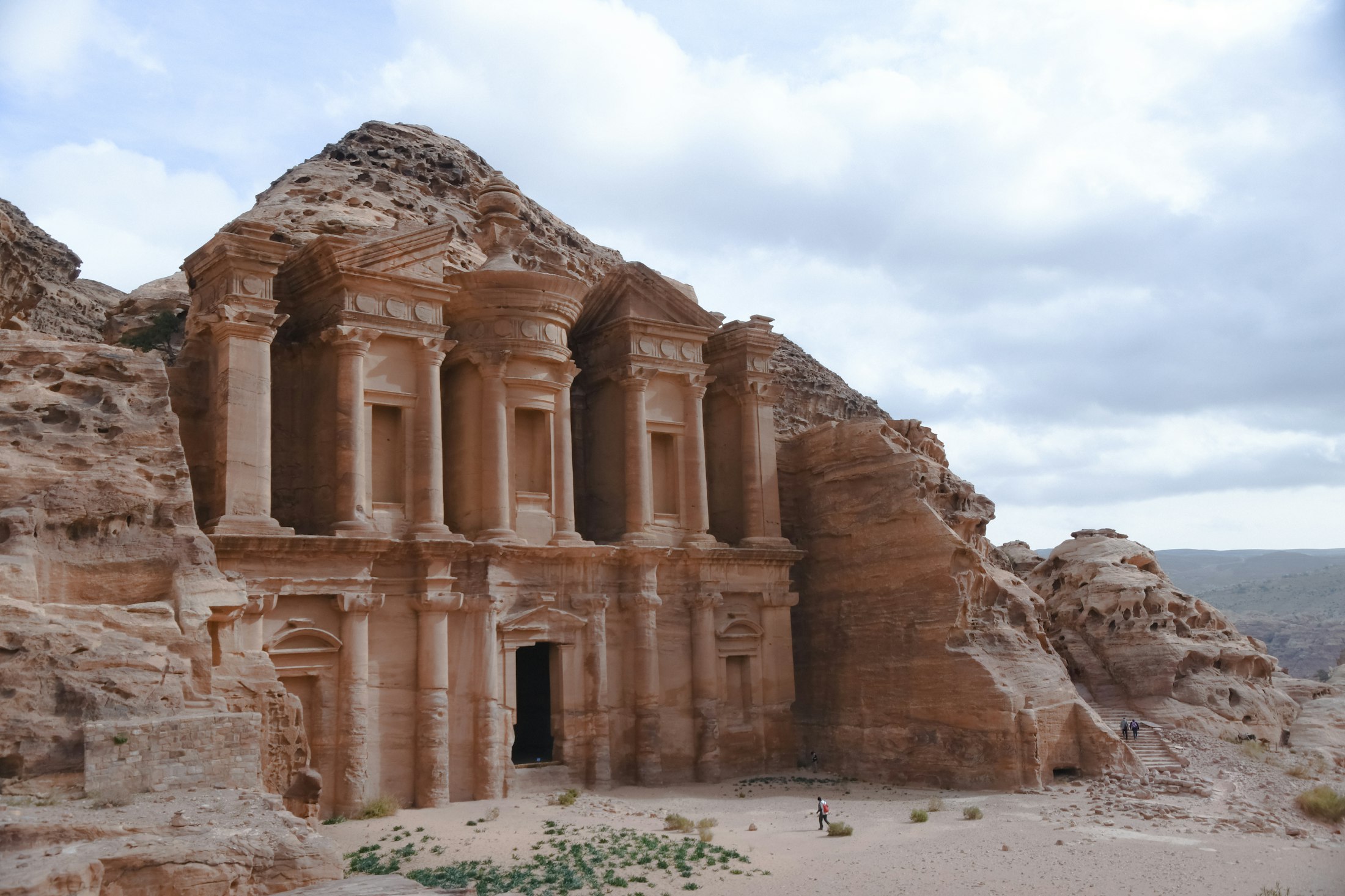
After tea, the trail re-enters the archaeological zone via a shepherd's path that crests the ridge directly above Ad-Deir, the Monastery. From this angle, you look down onto the monument's massive urn finial — a perspective reserved for eagles and the handful of hikers who know this route. The Monastery appears almost modest from above, its scale only registering when a tourist below shrinks to an ant.
Just below the ridgeline, two Nabataean cisterns survive in remarkable condition, their plaster linings still holding seasonal rainwater. These aren't marked on any tourist map. The larger cistern measures roughly four by six metres and in May still holds ankle-deep water, greenish and fringed with maidenhair fern — proof of the Nabataean engineering genius that sustained 30,000 people in a desert city.
Your guide will likely suggest descending via the cistern path rather than the 800-step tourist staircase to Ad-Deir. The route is steeper but shorter, and it deposits you at the Monastery's eastern flank where a Bdoul vendor named Salem sells cold water and tangerine juice from a cave stall. His prices are fair — 1.5 JOD for juice — and his cave catches a cross-breeze that feels miraculous in the midday heat.
Spend twenty minutes at Ad-Deir itself while the tour groups are still climbing up. By 11 a.m. it gets crowded. The facade faces northwest, so morning light rakes across the carved details with maximum drama. Afternoon visitors get flat, washed-out stone.
Pro tip:Fill your empty water bottles at Salem's cave stall rather than carrying extra weight over the ridge. He sells 1.5-litre bottles for 2 JOD — a premium over town prices but a bargain against dehydration on the return trail.
5. Lunch at Al-Arabi Restaurant in Wadi Musa
You'll exit the park by early afternoon, sun-scorched and ravenous. Skip the tourist buffets near the Visitor Centre and drive five minutes into central Wadi Musa to Al-Arabi Restaurant on King Hussein Street, opposite the Arab Bank. It's a fluorescent-lit local joint with plastic tablecloths and zero ambience — and the best mansaf in the Petra region.
Order the half-mansaf plate with jameed sauce. The lamb is stewed until it collapses, the yoghurt broth is tangy and rich from dried jameed balls sourced from a dairy in Tafila, and the rice is properly toasted with almond slivers and pine nuts. A full plate feeds two comfortably and costs around 8 JOD. Add a side of fattoush — they make it with sumac so sharp it puckers your lips.
Avoid the grilled chicken, which sits too long under a heat lamp, and skip the hummus, which arrives from a tub rather than made fresh. The kitchen's strength is slow-cooked Bedouin-style dishes: mansaf, makloubeh on Fridays, and a lamb-stuffed vine leaf preparation that appears sporadically on the handwritten daily board.
Al-Arabi fills up with local families by 1:30 p.m. on Fridays, so arrive at noon or wait until 3 p.m. Seating is communal during peak hours. The owner, Abu Fadi, will likely bring you complimentary tea after the meal — accept it, and you've completed a full loop of Jordanian hospitality from Bedouin camp to town kitchen.
Pro tip:Ask Abu Fadi for the makloubeh if it's Friday — he flips the pot tableside with theatrical flair, and the caramelised onion crust on the rice base is worth timing your entire hike exit around.
Stay in Petra
Top-rated hotels near Petra
Best locations · Verified reviews · Free cancellation
View deals
Expedia →6. Sunset From the High Place of Sacrifice Without the Crowds
Most visitors climb to the High Place of Sacrifice at midday, following the signed trail from the main colonnade. You'll take the back approach instead: a path beginning at the Wadi Farasa exit, climbing the southern flank of Jabal Madbah. In May, the light turns golden by 5:30 p.m., and by 6 p.m. you'll likely have the obelisk platform entirely to yourself.
The ascent from Wadi Farasa takes roughly 35 minutes at a moderate pace and is less trafficked because most tourists descend this way and don't think to reverse the route late in the day. The path passes the Garden Tomb and the Roman Soldier Tomb complex — both worth a pause in the amber light. Oleander grows here too, in smaller clusters than the gorge but no less vivid.
At the summit, two Nabataean obelisks mark the sacrificial platform where animal blood offerings were channelled through a carved stone basin. The engineering is chilling and beautiful. In May's twilight, the Sharah Mountains to the east turn violet, and the wadi below fills with shadow while the high places remain illuminated — a natural theatre of geology and light.
Descend via the main staircase to the colonnade street, which is quieter after 6:30 p.m. as tour groups have departed through the Siq. The walk back through the Siq at dusk, with angled light painting the upper walls in copper and rose, is worth enduring tired legs. You'll understand why the Nabataeans chose this specific canyon as their grand entrance.
Pro tip:Carry a headlamp for the Siq exit — in May, full darkness falls by 7:15 p.m. and the canyon floor is uneven. The park technically closes at sunset, but guards at the gate are accustomed to late stragglers and won't penalise you.
7. What to Pack and How to Prepare Your Body
The full back-trail loop covers roughly 18 kilometres with 600 metres of cumulative elevation gain. In May, daytime temperatures in Petra range from 28 to 34°C, but the gorges trap cooler air in the morning and radiate stored heat by afternoon. Dress in lightweight, long-sleeved sun protection — not cotton, which soaks through and chafes.
Carry a minimum of three litres of water per person. There are no reliable refill points between the trailhead and Um Sayhoun except the Nabataean cisterns, and drinking from those is inadvisable. Electrolyte tablets are essential, not optional. Hyponatremia from sweating without salt replacement is a genuine risk on exposed ridgelines.
Footwear matters enormously. Trail runners with aggressive grip outperform heavy hiking boots on Petra's sandstone, which is grippy when dry but catastrophically slick when wet or sandy. Avoid sandals entirely. Gaiters are unnecessary but tall socks prevent ankle scrapes on thorny burnet bushes lining the narrower trail sections.
Bring a 20-litre daypack with your water, a packable wind layer for ridgeline gusts, sunscreen rated SPF 50 or higher, and a portable charger. Phone signal is intermittent on the back trail but reliable on the ridgelines. Download offline maps via Maps.me before departure — the trail is partially marked on their database thanks to Bdoul guide contributions.
Pro tip: Start a hydration pre-load 48 hours before the hike — drink an extra litre daily with electrolyte tabs. Altitude is modest at 900-1200 metres, but the combination of desert heat and sustained climbing depletes you faster than you expect.
Essential tips
Buy a two-day Petra Jordan Pass (70 JOD) to cover your visa fee and park entry. The back trail requires a standard park ticket — no special permit — but you'll want the second day for Treasury and main-corridor sites you skipped on the hike.
May mornings start cool at 16-18°C but by noon exposed ridgelines hit 33°C. Layer a lightweight windbreaker over a wicking base layer at dawn and strip down by 9 a.m. Sunburn happens in under 20 minutes on the pale sandstone plateaus.
Buy a Zain or Orange Jordan SIM at Queen Alia Airport for 10 JOD with 10GB data. Coverage on the back trail is patchy but WhatsApp messages queue and send from ridgelines. Share live location with a contact at your hotel before departing.
Carry small denominations of Jordanian dinars — 1 JOD and 5 JOD notes — for Bedouin tea, cave stall purchases, and tipping your guide. Credit cards are useless inside the park and most Um Sayhoun homes. ATMs are available at the Arab Bank in central Wadi Musa.
Pack blister tape, antiseptic wipes, and a compression bandage. The nearest hospital is Queen Rania Al-Abdullah Hospital in Wadi Musa, 10 minutes by taxi from the Visitor Centre. Jordanian emergency number is 911. Trail evacuation from the back route takes 2-3 hours minimum.
Ready to visit Petra?
Book your hotel, flights, and activities through our Expedia-powered search.


