In This Guide
- 1.Salt coffee, and why you're drinking it wrong
- 2.The balcony situation on Nguyễn Huệ
- 3.Bến Thành Market: skip most of it
- 4.What the monsoon actually does to your day
- 5.Eating on Hồ Chí Minh's sidewalks in the dry window
- 6.Where to sleep without paying for a rooftop pool you won't use
- 7.The bus to Chợ Lớn is 7,000 VND
- 8.Evenings after the rain stops
The rain comes sideways in August. Not the polite drizzle you get in Singapore or the theatrical downpours of Bangkok — this is water thrown from buckets by a city that doesn't care if you're ready. I was sitting on a third-floor balcony on Nguyễn Huệ when the first monsoon cell hit, and my cà phê muối slid two inches across the tile table from the wind alone. The coffee survived. My shoes didn't.
District 1 in monsoon season is not the version of Saigon that gets posted to travel reels. The sidewalks flood to ankle depth by 3 p.m. The French colonial facades look less romantic when the plaster is actively dissolving. But the crowds thin, the hotel rates drop, and the salt coffee tastes better when you're watching sheets of water erase the street below. August is when this district stops performing.
1. Salt coffee, and why you're drinking it wrong
Cà phê muối — espresso or drip coffee topped with a whipped cream-and-salt foam — was popularized in Huế, not Saigon. Most District 1 cafés now serve some version, and most of them oversweet it. The foam should taste like salted butter, not frosting.
The best I had this trip was at Cộng Cà Phê on the second floor at 26 Lý Tự Trọng, which is a chain and I don't care. 45,000 VND. The condensed milk is restrained, the salt actually registers, and the balcony seats overlook the old post office without requiring you to go inside the old post office. Order it iced unless you enjoy lukewarm dairy in 90% humidity.
People will tell you to go to The Workshop on Lê Lợi for better coffee. They're right about the beans and wrong about everything else. It's a co-working space that charges café prices, and the acoustics make it sound like you're inside a laptop.
Pro tip:Ask for 'ít đường' (less sugar) when ordering cà phê muối anywhere. Default sweetness is calibrated for a different palate than mine — and probably yours.
2. The balcony situation on Nguyễn Huệ
Nguyễn Huệ walking street is the wide pedestrian boulevard that anchors District 1's tourist geography. At street level, it's fine — kids on roller skates, LED light shows, couples posing. The actual draw is above.
The apartment buildings lining the boulevard, particularly the one at 42 Nguyễn Huệ (locals just call it "the café building"), have been colonized floor by floor with small cafés, bars, and shops accessible via a single grimy elevator or a stairwell that smells like incense and drain cleaner. Each floor is a different operation. You pick a floor, you pick a balcony, you sit. In August, the balcony seats empty out because of the rain, which means you actually get one.
Eleven cafés across eight floors. Most charge between 40,000 and 75,000 VND for a drink. Saigon Oi on the top floor has the best sightline but the weakest coffee. Partea on a lower floor makes decent fruit teas.
Pro tip:The elevator line at 42 Nguyễn Huệ can hit 20 minutes on weekend evenings. Take the stairs. It's nine floors and the exercise is free.
3. Bến Thành Market: skip most of it
I'll say it plainly: the interior of Bến Thành Market is not worth your time during the day. The prices are marked up 200-400% over what you'd pay two blocks away, the vendors are tired of haggling with tourists, and the heat inside the hall in August is genuinely oppressive. I watched a woman buy a pair of knockoff Ray-Bans for 350,000 VND that I'd seen at 80,000 on Lê Lợi.
The night market that wraps around the exterior after 6 p.m. is a different animal. Food stalls set up along the south and west sides, and the prices, while still tourist-adjusted, at least correspond to food worth eating. Get the bánh xèo (sizzling crepe) — around 40,000 VND — and eat it standing.
The surrounding streets, particularly Phan Bội Châu running south, have actual shops with price tags. Price tags are your friend.
4. What the monsoon actually does to your day
Here's the pattern. Mornings are hot and dry. By 1 or 2 p.m. the sky turns the color of a bruise. Between 3 and 5 p.m., it rains hard enough to make crossing the street inadvisable. By 6:30, it's done — the temperature drops five degrees, the pavement steams, everything smells like wet concrete and grilled pork.
Plan around this. Do your walking before noon. Post up somewhere with a roof and a drink from 2 to 5. Then go back out for dinner when the streets are washed and the air is almost pleasant.
The one thing nobody tells you: the flooding. Certain blocks near the Saigon River, especially along Hàm Nghi and Tôn Đức Thắng, can flood knee-deep during a hard cell. I saw motorbikes pushing through water that was lapping at their seats. Wear shoes you'd throw away.
Pro tip: Cheap plastic ponchos — áo mưa — are sold at every convenience store and street vendor for 10,000-15,000 VND. Buy two on day one. Umbrellas are useless in sideways rain.
5. Eating on Hồ Chí Minh's sidewalks in the dry window
The morning-to-noon window is when District 1's street food peaks. Phở Hòa Pasteur at 260C Pasteur Street has been operating since 1968 and charges around 75,000 VND for a bowl of phở bò. It's not the cheapest in the district — not close — but the broth has a clarity that justifies it. Go before 8 a.m. or you'll wait.
For bánh mì, the consensus pick is Bánh Mì Huỳnh Hoa at 26 Lê Thị Riêng. The consensus is, for once, correct. A single sandwich is 47,000 VND and roughly the size of your forearm. The pâté is thick enough to mortar bricks. The line moves fast.
Two blocks north on Lý Tự Trọng, a woman whose name I never caught sells bún thịt nướng from a cart that appears around 10:30 a.m. and vanishes by 1 p.m. 35,000 VND. No signage. Look for the charcoal smoke.
6. Where to sleep without paying for a rooftop pool you won't use
August room rates in District 1 drop roughly 30-40% from the December-February peak. This is the one advantage of monsoon travel that actually holds up.
Skip the international chains along Đồng Khởi unless someone else is paying. You're buying a lobby and a brand name. The mid-range guesthouses on and around Bùi Viện and Đề Thám offer private rooms with air conditioning, decent Wi-Fi, and no pretense for 400,000-700,000 VND per night. I've stayed at places in this range that were clean and quiet, and places that were neither — check recent reviews, look at photos of the actual room, and confirm the AC works before you hand over your passport.
The sweet spot is the cluster of smaller hotels on Lê Thánh Tôn between Pasteur and Hai Bà Trưng. Close to food, close to the walking street, far enough from Bùi Viện that you can sleep before 2 a.m.
Pro tip:Book direct via the hotel's own website or by calling ahead on WhatsApp/Zalo. Booking platforms take a 15-20% commission that smaller hotels will sometimes split with you as a discount.
Stay in Ho Chi Minh City
Top-rated hotels near Ho Chi Minh City
Best locations · Verified reviews · Free cancellation
View deals
Expedia →7. The bus to Chợ Lớn is 7,000 VND
District 5's Chợ Lớn is a 30-minute bus ride from Bến Thành on route 1. Seven thousand đồng. About thirty US cents. A Grab car will cost you 50,000-80,000 VND depending on surge pricing, which kicks in the moment it rains, which in August is every afternoon.
The bus stops on the north side of the Bến Thành roundabout. It's not signed in English. Ask anyone under thirty; they'll point.
Ho Chi Minh City's bus system is underrated. Clean enough, rarely full outside rush hour, and the route map is on Google Maps. The 36 and 52 lines are useful for reaching District 3 from District 1 without dealing with the motorbike river on Điện Biên Phủ.
Pro tip:Exact change isn't required on HCMC buses — the conductor makes change — but having small bills (10,000 or 20,000 VND) speeds things up.
8. Evenings after the rain stops
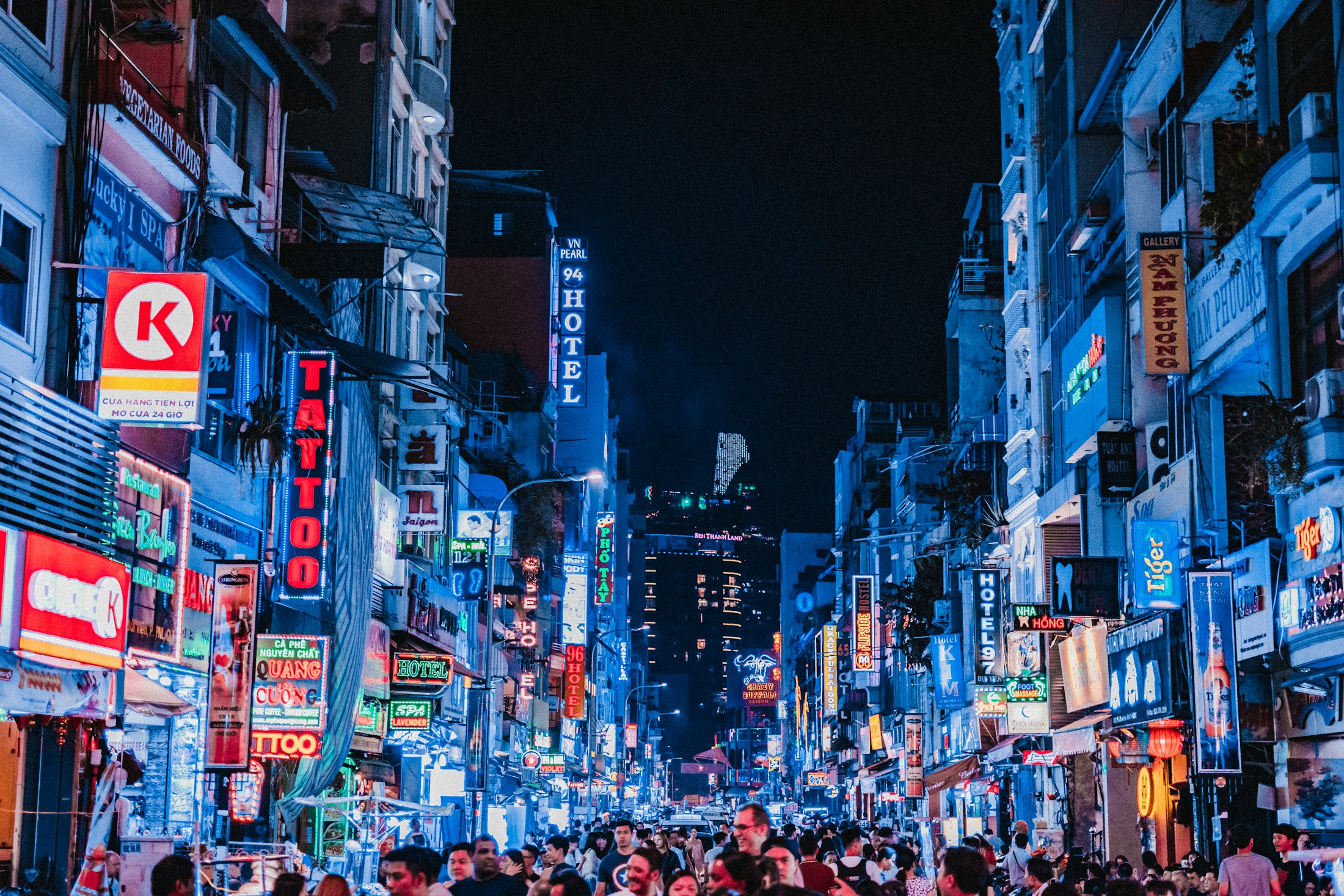
Post-storm District 1 is the version I come back for. The air cools to something tolerable. The neon on Bùi Viện reflects off wet asphalt. Street vendors reappear like they'd been held underwater.
Walk south from Nguyễn Huệ toward the river along Tôn Đức Thắng after 7 p.m. The waterfront promenade — still relatively new — is where locals go to sit on benches, eat corn from carts, and watch container ships move upriver. No admission. No gift shop.
For a drink, I'd rather sit at a plastic table outside a convenience store with a Saigon Export (12,000-15,000 VND at a Circle K) than pay 150,000 VND for a cocktail at one of the rooftop bars that every listicle recommends. The Bitexco Tower's skydeck bar charges 200,000 VND minimum. The view is the same from the street, just rotated 90 degrees.
Last trip I sat on the Nguyễn Huệ steps with a 333 beer and watched a monsoon cell roll in from the east. The whole sky went indigo in about four minutes. Nobody ran.
Stay in Ho Chi Minh City
Top-rated hotels near Ho Chi Minh City
Best locations · Verified reviews · Free cancellation
View deals
Expedia →Essential tips
ATMs are everywhere in District 1, but many charge 30,000-50,000 VND per withdrawal. Sacombank and ACB ATMs tend to have lower or no fees for international cards. Withdraw larger amounts less often.
Bring waterproof sandals with actual grip. August sidewalks are slick tile covered in rain. I watched three people fall on Đồng Khởi in a single afternoon.
Buy a Viettel or Mobifone SIM at the airport for around 100,000-200,000 VND with data. You'll need it for Google Maps on buses and for Grab. Don't rely on café Wi-Fi — it dies when the power flickers during storms.
Most street food stalls in District 1 operate on fixed windows — typically 6-10 a.m. for breakfast and 5-9 p.m. for dinner. Showing up at 2 p.m. expecting phở will get you a closed shutter.
Ready to visit Ho Chi Minh City?
Book your hotel, flights, and activities through our Expedia-powered search.


