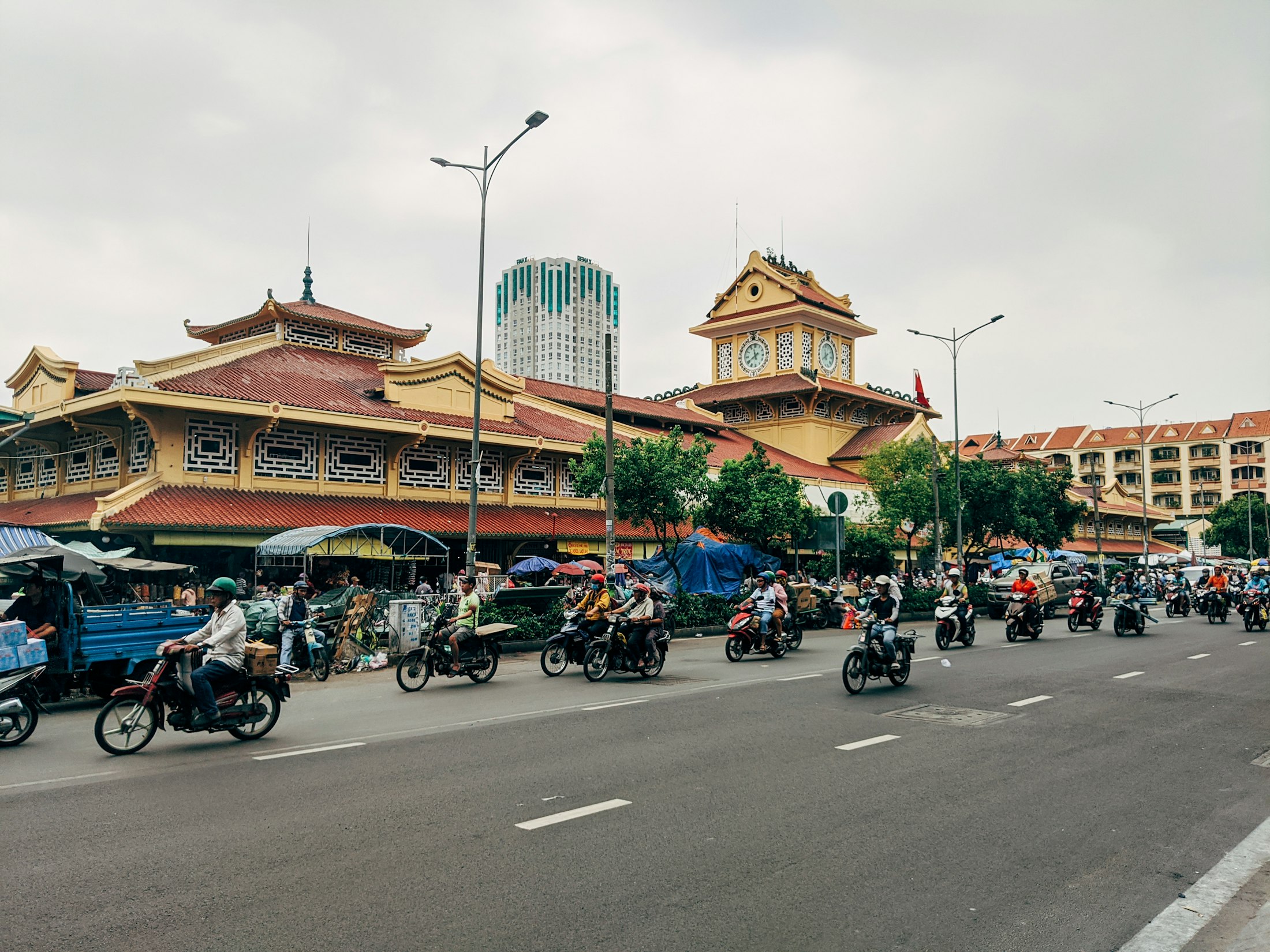
In This Guide
- 1.The 4 a.m. bowl at Hủ Tiếu Sa Đéc Bà Liểu
- 2.Why District 4, and why July
- 3.Skip the Vĩnh Khánh 'seafood street' hype
- 4.Cháo lòng before the rain stops
- 5.Getting there and staying dry (mostly)
- 6.The shipyard wall and the canal at first light
- 7.Cà phê sữa đá at the second breakfast hour
- 8.When to leave, and what to carry out
The rain starts before the bowls do. At 4:30 a.m. in July, District 4 is sheeted in monsoon water that runs ankle-deep through the alley off Tôn Đản, and the hútiếu vendors are already scraping pork bones into stockpots the size of oil drums. This is not the part of Saigon that makes it onto the pastel-filtered roundups. District 4 sits across the Kênh Tẻ canal from District 1, a ten-minute motorbike ride that most tourists never take, and it's better for it.
I came here last July because someone on a Saigon food forum said the hútiếu in District 4 was better at dawn during monsoon season — something about the humidity and the broth and the way vendors cook harder when it's cool enough to stand over the pot. That sounded like nonsense. It was also, annoyingly, correct.
1. The 4 a.m. bowl at Hủ Tiếu Sa Đéc Bà Liểu
Start at Hủ Tiếu Sa Đéc Bà Liểu on Vĩnh Khánh street. The shop has no number that anyone agrees on — look for the stainless-steel cart under a corrugated awning roughly opposite the Vĩnh Khánh – Tôn Đản intersection. They open around 4:30 a.m. and run until the pot's empty, which in July is usually by 9.
The hútiếu here is the Sa Đéc style: thin, glassy rice noodles in a pork-and-dried-shrimp broth that's sweeter than the Mỹ Tho version and clearer than Phnom Penh-style. A bowl with pork, liver, and quail eggs runs about 45,000 VND. You can get it dry (khô) with the broth on the side, which I prefer because the noodles hold their chew longer.
The plastic stools face the street. In monsoon season, the rain blows sideways under the awning and mists your arms. Nobody moves.
Pro tip:Ask for extra hẹ (garlic chives) — they don't charge for it and it cuts through the sweetness of the broth.
2. Why District 4, and why July
District 4 still runs on dockworker hours — the old Bason shipyard complex is just across the canal to the north, and the neighborhood's food culture is calibrated for people who need calories before a shift, not people who need a latte.
July is deep monsoon. The rains come in hard bursts, usually between 2 and 6 a.m. and again in the late afternoon. The practical effect: the streets empty, the vendors who do open have fewer customers, and you get their attention. The less practical effect: everything tastes better when you're slightly damp and slightly cold in a tropical city that rarely lets you be either.
3. Skip the Vĩnh Khánh 'seafood street' hype
Every Saigon listicle will tell you Vĩnh Khánh is the street for nighttime seafood and bia hơi. It was, maybe, five years ago. Now the eastern stretch near the Calmette Bridge end is dominated by places with laminated menus in four languages and prices that have drifted upward without the quality following. I watched a tourist pay 380,000 VND for a plate of ốc that would've been 120,000 two blocks south.
Skip the seafood strip after dark. If you want ốc in District 4, go to one of the unnamed carts on Nguyễn Khoái closer to the Tôn Thất Thuyết end, where the snails are smaller and the crowd is entirely local. Or just eat ốc in District 8. District 4 does hútiếu and cháo lòng. That's what it does.
Pro tip: If you do end up on the seafood strip, at minimum check prices before ordering. Point at the tank, confirm the price per kilo, and do the math yourself.
4. Cháo lòng before the rain stops
Organ porridge at 5 a.m. is a harder sell than noodle soup, I know. But cháo lòng — rice porridge with pork intestine, liver, heart, and blood pudding — is District 4's other anchor dish, and it's worth the squeamishness.
There's a cart on Xóm Chiếu street, near the intersection with Đoàn Như Hài, that starts ladling around 4 a.m. The porridge is loose and peppery. The organs are sliced thin and still have bite. A bowl is 35,000 VND. Add a quẩy (fried dough stick) for 5,000 to dip into the broth. The whole transaction takes about forty-five seconds.
The consensus take is that cháo lòng is "street food for the adventurous." I disagree. It's rice porridge with offal. Half the world eats this for breakfast. The only adventure is the alarm clock.
5. Getting there and staying dry (mostly)
From District 1, the cheapest route is bus 79, which runs from Ben Thanh Market down Nguyễn Thái Học, across the Calmette Bridge, and into District 4 along Hoàng Diệu. Fare is 6,000 VND. The first bus comes through around 5:15 a.m., which is too late for the earliest bowls. For the 4 a.m. window, you'll need a Grab bike — expect 15,000–25,000 VND from the backpacker district.
In monsoon July, bring a lightweight rain poncho, not an umbrella. You'll be eating under awnings and walking through alleys where an umbrella is more weapon than shelter. Sandals, not shoes. The water will find you.
If you're staying in District 4 itself — and there's no real reason not to — you'll find basic hotels along Khánh Hội and Bến Vân Đồn for 400,000–600,000 VND a night. Nothing fancy. Clean enough, close enough.
Pro tip:Set your Grab pickup location on Tôn Đản rather than inside an alley. Drivers won't enter the smaller sois at 4 a.m. in the rain, and you'll burn ten minutes watching them circle.
Stay in Ho Chi Minh City
Top-rated hotels near Ho Chi Minh City
Best locations · Verified reviews · Free cancellation
View deals
Expedia →6. The shipyard wall and the canal at first light
Walk north along Bến Vân Đồn toward the Kênh Tẻ canal after you eat. Around 5:30 a.m., the light is grey-blue and the water in the canal is flat. The old shipyard wall — what's left of it — runs along the north bank on the District 1 side. Most of it is behind construction hoarding now, as the Bason redevelopment turns it into another mixed-use tower district. In a year or two, this view will be glass and concrete.
For now, the canal still has the working boats. Small cargo barges loaded with sand and gravel chug through before dawn. Old women paddle sampans selling fruit to the houseboats that are, themselves, disappearing.
A dissolving city.
7. Cà phê sữa đá at the second breakfast hour
By 7 a.m. the rain usually pauses and the District 4 morning shifts to its second act. The coffee carts come out. There's no single legendary café here — District 4 doesn't do that — but the phin-drip carts on Xóm Chiếu near the market entrance make a strong cup for 15,000 VND.
Do not order anything that says "specialty" or "single origin" in this neighborhood. You'll get Robusta through a phin filter with condensed milk, and it will be thick enough to register on a viscometer. That's the point.
If you need a second breakfast — and you will, because the hútiếu was three hours ago — the bánh mì carts near Xóm Chiếu Market open around 6:30. Look for the one with the charcoal grill and the pâté going on warm. A bánh mì thịt nướng is 20,000–25,000 VND.
Pro tip:The market itself sells pre-mixed gói hútiếu (dried noodle packets with seasoning) for about 8,000 VND. They're surprisingly decent and weigh nothing in a backpack.
8. When to leave, and what to carry out
By 9 a.m., District 4 becomes a regular Saigon neighborhood — motorbikes, heat, construction noise. The window lives between 4 and 8 a.m. After that, cross back to District 1 or head south to District 7 for air conditioning and regret.
What you carry out: the taste of that broth, a damp poncho balled up in your bag, and maybe one of those gói hútiếu packets from the market. Also the understanding that the best food neighborhoods aren't the ones with the most options — they're the ones that do two or three things with the focus of people who've been making the same pot since before you were born.
District 4 doesn't need your attention. It's fine either way.
Stay in Ho Chi Minh City
Top-rated hotels near Ho Chi Minh City
Best locations · Verified reviews · Free cancellation
View deals
Expedia →Essential tips
July monsoon rains hit hardest between 2–6 a.m. Bring a thin poncho, not an umbrella. Wear sandals you can walk through puddles in.
Carry small bills — 10,000 and 20,000 VND notes. Most vendors at 4 a.m. can't break 500,000, and mobile payment isn't universal at street carts.
Set Grab pickups on main roads (Tôn Đản, Bến Vân Đồn), not inside alleys. Pre-dawn drivers avoid narrow lanes in heavy rain.
Order hútiếu khô (dry) if you want to taste the noodles themselves. The wet version is good but the broth dominates.
Arrive by 4:30 a.m. for the full experience. By 7 a.m. the best carts are winding down. By 9, the neighborhood has moved on.
Ready to visit Ho Chi Minh City?
Book your hotel, flights, and activities through our Expedia-powered search.


