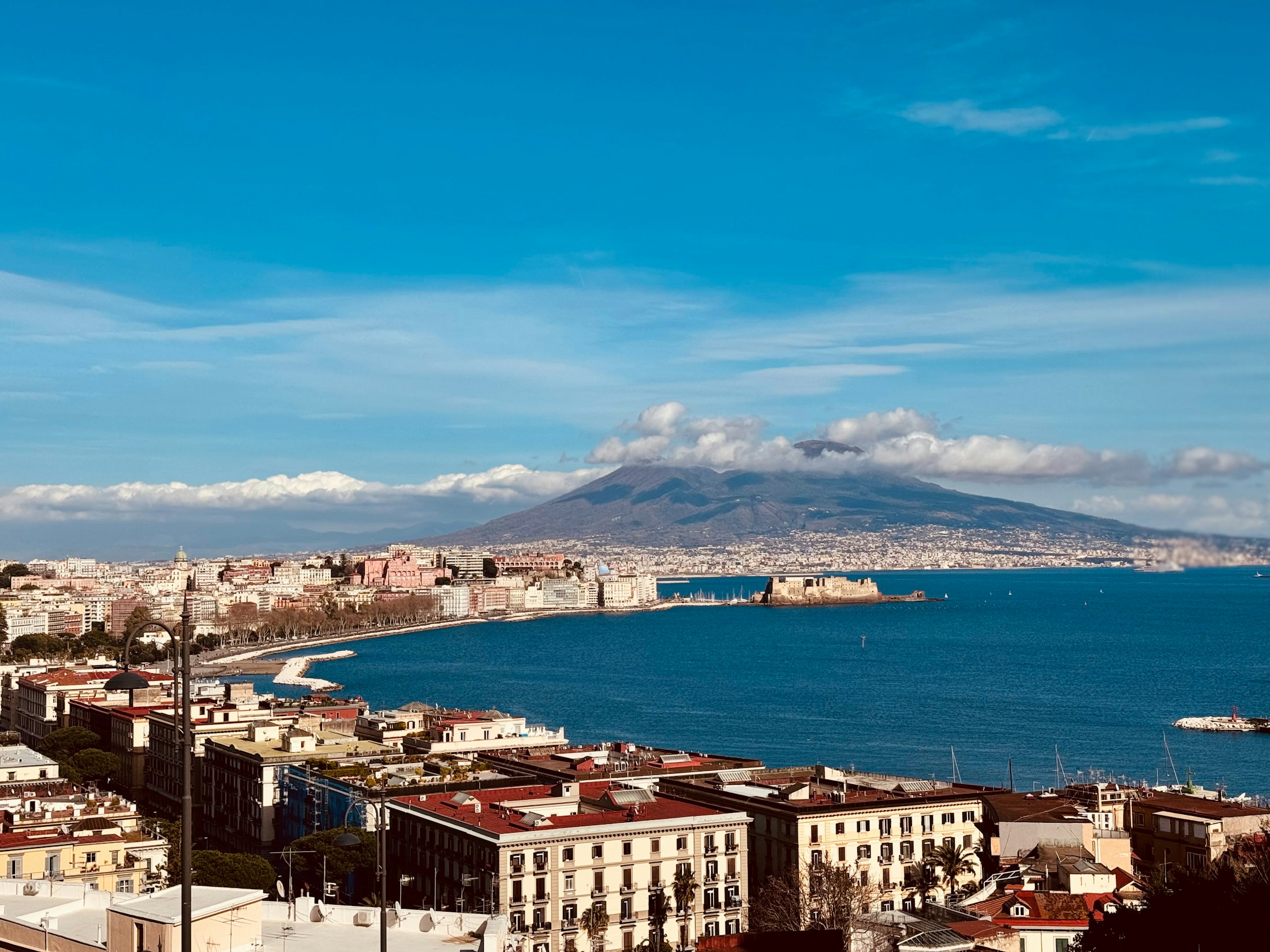
In This Guide
- 1.The ragù question, and why it matters more than you think
- 2.Below the Sanità: the Catacombs of San Gennaro
- 3.Concettina ai Tre Santi is not overrated
- 4.Palazzo Sanfelice and the staircase that earns its reputation
- 5.The blood miracle, explained for skeptics
- 6.What to eat that isn't pizza
- 7.Staying in the Sanità versus staying in the centro storico
- 8.The Capodimonte question
- 9.September evenings on Via Sanità
The ragù had been on the stove since six in the morning, and it was only nine when I walked into the Sanità and the whole neighborhood smelled like pork and tomato and someone's grandmother's life's work. September in Naples is strange — the city hasn't quite exhaled from August, the heat still pooling in the narrow streets of the Spanish Quarters, but the Sanità operates on its own calendar. The Festa di San Gennaro looms at the end of the month, when the saint's dried blood will either liquefy or it won't, and the city will either celebrate or hold its breath. But before the miracle, before the processions and the televised drama at the Duomo, the Sanità just lives. It cooks. It buries its dead in spectacular fashion. It keeps going in a way that most neighborhoods I write about do not.
1. The ragù question, and why it matters more than you think
Every family in the Sanità has a ragù opinion, and every family is right, and every other family is wrong. This is not a metaphor. I've watched two women on Via Sanità argue about whether you add the basil at the beginning or the end with the kind of fury most people reserve for politics.
The Sunday ragù — ragù napoletano, not bolognese, never bolognese, do not make this mistake — is a slow braise of pork ribs, sometimes beef involtini, sometimes sausage, sometimes all of it, in tomato sauce that cooks for a minimum of four hours. Some families go six. The meat falls apart. The sauce turns a deep, almost burnt sienna. You eat the sauce with pasta first (ziti spezzati, broken by hand, is traditional), and the meat comes after, as a second course. Two meals from one pot.
I once asked a woman at Trattoria Donna Romita on Via Vergini if she'd share her ragù method. She looked at me like I'd asked for her bank PIN.
Pro tip:If you're in the Sanità on a Sunday and smell ragù wafting from a ground-floor basso, you're not getting invited in. But Trattoria Donna Romita and Concettina ai Tre Santi (Via Arena alla Sanità 7bis) both serve versions on Sunday that are close to the real thing. Get there by 12:30 or wait.
2. Below the Sanità: the Catacombs of San Gennaro
The catacombs sit under the Basilica del Buon Consiglio, carved into the tufa rock of the Capodimonte hill — two levels of burial chambers, frescoes from the second century, and a silence that makes you forget you're underneath one of the loudest neighborhoods in southern Italy. The upper catacomb holds the original tomb of San Gennaro himself, before his relics were moved to the Duomo. You can still see the fresco of him with Vesuvius in the background, one of the earliest known depictions.
What sets these catacombs apart from the more famous ones in Rome is who runs them. The Cooperativa La Paranza, a group of young people from the Sanità, took over management in 2006 when the site was essentially abandoned. They cleaned the place out, trained their own guides, and turned it into the most visited catacomb in southern Italy. Tickets are €12 for adults, and tours run roughly every hour. The guides speak fast, know their material cold, and actually grew up in the neighborhood above.
Skip the Fontanelle Cemetery if you're short on time. I know it's all over social media — the skulls, the atmospheric lighting, the moody photos. But it's a single room, poorly explained, and the walk to get there through Materdei isn't worth the detour when the San Gennaro catacombs are right here with actual context and actual history.
Pro tip: Book the combined ticket for the Catacombs of San Gennaro and the Catacombs of San Gaudioso (€15). San Gaudioso is smaller but stranger — they used to drain corpses into stone seats and then paint their bodies on the walls, keeping only the real skulls. The guide will explain the technique with disconcerting enthusiasm.
3. Concettina ai Tre Santi is not overrated
I know. It's in every guide. It has a line. People will tell you it's become too touristy. Those people are wrong.
Ciro Oliva, who runs the place, grew up in the Sanità, trained seriously, and came back to open a pizzeria that charges €5-8 for most pizzas and also runs a fine-dining tasting menu upstairs for around €60. The margherita is almost offensively good — the dough ferments for over 24 hours, and the crust has that particular Neapolitan leopard-spotting that happens only in wood-fired ovens running above 450°C. But order the pizza con la scarola, with escarole, olives, capers, and pine nuts, because it's the one that tells you this kitchen understands the neighborhood it feeds.
The line moves faster than you think. Go at 19:00 on a weeknight.
4. Palazzo Sanfelice and the staircase that earns its reputation
Ferdinando Sanfelice built his own palazzo on Via Sanità 2 in 1728, and he designed the double-flight external staircase as a kind of architectural flex — an open-air octagonal structure that lets you see every landing from the courtyard below. Theatrical in a way that most Baroque architecture only attempts.
You can walk into the courtyard freely. No ticket, no hours, no guards. The building is still residential, so keep your voice down and don't treat someone's laundry line as a photo prop. I've seen people do this. Don't.
Two doors down, Palazzo dello Spagnuolo (Via Vergini 19) has a similar staircase, slightly grander, slightly more restored. See both.
Pro tip: Morning light in the Palazzo Sanfelice courtyard is better than afternoon — the sun comes over the hill behind and fills the stairwell around 9:30-10:00 in September.
5. The blood miracle, explained for skeptics
Three times a year — the Saturday before the first Sunday of May, September 19, and December 16 — the Archbishop of Naples holds up a sealed vial of San Gennaro's dried blood in the Duomo and waits for it to liquefy. If it does, Naples is safe. If it doesn't, bad things happen. The blood failed to liquefy in 1980, the year of the Irpinia earthquake. It failed again in 1973, during a cholera outbreak. Coincidence is a word you learn not to use in this city.
September 19 is the big one. The Duomo fills before dawn. People cry. The cardinal announces the miracle and the cathedral erupts. Outside, fireworks. I have no theological position on this. I only know that the Sanità — San Gennaro's own neighborhood, where he was originally buried — treats it as fact, and the energy in the streets on the 18th, the night before, is unlike anything I've felt in any other European city.
You will not get into the Duomo for the ceremony without arriving by 6:00 a.m. at the latest. The Museo del Tesoro di San Gennaro (Via Duomo 149, €10) is worth visiting in the days before, when it's quieter, to see the saint's reliquary bust and the jeweled mitre that rivals anything in the Vatican collection.
6. What to eat that isn't pizza
Fiocco di Neve, on Via Arena alla Sanità, does sfogliatella so aggressively filled with ricotta and candied citrus that it borders on structural failure. I ate one standing on the sidewalk at 8 a.m. and had orange oil on my shirt for the rest of the day.
For a proper sit-down lunch that isn't a pizzeria, Osteria Mediterranea (Via Arena alla Sanità 17) serves pasta e patate — a dish that sounds like poverty food and tastes like the reason poverty food became a tradition. Pasta cooked directly in a thick potato broth with provola cheese and sometimes a crust of baked cheese on top. Around €8.
Then there's the friggitoria culture. Walk down Via Vergini and you'll find at least two or three storefronts selling fried pizza (pizza fritta), crocchè, and arancini through a window. No seating. No menus longer than six items. Cash only.
Pro tip:Do not order a cappuccino after 11:00 a.m. in Naples. I know you know this rule. I'm restating it because I watched someone do it at Concettina last September and the waiter brought it with a look that could curdle the milk.
7. Staying in the Sanità versus staying in the centro storico
Most visitors to Naples default to the centro storico — Spaccanapoli, Via dei Tribunali, the area around Piazza del Gesù — and I understand why. The density of churches and restaurants per square meter is absurd. But staying in the Sanità puts you in a neighborhood that doesn't perform for tourists, and in September, when the pre-miracle energy starts building, that matters.
The Sanità sits in a valley below the centro storico and Capodimonte. The Ponte della Sanità, built by Murat in 1809, literally passes over the neighborhood, which is part of why it was isolated for so long. Getting in and out involves stairs or the Catacombe di San Gennaro entrance from the park above, or just walking down from Via Foria. Not hard, but it requires intention.
Several B&Bs and small hotels have opened in the neighborhood in recent years, mostly in converted palazzi. Prices in September hover around €70-120 per night for a double, which is roughly half what you'd pay on Via dei Tribunali.
Pro tip:If you stay in the Sanità, the Ponte della Sanità has an elevator (Ascensore Sanità) connecting the neighborhood to Corso Amedeo di Savoia above. It's free, it runs until late evening, and it saves you a steep climb multiple times a day.
Stay in Naples
Top-rated hotels near Naples
Best locations · Verified reviews · Free cancellation
View deals
Expedia →8. The Capodimonte question
The Museo di Capodimonte sits on the hill directly above the Sanità and holds one of the most important painting collections in Italy — Caravaggio's Flagellation, Titian's Danae, a Masaccio crucifixion that stops you cold.
The conventional wisdom is to pair Capodimonte with the Sanità as a single day. I'd push back on that. The museum alone takes three hours if you're being honest with yourself, and then you're tired and hungry and the Sanità deserves your full attention. Split them. Do Capodimonte in the morning on one day (it opens at 8:30, €14 for the permanent collection), walk through the park, and save the Sanità for the afternoon or the next day entirely.
The park is free. Sit under a tree. Eat a tarallo from the vendor near the southern entrance. Do nothing for twenty minutes.
9. September evenings on Via Sanità
By nine o'clock the heat has broken and the kids are out and the motorini are louder than the conversations, which is saying something. September in the Sanità feels like a neighborhood holding two things at once — the ordinary rhythm of daily life and the gathering anticipation of the 19th, when everything tilts toward the Duomo.
The evening passeggiata here is not the polished affair of Via Chiaia. It's families sitting on plastic chairs outside their bassi, old men playing cards, teenagers on phones, somebody's dog. I walked it last September on the 17th, two nights before the miracle, and a woman was setting up a small shrine to San Gennaro in her doorway — candles, flowers, a printed prayer card, a photograph of a young man who might have been her son. She didn't look up. It wasn't for me.
Pro tip:Bar pasticceria Poppella (Via Arena alla Sanità 28-29) stays open late and serves fiocco di neve pastries — dome-shaped brioches filled with cream — that are the neighborhood's unofficial dessert. Around €2 each. Get two.
Stay in Naples
Top-rated hotels near Naples
Best locations · Verified reviews · Free cancellation
View deals
Expedia →Essential tips
The Sanità has no metro stop. Take Line 1 to Museo or Cavour and walk down Via Foria, or take the 178 bus from Piazza Cavour. Budget 15 minutes on foot from the nearest metro.
Many small food shops, friggitorie, and bars in the Sanità are still cash-only. The nearest reliable ATM cluster is on Via Foria. Withdraw before you descend into the neighborhood.
The Catacombs of San Gennaro close for part of September 19 for the San Gennaro feast. Check with La Paranza (catacombedinapoli.it) for adjusted schedules in the days around the miracle.
The streets between Via Vergini and Via Sanità are basalt and uneven. Cobblestone-friendly shoes are not optional, especially at night when the lighting thins out past Palazzo dello Spagnuolo.
Ready to visit Naples?
Book your hotel, flights, and activities through our Expedia-powered search.