In This Guide
- 1.Getting there from Mérida (and why you shouldn't drive)
- 2.The yellow that actually means something
- 3.Convento de San Antonio de Padua, early and alone
- 4.Kinich Kakmó: the pyramid nobody climbs
- 5.September corn rituals in the milpa villages
- 6.Where to eat when half the town is closed
- 7.The rain schedule you need to respect
- 8.Staying overnight versus day-tripping
- 9.What Izamal is not
The bus from Mérida drops you in Izamal around 9 a.m. if you catch the 7:15 departure from the Noreste terminal on Calle 67. That's what I did last September, and when I stepped off, the town was so quiet I could hear a dog's nails clicking on cobblestones three blocks away. Every building painted the same colonial yellow, no tour groups, no craft-market hustle — just heat and silence and the faint smell of wood smoke from someone's breakfast tortillas.
September is low season in the Yucatán, which means afternoon downpours, thick humidity, and almost no other tourists. It also means you walk into one of Mexico's most visually striking towns and have it essentially to yourself. The corn rituals that happen this month in the surrounding villages are not staged for visitors. They're agricultural ceremonies tied to the milpa cycle, and stumbling into one felt less like tourism and more like trespassing — in the best way.
1. Getting there from Mérida (and why you shouldn't drive)
Second-class buses run from Mérida's Noreste terminal to Izamal roughly every hour starting at 5:30 a.m. The ride is about 70 minutes. Fare was 42 pesos last I checked — less than three dollars. The bus drops you on Calle 31, two blocks from the main plaza.
I know some guides tell you to rent a car. I'd push back on that. The highway is fine, but Izamal's one-way streets are narrow, parking is scarce near the convent, and September rain turns unpaved shoulders into mud traps. The bus lets you doze on the way back, which you'll want after a day in the heat.
If you insist on driving, it's about 72 kilometers east on Highway 180D toward Cancún, then south on the Izamal turnoff. Budget 90 minutes with traffic out of Mérida's periférico.
Pro tip:Sit on the left side of the bus heading east. You'll get shade for most of the ride, and you can spot the Kinich Kakmó pyramid above the treeline about ten minutes before arrival.
2. The yellow that actually means something
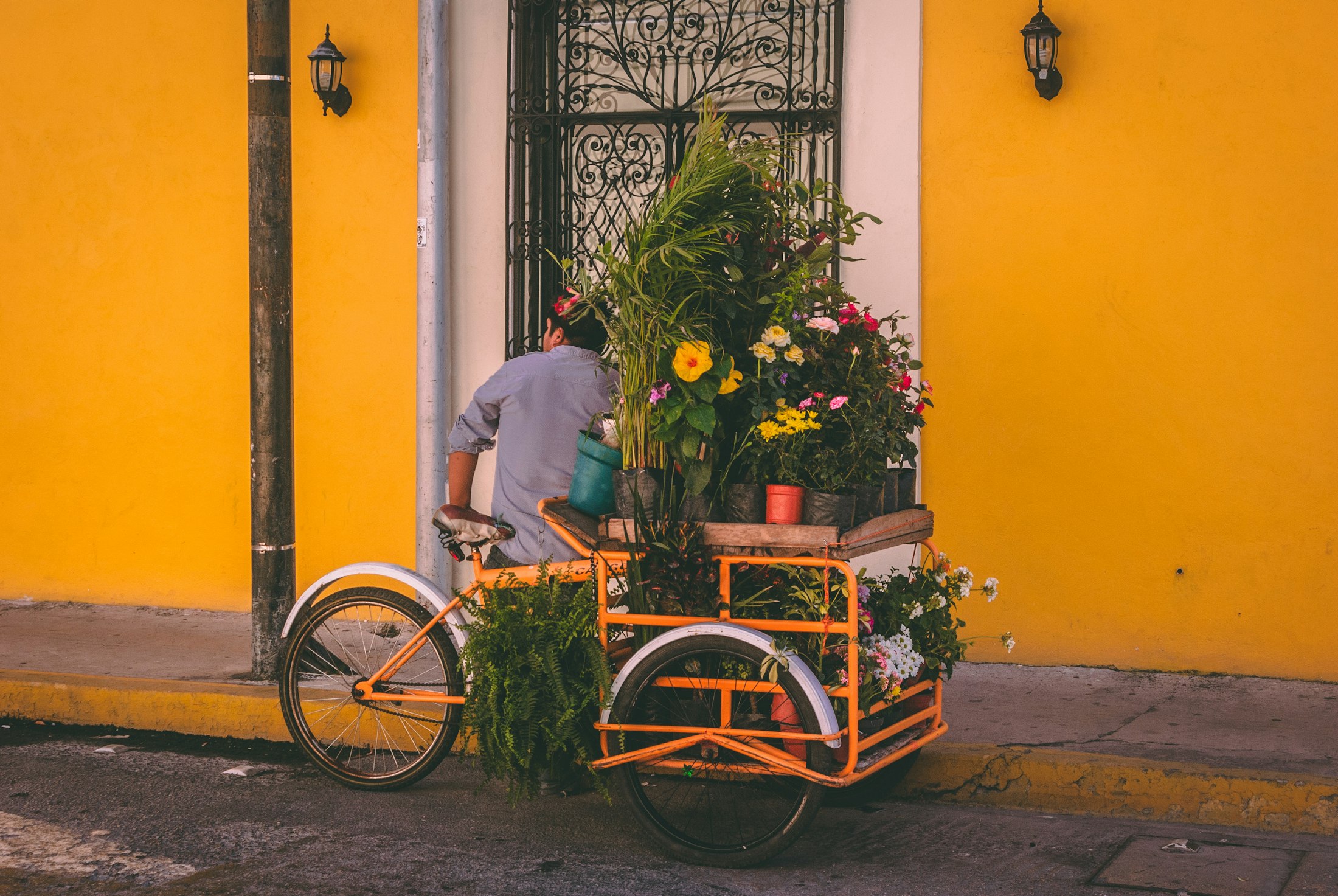
Every surface in central Izamal is painted the same shade of yellow — walls, curbs, window frames, the convent. Travel blogs call it "the Yellow City" like it's a branding exercise. It's not. The color dates to a 1993 papal visit, when the town repainted itself for John Paul II. Before that, buildings were various colors. The uniformity is recent, political, and a little weird when you think about it.
But I'll say this: in September's overcast light, especially around 4 p.m. when clouds roll in before the rain, the yellow turns almost amber. The whole town looks like it's glowing from inside. No filter needed, and I don't say that often.
3. Convento de San Antonio de Padua, early and alone
The Franciscan convent dominates the town. Its atrium is the largest enclosed churchyard in the Americas — bigger than St. Peter's Square, which sounds like a stretch until you're standing in the middle of it at 7 a.m. with nobody else there. Go early.
Skip the midday visit entirely. By 11 a.m. the few tour vans from Mérida and Chichén Itzá have arrived, guides are narrating loudly under the arches, and the sun makes the atrium feel like a reflector oven. Come at opening or after 5 p.m.
The convent was built on top of, and partially from the stones of, the Ppap Hol Chac pyramid. You can still see carved Maya stones repurposed into the convent walls if you look along the north side near ground level. The Spanish weren't subtle about it. The church interior has a small Virgin statue — the Virgen de Izamal — behind the altar. September is when devotees from surrounding pueblos begin preparations for the October fiesta, so you may see women arranging fresh flowers even on ordinary weekday mornings.
Pro tip:The convent's small museum on the south side of the atrium has colonial-era artifacts and closes at 5 p.m. No entrance fee, but there's a donation box. Leave something.
Stay in Mérida
Top-rated hotels near Mérida
Best locations · Verified reviews · Free cancellation
View deals
Expedia →4. Kinich Kakmó: the pyramid nobody climbs
Three blocks north of the convent, the Kinich Kakmó pyramid sits wide and squat above the rooftops. By volume, it's the third-largest pyramid in Mexico. By visitor count in September, it's practically abandoned.
I climbed it on a Tuesday and saw exactly two other people — a local couple eating elotes at the base. The stairs are steep and uneven, and there's no railing. At the top, you get a 360-degree view of Izamal's yellow roofline fading into scrub jungle in every direction. On a clear day you can see the cathedral spires of Mérida to the west. On a September day, you'll more likely see rain curtains drifting across the horizon.
Open daily, no entrance fee. The site technically opens at 8 a.m. and closes at 5 p.m., but I've seen the gate open earlier.
5. September corn rituals in the milpa villages
This is the part that doesn't show up in guidebooks, because it's not really for tourists. In September, Maya families in villages around Izamal — places like Citilcum, Sudzal, and Xanabá — perform ceremonial offerings tied to the corn cycle. The rituals go by different local names, but they're broadly part of the Ch'a Cháak tradition, asking for rain during the critical growing months.
What I saw in a village about 15 minutes south of Izamal: a h-men (ritual specialist) laid out a table with stacked tortillas, balché drink, copal incense, and a sacrificed chicken arranged over a pit of heated stones. Men from the community sat in a circle. Women prepared food behind a separate structure. Nobody invited me; a guy I'd been talking to at the Izamal market that morning told me his uncle's village was doing it that afternoon and said I could come watch from a distance.
You cannot Google your way to one of these. They're not scheduled on any tourism calendar. If you spend a day or two in Izamal, eat at the market, talk to people in Spanish or Maya, and express genuine interest without being pushy, you might hear about one. Or you might not.
Don't show up with a drone. Don't livestream. If someone hands you food, eat it.
Pro tip:Learn the phrase "Bix a beel" (How are you?) in Yucatec Maya. It won't get you an invitation, but it signals that you've done more than zero homework.
6. Where to eat when half the town is closed
September means some Izamal restaurants shut down or keep irregular hours. The reliable option is Kinich, on Calle 27 between 28 and 30, a sit-down place specializing in Yucatecan food. The poc chuc is good. The papadzules are better. Expect to pay around 180-250 pesos per person with a drink.
For cheaper food, the municipal market on Calle 31 has cochinita pibil tortas for 25-30 pesos and fresh jugos for 15. I made the mistake of skipping the market my first morning because I assumed it wouldn't be open yet. It was going strong by 6:30 a.m.
Don't bother with the handful of places near the convent that cater to tour groups. Overpriced aguas, sad panuchos, and the unmistakable vibe of a kitchen that only turns on when a bus pulls up.
Pro tip:If you see salbutes on any menu, order them. They're fried tortillas puffed with air, topped with shredded turkey and pickled onion. The ones at the market stalls are usually better than the restaurant versions.
Stay in Mérida
Top-rated hotels near Mérida
Best locations · Verified reviews · Free cancellation
View deals
Expedia →7. The rain schedule you need to respect
September in the Yucatán follows a pattern: clear mornings, cloud buildup by early afternoon, hard rain between 3 and 6 p.m., then cooler evenings. Plan your outdoor time accordingly. Climb the pyramid in the morning. Visit the convent after the rain passes.
Humidity runs around 80-90 percent. Drink more water than you think you need. I carry a one-liter Nalgene and refill it at purified-water stations — there's one near the market on Calle 31 for 3 pesos a liter.
Temperatures hover around 33°C (91°F) during the day. After the rain, it drops to maybe 26°C. That post-rain hour, when the yellow walls are wet and the light goes soft, is the best time to walk around with a camera.
8. Staying overnight versus day-tripping
Most people visit Izamal as a day trip from Mérida. That's fine if all you want is the convent and the pyramid. But the town changes completely after 6 p.m. when the last van leaves. Streets empty out. Families sit in doorways. The convent glows under floodlights against a dark sky.
There are a few small hotels. Macan Ché on Calle 22 #305 has rooms with gardens and a pool, and rates drop significantly in September — I've seen rooms around 800-1,000 pesos per night. Hotel Rinconada del Convento, right on the plaza, is pricier but puts you steps from everything.
Staying overnight also means you're there for the morning, which is when Izamal is at its quietest. The light at 6:30 a.m. on those yellow walls is worth the mosquito bites.
Pro tip:Bring mosquito repellent with DEET. September is peak mosquito season in the Yucatán. The natural stuff doesn't cut it here.
9. What Izamal is not
It's not Valladolid, which has leaned hard into the Instagram-tourist pipeline and now feels like a set. It's not Chichén Itzá, where you're herded through on a timer. It's not even Mérida, which I love but which has become self-consciously cool in a way that attracts a certain type of expat.
Izamal in September is a working town that happens to be beautiful. The corn rituals aren't attractions. The yellow paint is peeling in places. The dog that followed me for six blocks didn't belong to anyone.
Essential tips
Pack a compact rain jacket, not an umbrella. September downpours in the Yucatán come with wind, and you'll want both hands free on uneven cobblestones and pyramid stairs.
Izamal is mostly cash-only. The one ATM near the plaza (Banorte, on Calle 31) sometimes runs out on weekends. Withdraw pesos in Mérida before you leave.
Spanish is essential outside the convent area. Almost no one in the market or surrounding villages speaks English, and many older residents speak Yucatec Maya as a first language.
Sunscreen AND bug spray, applied in that order. The September combination of humidity and standing water after rain makes mosquitoes aggressive from dusk onward.
Ready to visit Mérida?
Book your hotel, flights, and activities through our Expedia-powered search.