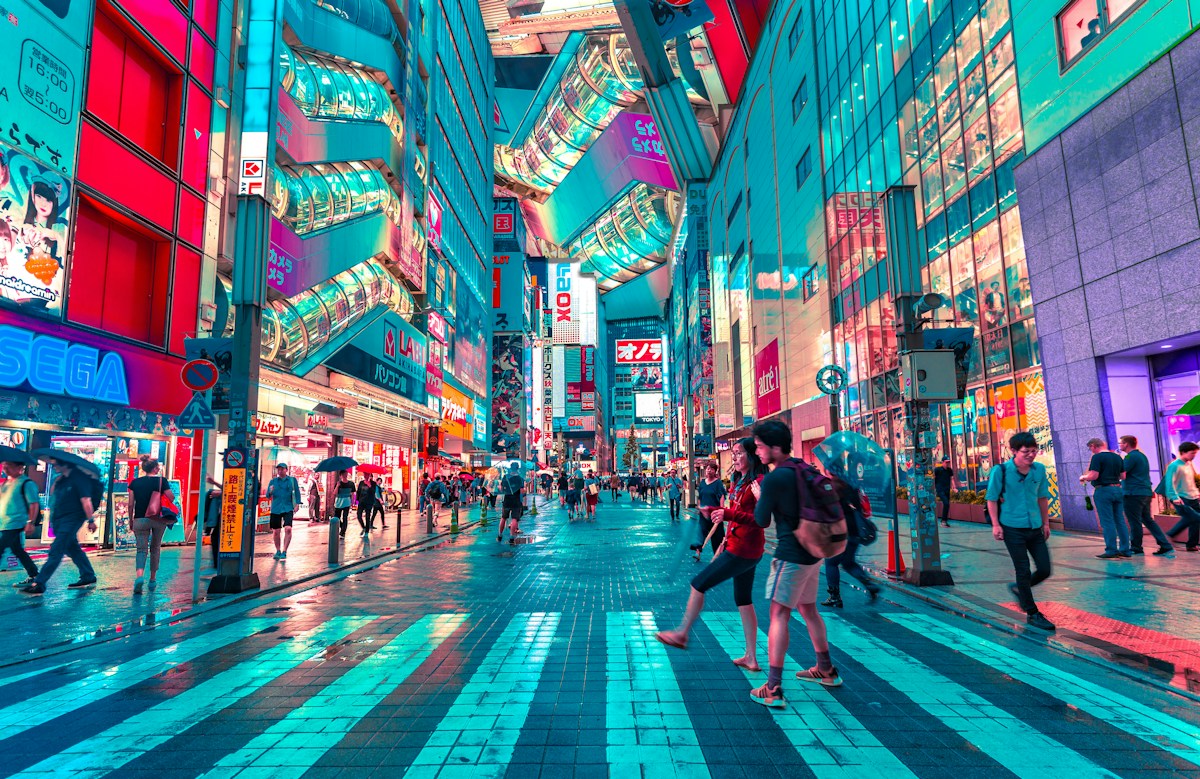
Tokyo rewards the unhurried traveler
Japan's capital isn't loud — it's layered, and the longer you stay, the deeper it pulls you in.
Advertisement
The city moves on its own logic
We have been to cities that demand your attention and cities that reward your patience. Tokyo is the latter, emphatically. It operates at a register that takes a few days to tune into — not slow, not fast, but precise. Everything runs on a kind of civic contract that visitors can feel but rarely articulate. Standing on the platform at Shinjuku Station as the 8:14 Chuo Line arrives within fifteen seconds of its scheduled time, you understand that punctuality here is not a virtue so much as a shared language. The doors open exactly where the painted footprints on the platform said they would.
Food is a form of devotion, not just sustenance
The ramen at Fuunji in Shinjuku — a ten-seat shop where the counter is close enough to watch the cook fold soft-boiled eggs into broth with the concentration of a jeweler — costs around 1,200 yen and represents something most expensive restaurants in other cities cannot buy: complete sincerity. The tsukemen here arrives with a dipping broth so intensely reduced that the first spoonful stops the conversation cold. Tokyo has more Michelin stars than any city on earth, but the more useful observation is that this same obsessive craft appears at every price point. The cook at Fuunji has likely made this dish ten thousand times. It shows.
Silence is available, if you know to look sideways
The assumption that Tokyo is all density and noise is a failure of attention. Walk twenty minutes east from Harajuku's main drag and you reach Yanaka Cemetery, where old camphor trees push through the gravel paths and the air smells of incense from the small temples at the perimeter. On a September afternoon the cicadas are still going — a high, continuous sound that somehow deepens the quiet around it rather than breaking it. Yanaka as a neighborhood has resisted the renovation pressures that remade so much of the city after the 1964 Olympics, and wandering its shotengai shopping street on a Thursday feels like finding a draft of Tokyo that didn't get revised.
Commerce and aesthetics are not in tension in Tokyo — they have arrived at a working truce.
The department store is a genuine cultural institution
We resist the reflex to be ironic about this. Isetan in Shinjuku — particularly its basement food halls, the depachika — is worth an hour of anyone's time regardless of whether they intend to buy anything. The displays are architectural: peaches from Yamagata wrapped individually in foam and stacked in lacquered boxes, each one sitting at the same angle. Wagashi confections arranged in cases with the same lighting philosophy as the jeweler two floors up. Spending money here is almost beside the point. What Isetan demonstrates is that commerce and aesthetics are not in tension in Tokyo — they have arrived, through some long cultural negotiation, at a working truce.
The city rebuilds itself without losing the thread
Tokyo has been destroyed and remade more than once — by earthquake in 1923, by firebombing in 1945, by the bulldozer ambitions of postwar development — and yet it carries a remarkably coherent identity through all of it. Stand on the observation deck of Tokyo Skytree at dusk and the city spreads in every direction to the horizon, a low continuous grid interrupted by the occasional tower. What strikes us is not the scale but the evenness. There are no ruins, no derelict zones, no obvious seams between centuries. The city heals quickly and quietly. Whether that is a loss or a strength depends on what you think cities are for. We think it is both, simultaneously, and that Tokyo is one of the few places honest enough not to pretend otherwise.
Why September specifically
We publish this in early September because this is, frankly, when Tokyo becomes habitable again after the brutal humidity of July and August. The light changes around the first week of the month — it acquires a lateral quality in the late afternoon, the kind that makes even the grey concrete of the elevated expressways look considered. The city's enormous park system, from Shinjuku Gyoen outward, begins to exhale. The summer crowds at the major temples thin without disappearing entirely. This is not the Tokyo of the cherry blossom photographs, but it may be the Tokyo closest to what the city actually is on an ordinary day — focused, generous, and completely itself.
Advertisement