Singapore keeps its receipts
The city-state doesn't erase its past so much as file it neatly beside the future, and the gap between them is where it gets interesting.
Advertisement
The hawker center is the real institution
At Tiong Bahru Market, a woman at stall 02-18 has been ladling the same lor mee for what regulars insist is three decades, and the queue at 8am already bends around the fishmonger's stall next door. The steam off the broth fogs your glasses the second you sit down, and nobody apologizes for the plastic stools or the fluorescent light. This is not nostalgia theater. It's a functioning subsidy system disguised as a food court, where a bowl costs four dollars because the government has kept rents fixed since the buildings went up in the 1950s. Singapore gets called sterile by people who never sat in one of these rooms at rush hour, sweating, elbow to elbow with a construction crew and a retired schoolteacher, all of them silent and serious about the food in front of them.
The rainforest was never actually removed
What outsiders read as an engineered skyline is, at ground level, an argument that the jungle only agreed to a truce. Walk into MacRitchie Reservoir on a weekday morning and within four minutes the traffic noise disappears entirely, replaced by long-tailed macaques crashing through the canopy and the specific, ratcheting call of a black-and-red broadbill. The TreeTop Walk suspension bridge, 25 meters up, sways slightly underfoot in a way that makes you grip the cable rope even though the engineering is not in question. Fifty-six percent of the island still carries green cover, more than when the British arrived, and the humidity that clings to your shirt by 9am is the same humidity that has been here the entire time, unmoved by any of the concrete.
Multilingualism is a texture, not a policy line
Stand at the corner of Serangoon Road near the Sri Veeramakaliamman Temple on a Friday evening and you'll hear four languages stack on top of each other without anyone adjusting volume for the others: Tamil devotional music from a speaker outside a garland stall, Mandarin from a delivery rider's phone call, Malay between two teenagers on scooters, English from a tour group's headset guides. The temple's gopuram, crowded with painted deities, gets restated in gold leaf every few years, and the smell of jasmine garlands competes with frying vadai from the stall across the five-foot way. Nobody translates for anybody. The city simply runs on the assumption that everyone present understands enough to get by, and mostly they do.
The difference between fake and constructed matters less than whether the thing works, whether the orchids actually bloom.
Land reclamation has its own smell
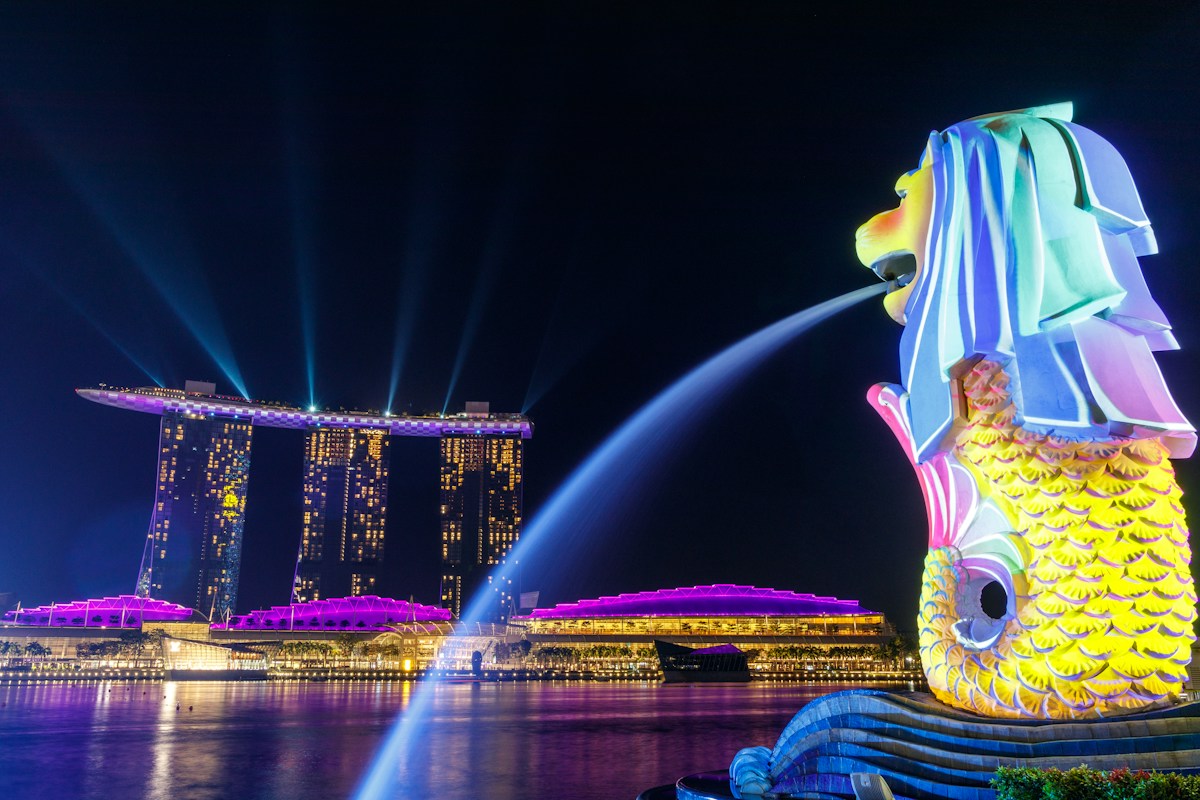
Gardens by the Bay sits on ground that didn't exist fifty years ago, and the air there still carries something faintly mineral, almost oceanic, that older reclaimed districts like Marina Bay have long since lost under decades of landscaping. Inside the Cloud Forest dome the temperature drops hard enough to raise goosebumps, misted air condensing on a 35-meter indoor waterfall built to cool an artificial mountain of epiphytes. It is entirely manufactured and entirely convincing, which is the trick Singapore pulls off more often than it gets credit for: the difference between fake and constructed turns out to matter less than whether the thing works, whether the air actually cools you, whether the orchids actually bloom.
The old shophouses argue back
On Koon Seng Road in Joo Chiat, a row of Peranakan shophouses in pistachio, salmon, and cobalt still has hand-painted tilework on the facades, ceramic details commissioned by Straits Chinese merchants who wanted their wealth visible from the street. Cats sleep on the five-foot-way in patches of afternoon sun, indifferent to the tour groups photographing the plaster relief above them. The buildings are protected now, conserved rather than demolished, which was not the assumption forty years ago when whole blocks like this were cleared elsewhere for housing blocks. What's left standing on Koon Seng Road functions like an argument still being made in real time: that a small, land-hungry country can choose to keep something simply because it's beautiful, and count that as a form of use.
Advertisement