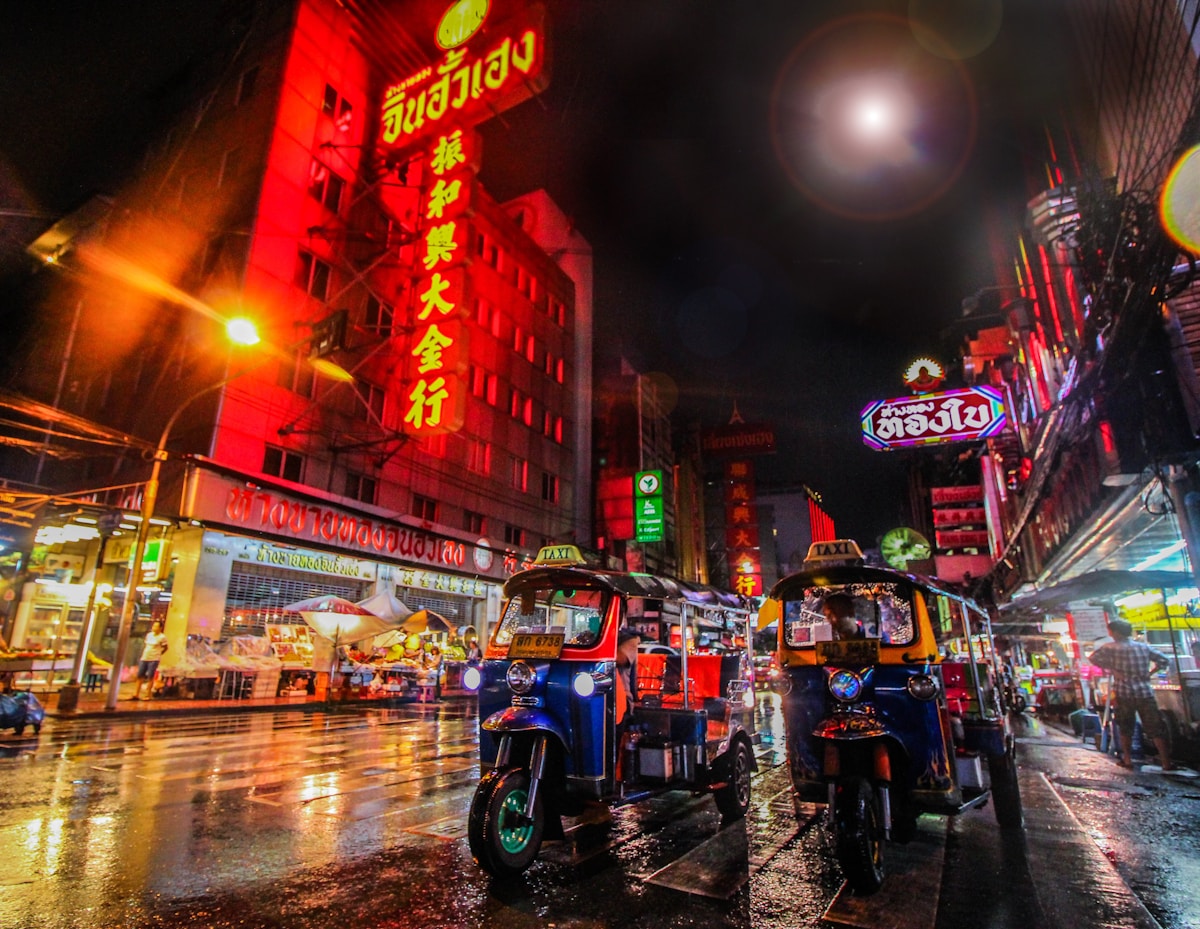
Bangkok never finishes a sentence, and that's the point
The city runs on interruption, and its best moments live in the gap between one thing and the next.
Advertisement
The river doesn't care about your itinerary
We planned a straight line from Tha Tien pier to Wat Arun and never made it in under an hour, because the Chao Phraya Express boats operate on a logic that resists Google Maps. You wait at the pier and watch the brown water churn against the pilings, thick with the diesel smell of the longtail engines, and a boat that looks full pulls up anyway, and the crew waves you on with a bamboo pole they use to fend off the dock. Nobody apologizes for the delay because nobody considers it a delay. The river is the schedule.
Chinatown eats standing up, and so should you
On Yaowarat Road after dark, the stalls near Soi Texas set up folding tables that wobble on the uneven pavement, and the smart move is to skip the table entirely. We stood at Nai Ek Roll Noodle while the cook tore duck from a hook with bare hands, the fat still hissing, and ate off a stool meant for someone shorter. The street smelled like charcoal and five-spice and motorbike exhaust in roughly equal measure, which sounds unpleasant until you're holding a bowl of the stuff and understand why regulars come back for forty years running.
Air-conditioning is a class system
Step from Siam Paragon's marble atrium, cold enough to fog your glasses, onto the skywalk above Rama I Road, and the heat hits like a held breath being released. Bangkok makes you feel this transition dozens of times a day, mall to street to BTS platform to soi, and each threshold recalibrates your sense of the city's temperature both literal and social. The street vendors working the skywalk shade sell chilled sliced mango from ice chests, and we noticed office workers in lanyards buying it on their way between two air-conditioned buildings, unwilling to fully leave the heat behind or fully escape it either.
The river doesn't care about your itinerary; the river is the schedule.
The temples work because they're still working
At Wat Pho, monks in saffron robes move through the reclining Buddha hall alongside tourists photographing the soles of its feet, inlaid with mother-of-pearl in geometric patterns that took years to complete. A bell-ringing corridor runs the length of the building, and visitors are invited to strike each one with a small brass rod, so the whole hall hums continuously, a low metallic weather system of sound that never fully stops. This isn't performance for visitors. The temple functions as a temple first, which is precisely why standing inside it feels different from standing inside a museum piece.
Traffic teaches patience nobody asked for
Sukhumvit Road at 6pm moves at the pace of continental drift, and the motorbike taxis parked at every soi entrance exist specifically to solve this, their drivers in orange vests napping in the saddle until a fare wakes them. We took one from Asok to Thong Lo, gripping the handle behind the seat while the driver split lanes between a truck and a food cart on wheels, close enough to touch both, and arrived in six minutes what would have taken forty by taxi. The wind, briefly, smelled like frying garlic from someone's open-air kitchen and then like nothing at all, just speed.
Nightfall doesn't quiet the city, it just changes key
Around 9pm, Lumphini Park closes its gates, but a few blocks south the rooftop bars along Sathorn Road are just filling in, ice clinking in glasses forty floors above the same streets that were gridlocked an hour earlier. From up there the city reads as a circuit board, gold temple spires lit up beside glass towers, tuk-tuk horns rising faint from below like a signal you have to strain to catch. Bangkok doesn't resolve into a single image from any vantage point, high or low, and that refusal to simplify itself is, we've come to think, the whole appeal.
Advertisement