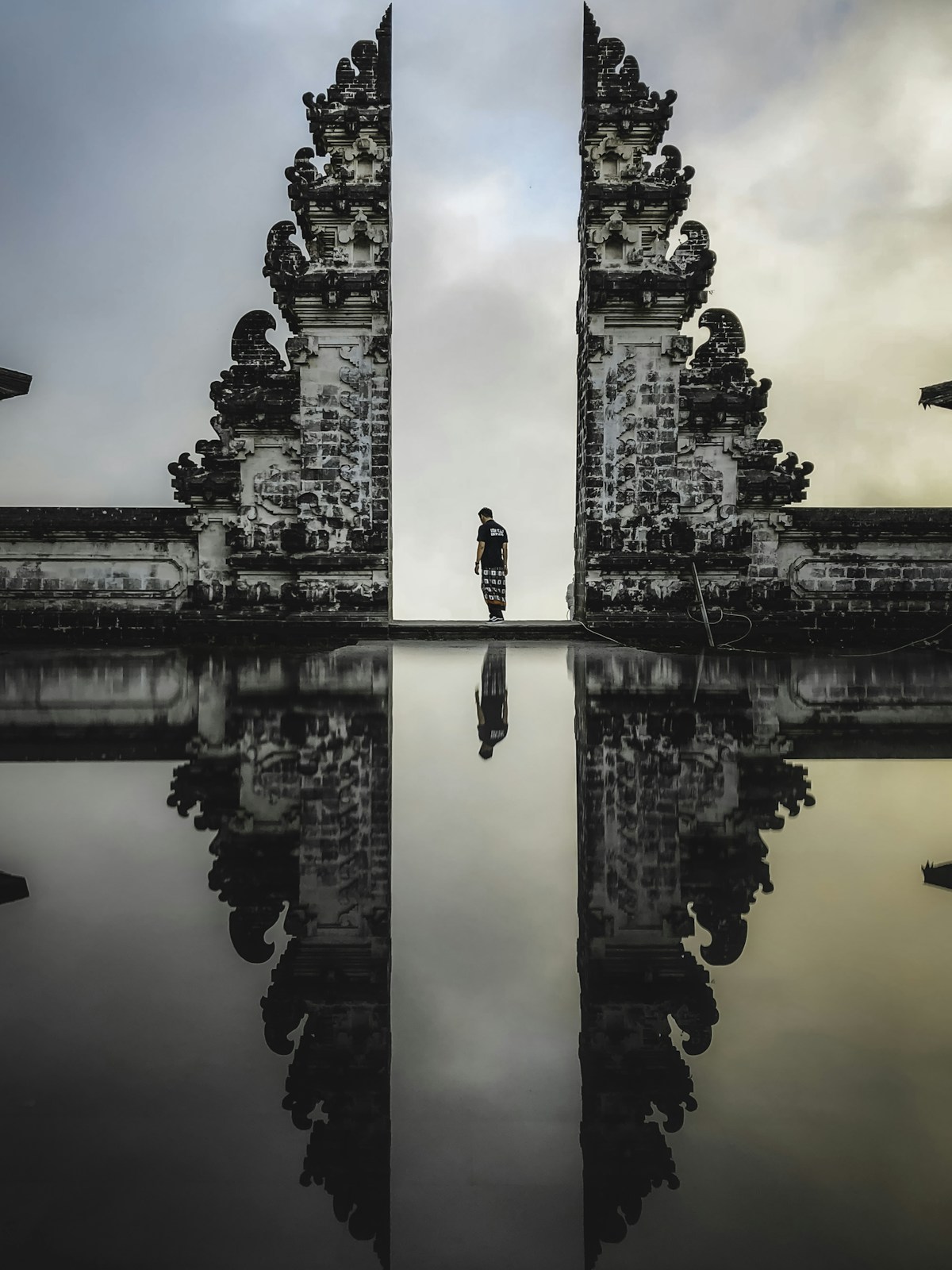
Bali has stopped apologizing for its own contradictions
Between Canggu's cold brew and Besakih's incense smoke, the island has quietly made peace with being two places at once.
Advertisement
The temple keeps its own schedule
At Pura Besakih, on the slopes of Gunung Agung, a priest in white cloth was ringing a small brass bell at 7 a.m. while three motorbikes idled behind him, their riders waiting for a ceremony to clear the road. Nobody honked. We stood there for twenty minutes and understood that the mountain's temple complex does not run on tourist time or even Balinese clock time — it runs on a ritual calendar of 210-day cycles that has nothing to do with whether your driver is double-parked. The smell was clove cigarettes and frangipani left in offering baskets, going slightly sweet in the heat.
Canggu is not pretending anymore
For years Canggu marketed itself as a surf village that happened to have wifi. That fiction is over. On Jalan Batu Bolong, the espresso machines at Crate Cafe hiss louder than the waves across the street, and the clientele on a Tuesday morning is remote workers in linen, laptops angled away from the sun glare off the Canggu Beach break. This is not a complaint. The rice paddies are still there, visible from the cafe's back deck, a single farmer bent over green stalks while a drone buzzes past filming content fifty meters away. Both things are true at once, and the island has stopped pretending otherwise.
Ubud's market still smells like a market
Walk into Pasar Ubud before 8 a.m., before the day-trip buses arrive, and it still functions as what it was before anyone photographed it: a produce market. Women arrange mounds of bird's-eye chilies and curry leaves under corrugated tin roofing, the air thick with galangal and clove and the diesel exhaust of delivery trucks idling on Jalan Raya. By 10 a.m. the upper floor fills with sarongs and wooden masks aimed squarely at visitors, but the ground floor keeps selling actual food to actual cooks, unbothered by the shift happening one staircase up.
There is no view here that will stop your scroll. That is the point.
Amed trades scenery for stillness
The east coast moves at a different pace entirely, and Amed is the clearest example. The beach itself is black volcanic sand, unglamorous compared to the white stretches of the Bukit Peninsula, and the water is calm enough that at dawn you can watch jukung fishing boats — thin, outrigger-balanced, painted in faded reds and blues — slide out past the reef without a single wave breaking their hull. We sat at a warung with a tin roof, ate nasi campur off a banana leaf, and watched a fisherman untangle net for forty-five minutes without once checking a phone. There is no view here that will stop your scroll. That is the point.
The rice terraces work, they are not a backdrop
At Jatiluwih, the terraces spread wide enough that you cannot frame them entirely in one photograph, which seems to annoy some visitors and delight others. The subak irrigation system here is centuries old, a cooperative water-sharing network between farmers that UNESCO recognized not for its prettiness but for its engineering. Walking the ridge path at midday, we passed a farmer ankle-deep in mud, adjusting a wooden sluice gate by hand, entirely indifferent to the group of photographers forty meters up the hill. The terraces are not staged for anyone. They happen to also be beautiful, the way a well-run kitchen happens to also be beautiful.
What the island actually offers
Bali's real trick is refusing to resolve its own tension between devotion and convenience, between subsistence farming and smoothie bowls. Spend a week moving between Besakih and Canggu and Amed and you stop expecting consistency. The reward is not a single defining image of Bali but a working knowledge of how many different rhythms one island can hold without breaking.
Advertisement