Military Giants Skip Winglets: Why C-5 Galaxy Relies On Wingspan Alone
The world's largest military cargo planes forgo the upward-curved wingtip devices found on most commercial jets, relying instead on extreme wingspan and raked tips for aerodynamic efficiency.
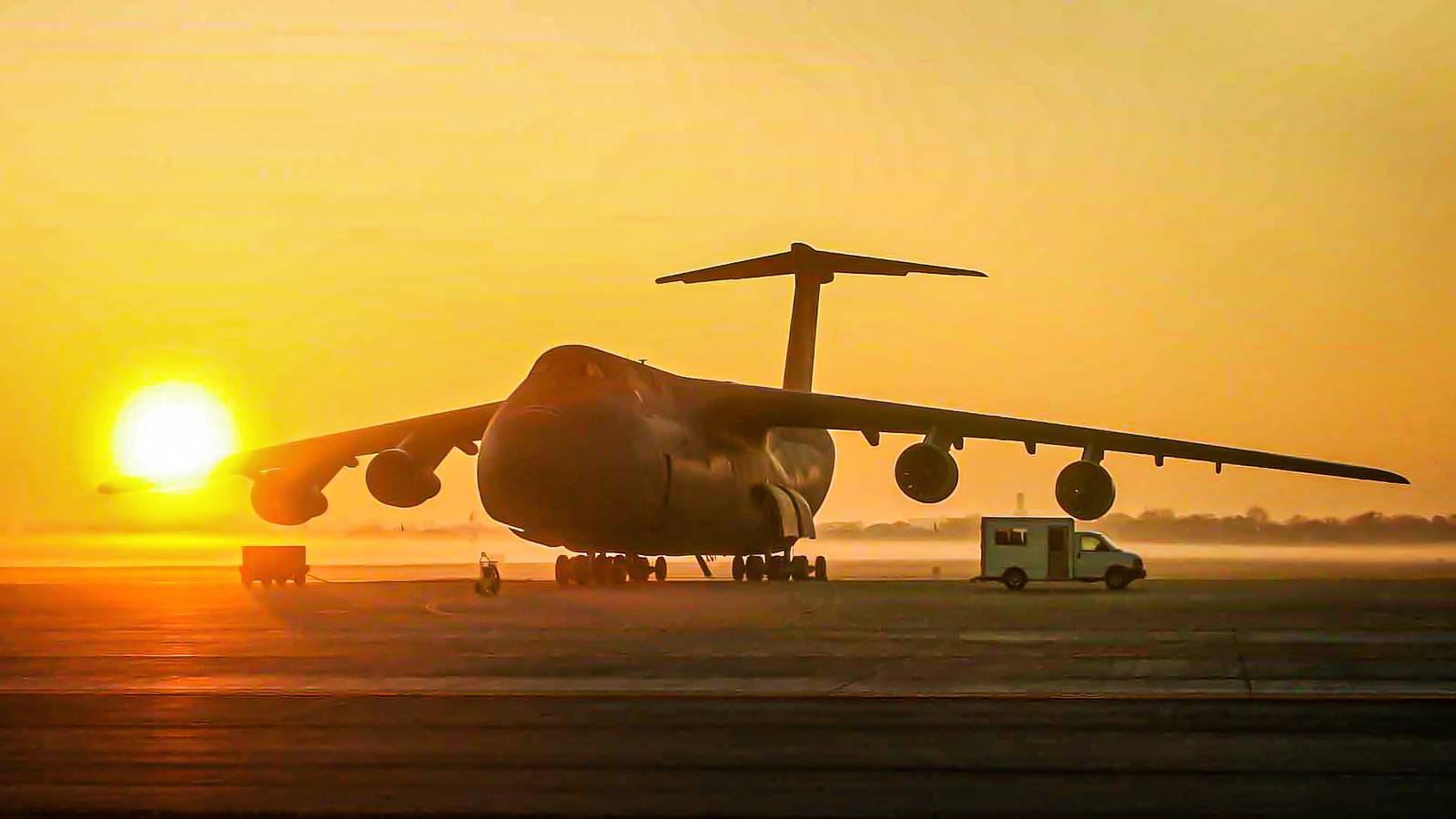
While winglets have become a standard feature on modern commercial aircraft in 2026, offering improved fuel efficiency and handling through reduced wingtip vortices, the world's heaviest military transport planes deliberately avoid them—a design choice rooted in both engineering economics and structural realities.
With the exception of the McDonnell Douglas C-17 Globemaster III, major military airlifters including the Lockheed C-5 Galaxy and Antonov An-124 Ruslan operate without any form of winglet. The absence reflects both the historical context of their development and intentional aerodynamic optimization, according to an analysis published this week.
The Lockheed C-5 Galaxy, which first flew in 1968, predates the era when winglets became proven technology for large aircraft. Even the modernized C-5M Super Galaxy variant, which received updated engines and avionics, retained its original winglet-free profile. The reasoning extends beyond simple heritage: when a wing design achieves sufficient efficiency through other means, vertical winglets can impose more penalties than benefits.
Military transports achieve aerodynamic performance through high aspect ratio wings—extremely long spans relative to chord width—paired with raked wingtips that integrate smoothly into the wing structure. This approach mirrors Boeing's 777X, which similarly eschews winglets despite being a next-generation design. Raked tips disrupt wingtip vortices like their vertical counterparts but prove more efficient during high-altitude cruise while requiring less structural reinforcement.
The structural trade-off proves particularly significant for cargo aircraft. Winglets create substantial bending moments at the wingtip, demanding heavy internal bracing that adds weight precisely where engineers least want it. For aircraft engineered to handle extreme aerodynamic loads and support massive turbofan engines, that reinforcement translates directly into reduced payload capacity.
The extreme wingspans of these military giants—designed to generate enormous lift for outsized cargo—render the incremental efficiency gains from winglets marginal compared to the weight penalty. In the calculus of military airlift, where every pound of structural mass represents a pound of cargo left behind, the wide-wing approach without winglets remains the optimal solution even as commercial aviation moves in a different direction.
Plan this trip
Here's what it costs.