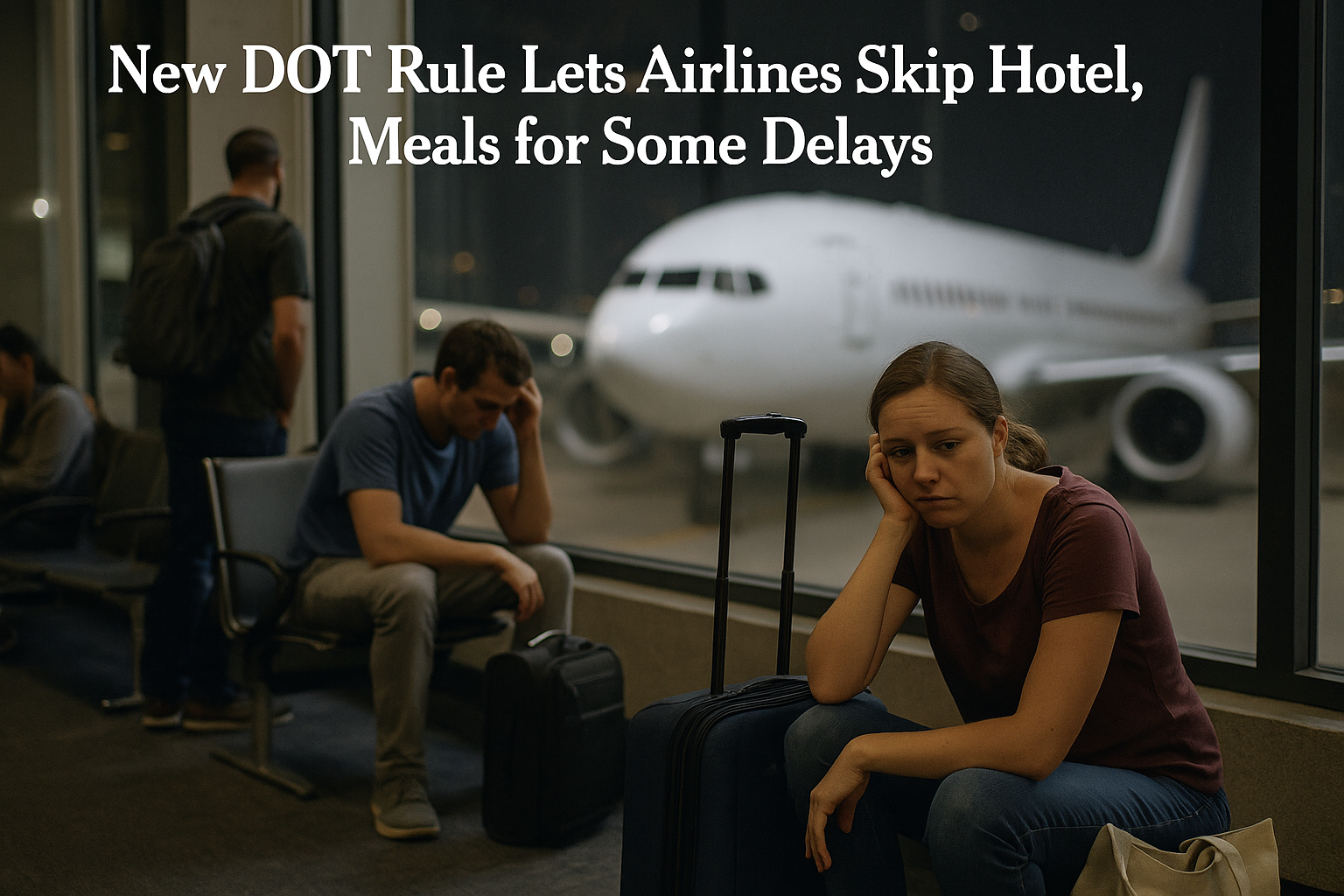
New DOT Rule Lets Airlines Skip Hotel, Meals for Some Delays
Starting October 19, a slate of mechanical problems will count as outside an airline's control, meaning carriers won't owe stranded passengers lodging or meal vouchers — even as DOT disputes that characterization.
What travelers need to know
- What happened: A new DOT regulation adds categories of delay that count as outside an airline's control, relieving carriers of the obligation to provide hotels and meals for passengers affected by certain mechanical issues.
- Who's affected: Passengers on flights delayed or canceled by unscheduled maintenance problems, including hydraulic or fuel leaks found during inspection, engine warnings or abnormal vibration, and cracked windshields or structural defects.
- Where: U.S. airlines and flights subject to Department of Transportation rules.
- When: The rule takes effect .
- What to do: Travelers should check their airline's own contract of carriage for delay compensation policies rather than assume DOT mandates lodging or meals in all mechanical-delay cases.
A regulation taking effect will let U.S. airlines decline to provide hotel rooms and meal vouchers for a range of mechanical delays, reclassifying those incidents as beyond the carrier's control. The change has drawn public criticism aimed at the Department of Transportation, which has pushed back hard on social media, calling the characterization an "obvious lie." But travel blogger Gary Leff of View from the Wing, who says he first reported the change, argues DOT's own defense is itself misleading even though the agency didn't originate the policy.
The dispute centers on language the DOT posted from its @USDOTRapid account, which stated that "when airlines are responsible for a delay or cancellation, they have to provide compensation," and pointed to the 2024 FAA reauthorization signed by President Biden as the source of new exemption categories like cyberattacks and volcanic ash. Both claims are accurate on their face, according to Leff's analysis, but he says they obscure the real impact: the law carved out ten total scenarios where airlines are no longer considered responsible for a delay, and the mechanical-maintenance exemptions — not cyberattacks or volcanic eruptions — are what's generating the backlash.
Advertisement
Where the exemption originated
The provision traces back to a broader amendment from Rep. Tom Kean Jr., a New Jersey Republican, whose original proposal listed 22 exclusions before Congress narrowed it to ten in the final bill. That legislation passed the Senate 88-4, a bipartisan margin from a chamber then controlled by Democrats, before Biden signed it into law as part of the 2024 FAA reauthorization. The Trump administration's DOT is enforcing a rule it didn't write, which is the part of its defense that checks out — the agency's framing of what the rule actually does is the sticking point.
Among the newly excused scenarios is what the law describes as unscheduled maintenance that falls outside a scheduled maintenance program and cannot be deferred or must be fixed before departure. According to Leff's breakdown, that standard could sweep in several common failure types.
| Mechanical issue | When it's typically found |
|---|---|
| Hydraulic or fuel leak | After arrival or during preflight inspection |
| Engine warning, abnormal vibration or metal contamination | Requiring inspection before next flight |
| Cracked windshield or structural defect | Outside allowable safety limits |
Why the framing matters to passengers
Leff's objection isn't that DOT invented the carve-outs — it's that citing rare events like cyberattacks and volcanic ash as the examples minimizes what's actually driving complaints: everyday mechanical problems that used to trigger airline-funded hotels and meals under the agency's prior guidance. Under the new framework, if a maintenance issue meets the "cannot be deferred" standard, the airline can treat it the same as weather or air traffic control delays — events nobody disputes are outside a carrier's control.
For now, there's no indication DOT plans to revisit the rule before it takes effect this month. Travelers with trips booked around that date should review individual airline policies on delay accommodations, since the federal floor for what's guaranteed is about to drop for a meaningful slice of mechanical breakdowns.
Advertisement
Plan this trip
Here's what it costs.