C-17 and A400M Deploy Different Solutions for Combat Airlift Missions
Western military transport aircraft take divergent engineering approaches to survive hostile battlefield environments, with the Boeing C-17 Globemaster III prioritizing heavy payload capacity while the Airbus A400M Atlas emphasizes tactical agility through turboprop power.
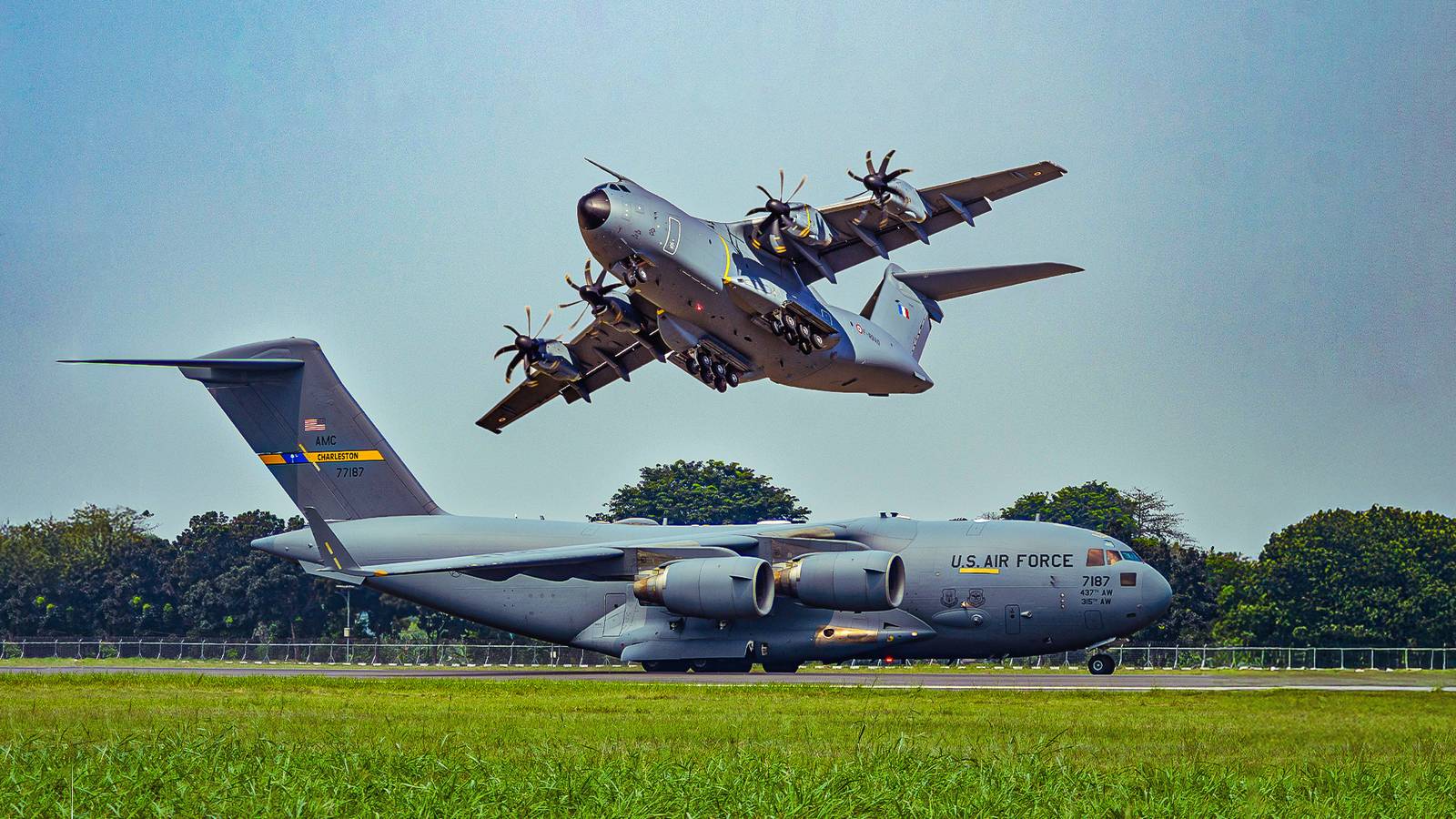
Military cargo aircraft operating in contemporary conflict zones face intensifying threats from shoulder-launched missiles, anti-aircraft fire, and ground-based weaponry, driving demand for transport platforms capable of rapid assault landings on austere airfields. The Boeing C-17 Globemaster III and Airbus A400M Atlas represent the West's primary solutions to these challenges, though each achieves tactical effectiveness through fundamentally different design philosophies.
Payload capacity marks the sharpest distinction between the platforms. The American-built C-17 functions as a strategic heavy lifter with maximum cargo capacity reaching 170,900 pounds, according to a published comparison. Its cavernous hold was engineered specifically to accommodate a 70-ton M1 Abrams main battle tank for intercontinental delivery to forward operating locations. Four Pratt and Whitney F117 turbofan engines producing a combined 161,600 pounds of thrust enable the aircraft to maintain high-speed cruise performance across oceanic distances.
The European A400M pursues a tactical-focused mission set, capping payload at 81,600 pounds—less than half the American aircraft's capacity. While sufficient for wheeled armored vehicles, infantry fighting platforms, and attack helicopters, the Airbus design cannot accommodate heavy tracked armor. The aircraft's defining characteristic lies in its propulsion system: four Europrop turboprop engines driving 17.5-foot scimitar propeller blades, reportedly the most powerful turboprops in operational service at 11,000 horsepower each.
This turboprop configuration delivers instantaneous throttle response critical for low-altitude maneuvering and short-field operations in hostile environments. Both aircraft can operate from minimally prepared dirt strips, but achieve this capability through contrasting aerodynamic solutions. The competing designs reflect divergent operational priorities—the C-17 optimized for strategic reach and maximum payload, the A400M engineered for tactical agility and rapid-response scenarios.
In modern battlefield environments where transport aircraft must descend rapidly, offload cargo, and depart before enemy forces can react, both platforms provide critical capabilities. The choice between them hinges on mission requirements: moving maximum tonnage across continents versus delivering medium loads with enhanced tactical flexibility into high-threat zones.