In This Guide
- 1.Start at Rynek Podgórski, not the main square
- 2.Bar Mleczny Podgórski and the case for cold beet soup at 11 a.m.
- 3.Plac Bohaterów Getta and what the chairs mean
- 4.Climb Krakus Mound before the tour buses figure it out
- 5.Schindler's Factory, or: the museum that outgrew its name
- 6.Where to eat dinner when the lindens are still warm
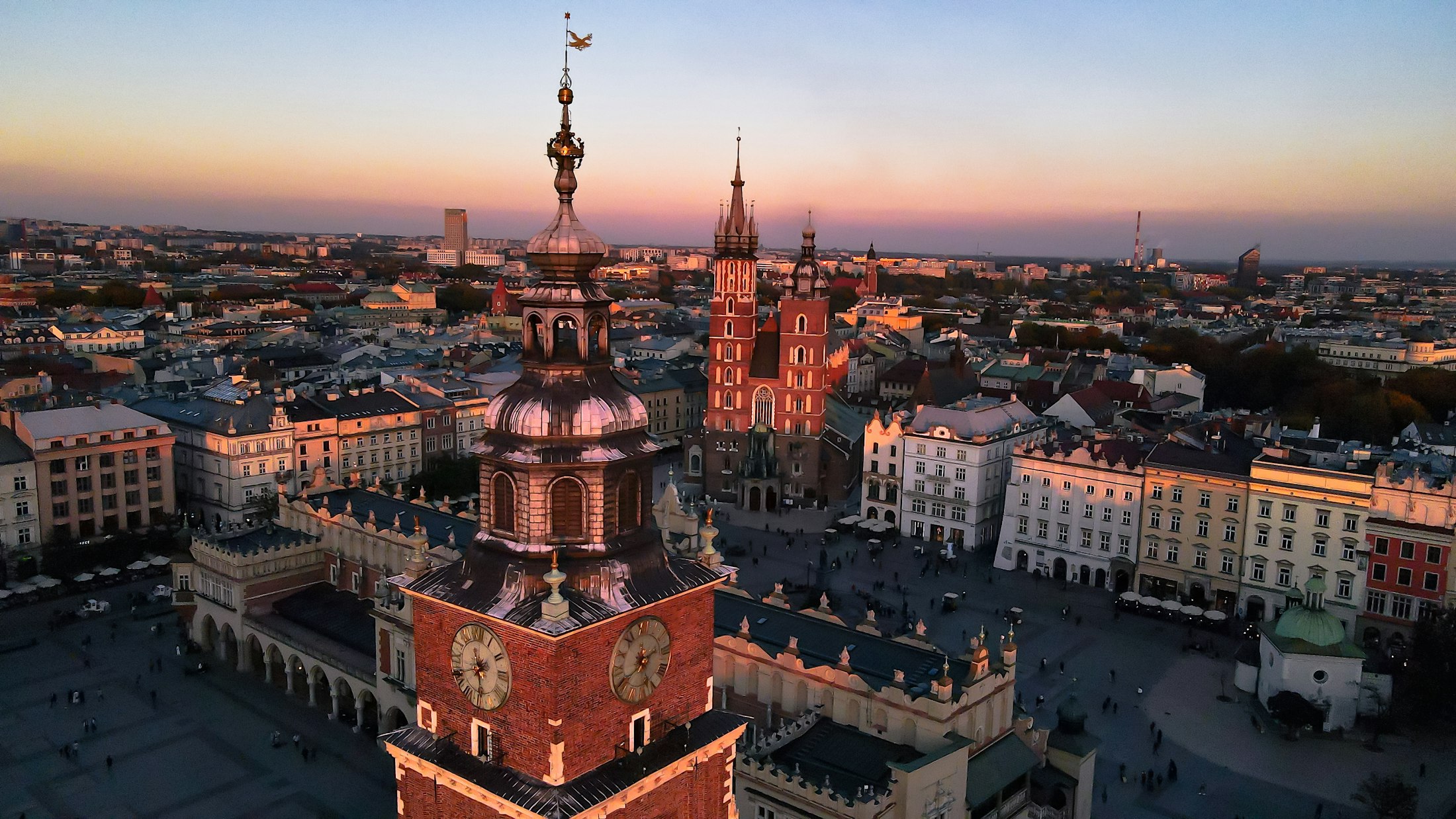
The lindens were blooming the morning I crossed the Józef Piłsudski bridge into Podgórze, and the whole south bank of the Vistula smelled like honey cut with diesel. June does that here — the trees along the river throw out so much pollen that the air itself turns thick and sweet, and every café table on Rynek Podgórski wears a fine yellow dust by noon. Most visitors to Kraków never make it past the Main Square and Kazimierz, which is a shame, because Podgórze is the neighbourhood that actually tells you something true about how this city eats, argues with its own history, and refuses to prettify itself for your benefit.
This was Kraków's independent town until 1915, and it still carries that separatist energy — fewer English-language menus, more grandmothers hauling string bags of tomatoes, a milk bar that hasn't changed its pierogi recipe since the Cold War. I keep coming back.
1. Start at Rynek Podgórski, not the main square
Podgórze's own market square is a long rectangle with a modest church at one end and a row of low Austro-Hungarian buildings in various states of patchy repair. It is not grand. That's the point.
On Saturday mornings a small produce market sets up along the east side — farmers from villages south of the city sell smoked oscypek cheese, bundles of dill the size of your forearm, and jars of forest honey that cost 25–35 zł depending on how much you smile. I bought a jar of lime-blossom honey last June for 28 zł and it was gone within the week, spooned straight into my mouth over morning tea. The woman who sold it to me also pressed a sprig of linden flowers into my hand and mimed dunking it in hot water.
Skip the so-called street-food stalls that occasionally appear near the tram stop on Limanowskiego — overpriced, underseasoned, and aimed at people who wandered over from Kazimierz by accident. You're better off walking two minutes to any of the actual places I'm about to describe.
Pro tip: Tram lines 3, 9, and 24 all stop at Plac Bohaterów Getta, which is a five-minute walk to the square. Avoid the 13 — it loops the long way around.
2. Bar Mleczny Podgórski and the case for cold beet soup at 11 a.m.
Milk bars — bar mleczny — are Poland's Soviet-era subsidised canteens, and the ones that survive do so on stubbornness and low prices. Bar Mleczny Podgórski on ul. Kalwaryjska is one of the last authentic ones on this side of the river. The fluorescent lighting is hostile, the trays are brown plastic, and a full meal — say, a plate of pierogi ruskie, a bowl of chłodnik (cold beet soup, startlingly pink), and a glass of kompot — will run you about 18–22 zł total.
I'll argue with anyone who says milk bars are just nostalgia tourism. The pierogi here are hand-pinched every morning, the fillings are potato and farmer's cheese with enough white pepper to actually register, and the żurek (sour rye soup) on Fridays has a depth that most restaurant kitchens in the Old Town can't touch. The clientele is mostly pensioners and construction workers, which is the best quality signal I know.
Go between 11:00 and 13:00. By 14:00 they start running out of the good dishes and you'll be left choosing between overcooked kotlet schabowy and a sad plate of mizeria.
Pro tip:Chłodnik is seasonal — available roughly May through September. If you're here in linden season, order it. The kitchen doesn't list it on the permanent menu board.
3. Plac Bohaterów Getta and what the chairs mean
The square at Plac Bohaterów Getta is where the Kraków Ghetto's residents were assembled for deportation in March 1943. Today it holds 70 iron-and-bronze chairs, oversized, empty, scattered across the open space. The installation is by Piotr Lewicki and Kazimierz Łatak, and it works precisely because it doesn't try to narrate — it just presents absence.
I have complicated feelings about recommending this as a "stop" on a neighbourhood walk, because it's not a stop. It's the ground you're walking on. Podgórze's history as the site of the ghetto is not separable from its present identity, and treating the square as a photo opportunity between meals would be grotesque. So: go, sit in one of the chairs if you want, read the plaques, and then keep walking with that weight in your chest. The Apteka Pod Orłem (Eagle Pharmacy) museum is on the square's south side — open Tuesday through Sunday, entry 14 zł, free on Mondays — and it tells the story of Tadeusz Pankiewicz, the pharmacist who refused to leave the ghetto and smuggled food and information to its residents.
The museum is small. You'll be through it in forty minutes.
Stay in Krakow
Top-rated hotels near Krakow
Best locations · Verified reviews · Free cancellation
View deals
Expedia →4. Climb Krakus Mound before the tour buses figure it out
Kopiec Krakusa is a pre-medieval burial mound — nobody is entirely sure who's buried in it or when it was built — that sits on a limestone hill at the southern edge of Podgórze. The climb from ul. Wielicka takes about fifteen minutes and is steep enough to make you regret that second plate of pierogi.
The view from the top is the best panorama in Kraków, and I will die on this hill — figuratively. Wawel Castle, the Old Town's church spires, the industrial sprawl of Nowa Huta to the east, the Tatra Mountains on a clear day to the south. Everyone fights over the view from Wawel itself or from Kościuszko Mound on the west side of the city, but Krakus Mound has two advantages: it's free, and in June the slopes are covered in wildflowers and linden saplings that fill the air with that honeyed sweetness I keep going on about.
Early morning, before ten. By midday in summer the exposed hilltop is brutal.
Pro tip:There's no shade at the top. Bring water and a hat. The nearest place to buy a drink afterward is a small sklep on ul. Wielicka, about 200 metres downhill from the mound's entrance path.
5. Schindler's Factory, or: the museum that outgrew its name
Everyone calls it Schindler's Factory, but the permanent exhibition inside — "Kraków Under Nazi Occupation 1939–1945" — covers far more than one man's story. It traces daily life under occupation through ration cards, forged documents, underground press clippings, and recreated interiors of wartime apartments. The curators were clearly more interested in texture than heroism, and the result is a museum that feels like opening someone's desk drawer rather than watching a biopic.
I made the mistake of showing up on a Saturday afternoon in July once and waited over an hour in a line that snaked down ul. Lipowa. Don't do that. Book tickets online at least a few days ahead — entry is 32 zł for adults, 24 zł reduced — and go on a weekday morning. The building is at ul. Lipowa 4.
One contrarian note: I think the exhibition's final room, which tries to end on a note of reconciliation and hope, is the weakest part. The rest of the museum earns its emotional weight through specificity — a child's shoe, a tram ticket, a clandestine newspaper — and then the ending retreats into abstraction. Walk through it quickly and carry the earlier rooms with you instead.
Pro tip:Monday admission is free but slots fill fast. If you're budget-conscious, book a Monday slot the moment they open online — sometimes two weeks out.
Stay in Krakow
Top-rated hotels near Krakow
Best locations · Verified reviews · Free cancellation
View deals
Expedia →6. Where to eat dinner when the lindens are still warm
Podgórze's restaurant scene is thin compared to Kazimierz, and I prefer it that way — fewer places trying to sell you a deconstructed zapiekanka for 45 zł.
Kuchnia u Doroty on ul. Augustiańska is a small lunch-and-dinner spot that does Polish home cooking without apology: gołąbki (stuffed cabbage rolls) in a tomato sauce that tastes like someone's grandmother actually made it, bigos with enough smoked sausage to anchor the whole dish, and a rotating soup that in June tends to be szczawiowa — sorrel soup, tart, ladled over a halved hard-boiled egg. Main dishes run 22–35 zł. They close at 20:00 most nights, so this is an early-dinner situation.
For something with a longer evening, Bal on ul. Ślusarska has natural wines and a short menu of small plates — smoked trout with horseradish cream, bread with lard and pickled onions — in a converted industrial space near the river. Glasses of wine start around 28 zł. The terrace, if you can get a seat, catches the linden-scented breeze off the Vistula, and on a warm June evening there is genuinely nowhere else in Kraków I'd rather sit.
A heel of bread, a glass of something from Moravia, the river below.
Essential tips
Podgórze is a 10-minute tram ride from Kraków Główny station. Buy a 24-hour tram/bus pass for 17 zł at any ticket machine — it covers the whole city and saves you fumbling for coins on every ride.
Milk bars are often cash-only or accept only Polish debit cards. Carry small bills — 10 and 20 zł notes. The Euronet ATMs charge steep fees; use the PKO Bank Polski ATM on ul. Kalwaryjska instead.
Linden season peaks roughly mid-June to early July. The trees along the Vistula embankment and on Krakus Mound are at their most fragrant in the morning before the heat sets in.
Both the Eagle Pharmacy and Schindler's Factory are branches of the Muzeum Krakowa. Check their shared website (muzeumkrakowa.pl) for combined tickets and updated hours — they shift seasonally and close earlier on Sundays.
Ready to visit Krakow?
Book your hotel, flights, and activities through our Expedia-powered search.