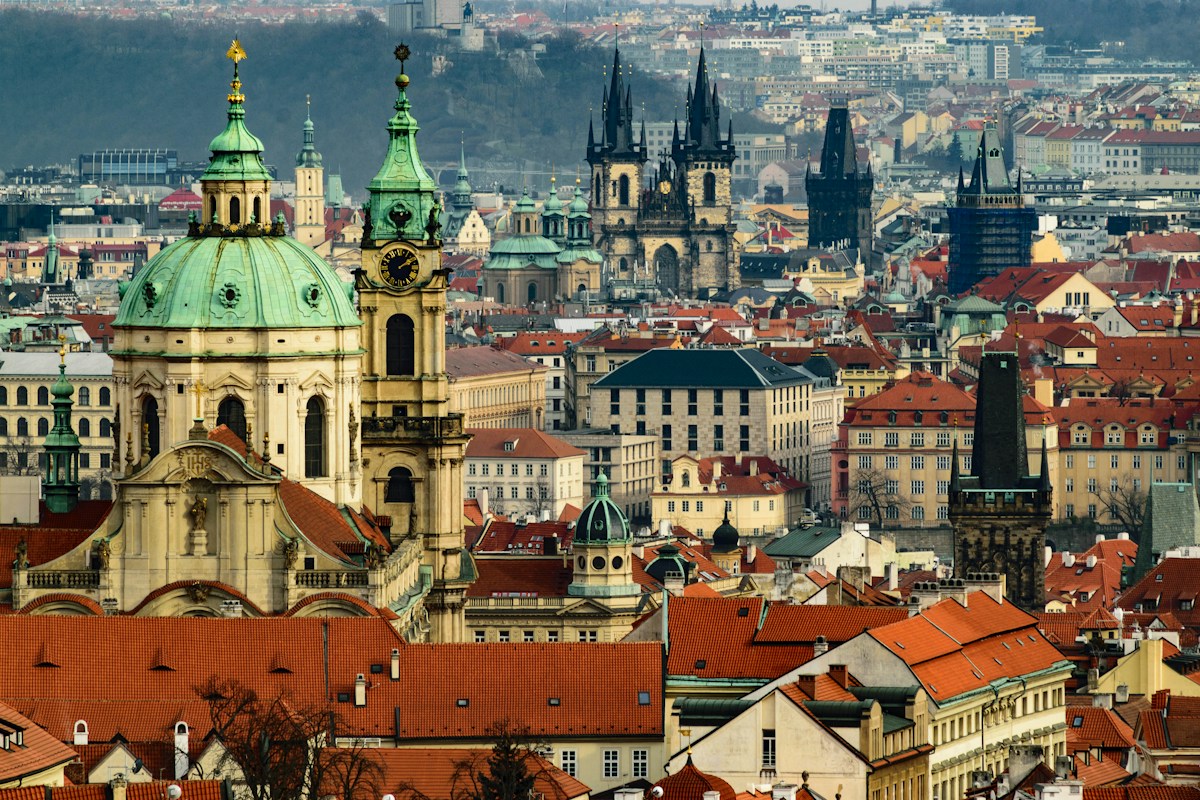
Prague asks you to slow down, and it's right
The Czech capital rewards the traveler willing to let an afternoon dissolve into evening without a plan.
Advertisement
The city that punishes the itinerary
We have watched Prague defeat more organized travelers than almost anywhere else in Europe. Not through chaos or difficulty, but through sheer, almost aggressive beauty that stops you mid-stride and refuses to let you continue on schedule. Arrive with six things ticked off a list and you will leave having done two of them properly. Arrive with two things in mind and you will leave changed. The lesson announces itself early, usually somewhere on Karlův most — Charles Bridge — at the hour when the morning tour groups have dispersed and the light off the Vltava turns the sandstone saints amber. Stand there and try to feel rushed. You cannot.
Stone that remembers more than you expect
Prague's architectural density is not merely a question of beauty; it is a record of survival. The city was not bombed flat in the Second World War, which means it carries eight centuries of competing styles in uneasy, magnificent cohabitation. Gothic crowds Baroque, which crowds Art Nouveau, which crowds Cubist — and yes, Prague has an entire strain of Cubist architecture found essentially nowhere else on earth. The Dům U Černé Matky Boží, the House at the Black Madonna on Celetná Street, is the place to start that conversation. Step into the spiraling stairwell and run your hand along the angular ironwork: it is cold and precise and slightly hostile, which is exactly what Cubism promised and rarely delivered so literally.
What Czechs actually drink
The Pilsner Urquell mythology is real but incomplete. Spend a week in Prague and you begin to notice that the locals in neighborhood podniks — the unassuming pub-restaurants that anchor every residential quarter — are more likely to be drinking Kozel or Bernard or a regional pale lager you have never heard of, served at exactly the correct temperature with a head so thick a coin could rest on it. At Lokál Dlouhááá on Dlouhá Street, the tank-fresh Pilsner Urquell is genuinely better than anything from a bottle, but the more instructive ritual is watching the staff practice hladinka — the all-foam pour — which exists not as theater but as palate cleanser between glasses. Order one. Drink it like milk.
Arrive with six things ticked off a list and you will leave having done two of them properly.
The neighborhoods that don't perform for you
Vinohrady and Žižkov sit adjacent on the hill east of the center and share almost nothing in temperament. Vinohrady is leafy and composed, its turn-of-the-century apartment buildings housing young professionals and good wine bars with natural pours and chalkboard menus. Žižkov is rougher at the edges, historically a working-class district that still has the posture to prove it. The Žižkov Television Tower — the brutalist rocket ship that Kafka himself might have dreamed up — looms over both, its legs crawling with David Černý's giant bronze infants, their faces replaced by barcodes. It is the most sincerely unsettling public artwork in Central Europe, and the view from the top at dusk, when the red rooftops of Vinohrady stretch toward the river, is worth every meter of the ascent.
On eating seriously here
Czech cuisine has spent decades absorbing condescension from food writers who expected the svíčková — slow-braised beef sirloin in root vegetable cream sauce, served with bread dumplings and a crown of whipped cream — to be some kind of peasant apology. It is not. At Café Savoy on Vítězná Street, a beautifully restored Neo-Renaissance dining room in Smíchov, the svíčková arrives with the kind of confidence the dish has always deserved. The sauce is sweet-sour and deep, the dumplings absorb it without collapsing, and the room smells of roasting and old wood and strong coffee. This is not comfort food in the diminishing sense. It is precision applied to tradition.
The hour Prague belongs to nobody
Stay long enough — a week is barely sufficient — and you will find the city's true register: the hour just after midnight on a Tuesday, when the last trams run nearly empty along the embankment and the castle is lit gold against a black sky and you are walking somewhere without much purpose. Prague does not sleep so much as withdraw. The stone goes quiet. The Vltava keeps moving. We keep coming back for this exact feeling, which no photograph has ever successfully held.
Advertisement