In This Guide
- 1.Why District 6, and why Khmer?
- 2.Nùm Bò Chóc: the dish that justifies the alarm clock
- 3.The alley behind Chùa Chantarangsay
- 4.Skip the Bình Tây Market food court
- 5.The sticky rice woman on Ngô Nhân Tịnh
- 6.Monsoon timing is the whole point
- 7.How to get there at 5 a.m. without losing your mind
- 8.What nobody tells you about ordering
- 9.The cathedral vs. the noodles (an opinion)
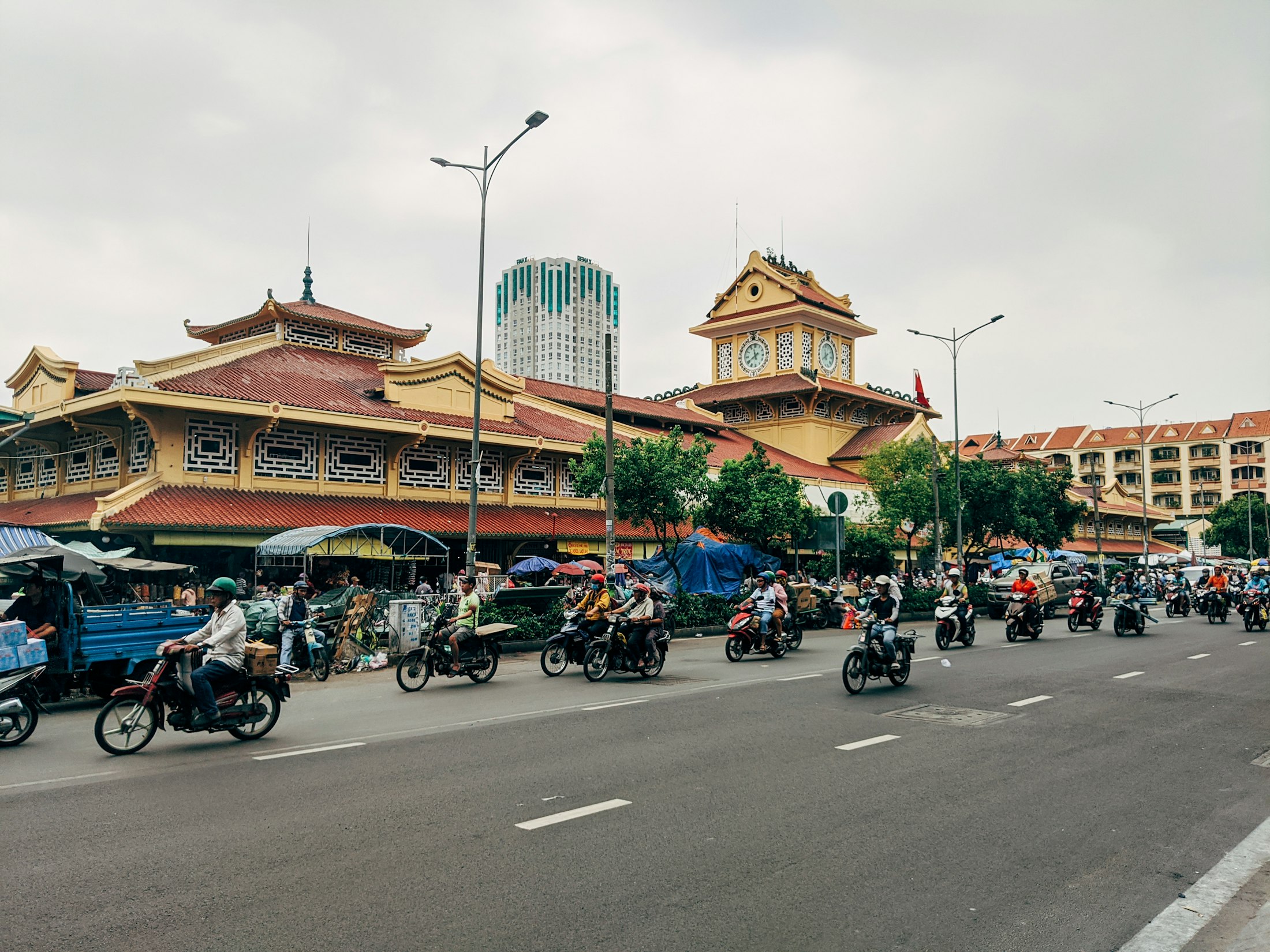
The motorcycle taxi dropped me at the mouth of a nameless alley off Hậu Giang at 5:15 a.m. and the air was already thick with pork bone steam and the wet green smell of morning glory piled in plastic crates. District 6 doesn't get much foreign foot traffic — most travelers eat their way through District 1 or make the pilgrimage to District 5's Chợ Lớn and call it done. Their loss.
What's happening in the alleys between Bình Tây Market and the Cambodian pagodas along Trần Văn Kiểu is, to my mind, the most interesting breakfast scene in Ho Chi Minh City right now: Khmer rice noodle soups served from storefronts so narrow two people can't pass each other, finished before most of Saigon has its cà phê sữa đá. The window is roughly 5 a.m. to 8:30 a.m. Show up at ten and you'll find stacked plastic stools and a locked gate.
1. Why District 6, and why Khmer?
Ho Chi Minh City has one of the largest Khmer communities in Vietnam, and District 6 is where a lot of that community has cooked, prayed, and traded for generations. The food here doesn't read as Vietnamese-Cambodian fusion — a phrase I'd be happy never to type again — it reads as Khmer food made by Khmer families who happen to live in a Vietnamese city. There's a difference, and you taste it in the curry pastes, in the raw bean sprout piles, in the way lemongrass shows up braised rather than sliced raw.
Most food blogs will point you to Nùm Bò Chóc as the flagship Khmer noodle soup of the neighborhood, and they're not wrong. But the breakfast ecosystem here is wider than one dish. You'll find bò kho with coconut milk, fish-based soups closer to the Cambodian samlor korkor tradition, and sticky rice desserts that nobody photographs because they're wrapped in banana leaf and not particularly cute.
2. Nùm Bò Chóc: the dish that justifies the alarm clock
Nùm Bò Chóc is a fish-based rice noodle soup, and if you've eaten bún nước lèo in Sóc Trăng or Trà Vinh, you already know a cousin of this dish. The broth is built on pounded fermented fish — prohok — simmered with lemongrass, galangal, and a curry paste that each household keeps slightly different. The noodles are fresh rice vermicelli, thicker than standard bún, with a chew that holds up under the broth's weight.
What makes the District 6 versions distinct is the garnish tray. You get a plate of raw vegetables — banana blossom, water lily stems, morning glory, mint — that's twice the size of what you'd see in the Mekong Delta versions. The ratio of greenery to soup is almost 1:1 if you load up properly, which you should.
I've seen people compare this to phở. Don't. The flavor architecture is completely different: funkier, more acidic, with a sweetness that comes from the fish itself rather than from rock sugar. A bowl runs 35,000–45,000 VND depending on the stall.
Pro tip: Ask for extra nước mắm ớt on the side — the chili fish sauce — and add it in small doses. The broth is already complex; you want to sharpen it, not drown it.
Stay in Ho Chi Minh City
Top-rated hotels near Ho Chi Minh City
Best locations · Verified reviews · Free cancellation
View deals
Expedia →3. The alley behind Chùa Chantarangsay
Chùa Chantarangsay is the Khmer Theravada pagoda at 164/62 Trần Quốc Toản, and the alley that runs behind its south wall is where I've had my best mornings in District 6. Two stalls operate here before dawn, neither with a name posted in any language I could read. The one on the left — the one with the blue plastic tables — serves a nùm bò chóc that's heavier on the galangal and comes with a small dish of pounded dried shrimp you mix in yourself.
The stall across from it does a bò kho with coconut milk that I've never encountered anywhere else in the city. The beef is cut into rough cubes, braised until the connective tissue goes glossy, and the broth has that faintly sweet coconut richness that turns the whole thing into something closer to a Cambodian curry than a Vietnamese stew. Served with a torn-off piece of baguette or with noodles — get the noodles.
Monks from the pagoda eat at both stalls. Not a guarantee of quality, but a decent leading indicator.
Pro tip: The alley is dark at 5 a.m. Use your phone flashlight to watch your footing — the pavement is uneven and sometimes wet from overnight rain.
4. Skip the Bình Tây Market food court
I know. Every guide tells you to eat at Bình Tây. The market itself is worth walking through for the wholesale chaos — towers of dried goods, fake eyelashes sold by the kilo, lotus seeds in sacks the size of a child. But the renovated food court on the upper level is a tourist-facing operation now, with laminated menus and prices marked up 30–40% over what you'd pay fifty meters outside the gates.
Eat in the alleys. Come to Bình Tây for fish sauce in bulk.
5. The sticky rice woman on Ngô Nhân Tịnh
She sets up around 5:30 a.m. on the corner of Ngô Nhân Tịnh and a smaller lane I could never get the name of, with a glass cart and a stack of banana leaves. Her xôi is Khmer-style: coconut sticky rice with black bean, served in a banana-leaf packet with a drizzle of coconut cream that's been salted just enough to make you want another one. 10,000 VND per packet.
Buy three. They're small, they hold up at room temperature, and you'll want one for later when the heat kicks in around noon and you can't face a full meal.
She's gone by 7:30 most days. On Sundays, sometimes earlier.
Pro tip:If she has the version with grated young coconut on top, get that one. It's not always available.
Stay in Ho Chi Minh City
Top-rated hotels near Ho Chi Minh City
Best locations · Verified reviews · Free cancellation
View deals
Expedia →6. Monsoon timing is the whole point
Ho Chi Minh City's monsoon season runs roughly May through November, and most visitors treat rain as a scheduling inconvenience. I think the monsoon is when this city is at its best, and I'll argue about it. The overnight storms clear the exhaust haze, drop the temperature to something almost pleasant before 7 a.m., and leave the alleyways with that wet-concrete-and-frangipani smell that I associate with every good morning I've had here.
The breakfast stalls in District 6 are busiest during monsoon months. Families eat hot soup in the rain. The logic is the same as phở in Hanoi in January — you want the steam, you want the warmth against the damp, you want to sit on a plastic stool under a corrugated awning and watch the water sheet off the edges.
Dry season breakfast is fine. Monsoon season breakfast is the reason you came.
7. How to get there at 5 a.m. without losing your mind
Grab bike. That's it.
District 6 is about twenty minutes from District 1 at that hour, when the streets are still empty enough that your driver can actually move. A Grab bike from Phạm Ngũ Lão to the Bình Tây area costs roughly 20,000–30,000 VND. Don't bother with a Grab car — the alleys are too narrow for anything with four wheels, and you'll spend ten minutes walking from wherever the car drops you.
From Thảo Điền or District 7, add another ten minutes and maybe 40,000 VND. Last time I was there in June, the Grab bike driver asked me where I was going and when I said "Chùa Chantarangsay," he nodded like that was the most normal 5 a.m. destination in the world.
Pro tip: Screenshot the pagoda address (164/62 Trần Quốc Toản) and show it to your driver. The street names in District 6 confuse even local riders sometimes.
8. What nobody tells you about ordering
Most of these stalls don't have menus. Some have a single dish. You sit, you get a bowl. If there's a choice, it's usually size — point at the small bowl or the large bowl on someone else's table. The garnish plate arrives automatically.
Vietnamese is more useful than English here, but even basic Vietnamese won't always land because some of the older cooks speak Khmer at home. Pointing works. Holding up two fingers for two bowls works. I've never had a communication failure that lasted more than fifteen seconds.
One genuine tip: if you want extra broth on the side, mime pouring from a ladle into your bowl. Every stall I've visited will top you off for free.
9. The cathedral vs. the noodles (an opinion)
I like the Notre-Dame Cathedral Basilica fine. I understand why it's on every itinerary. But if you're in Ho Chi Minh City for three days and you spend a morning posing in front of a scaffolding-wrapped French colonial church instead of eating nùm bò chóc in a Khmer alley at dawn, I think you've made a mistake. The cathedral will look the same in every photo you've already seen of it. The soup won't.
District 6 is not convenient. It's not on any walking tour. The stalls don't have Instagram accounts or English-language reviews. That's precisely why the food still tastes like someone's grandmother made it, because in most cases, someone's grandmother did.
Essential tips
Arrive between 5:00 and 6:30 a.m. for the widest selection. By 8:00 a.m., at least half the stalls have sold out and are washing pots.
Bring cash in small denominations — 10,000 and 20,000 VND notes. No stall in this area accepts cards or mobile payment, and breaking a 500,000 VND note at 5 a.m. will get you a look.
Pack a thin rain poncho if visiting May–November. The corrugated awnings leak, and a five-minute downpour can soak you between stalls. Umbrellas are useless in the narrow alleys.
Use Chùa Chantarangsay (164/62 Trần Quốc Toản, District 6) as your anchor point. The best breakfast stalls are within a 200-meter radius of the pagoda's south wall.
Ready to visit Ho Chi Minh City?
Book your hotel, flights, and activities through our Expedia-powered search.


