In This Guide
- 1.Hải Thượng Lãn Ông Street: The Apothecary Corridor at First Light
- 2.Hẻm 502 Dim Sum Alley: The Queue That's Worth Joining
- 3.Trà Lương Ký: A Herbal Tea House Frozen in 1962
- 4.Chợ Bình Tây: The Wholesale Market Before the Tour Buses
- 5.Mỹ Liên: The Dim Sum Restaurant Cholon Families Trust
- 6.Thien Hau Temple: Incense Coils and Stillness Before Nine
- 7.Closing the Morning: Cà Phê Sữa Đá on Triệu Quang Phục
The sky over Cholon is still bruised purple when the first shutters rattle open along Hải Thượng Lãn Ông street. Apothecary owners drag burlap sacks of dried chrysanthemum and astragalus root onto the pavement, their movements unhurried and ancestral. The air thickens with camphor and star anise, and somewhere behind a steamed-up window, a dim sum cart begins its first orbit. This is District 5 before the motorbikes conquer it — intimate, aromatic, and deeply Chinese-Vietnamese in its bones.
This guide walks you through a curated dawn-to-mid-morning itinerary through Cholon's most rewarding culinary and cultural corridors. You will learn where to drink lotus-seed herbal tea brewed from century-old family recipes, which dim sum houses merit the early alarm, and how to navigate the apothecary street like a local. Cholon is often reduced to a market stop on tourist circuits, but at dawn it reveals a layered, living neighbourhood that rewards those who arrive before eight.
1. Hải Thượng Lãn Ông Street: The Apothecary Corridor at First Light
Start your morning on Hải Thượng Lãn Ông, the concentrated artery of traditional Chinese medicine that runs through the heart of District 5. By 5:45 a.m., vendors have already arranged their pharmacopoeias — glass jars of goji berries, sliced ginseng, and dried seahorses — in meticulous rows that haven't changed in decades. The visual density alone is staggering.
Duck into An Khang Đường at number 73, a fourth-generation apothecary whose wooden drawers are labelled in both Cantonese and Vietnamese. The owner, if he's behind the counter, will brew you a complimentary sample of his house herbal cooling tea — a bitter, complex blend of chrysanthemum, honeysuckle, and prunella. Don't refuse it; the gesture is part of the commerce.
The best strategy is to walk the odd-numbered side first, where the older, family-run shops cluster. Cross to the even side on your return. You'll notice that some storefronts double as wholesale operations, shipping dried longan and red dates across Southeast Asia. The scale of trade here is quietly enormous.
Avoid buying loose herbs unless you know your materia medica. Instead, look for pre-packaged herbal tea blends — the eight-treasure tea bags make excellent, lightweight souvenirs. Prices are rarely marked, so confirm before purchasing, and expect to pay between 40,000 and 80,000 VND for a standard packet.
Pro tip: Arrive before 6:15 a.m. for the best photography light — the shops face east, and the low sun ignites the amber and ochre jars into something genuinely cinematic. By 7 a.m., awnings go up and the magic flattens.
2. Hẻm 502 Dim Sum Alley: The Queue That's Worth Joining
Follow Trần Hưng Đạo B south until you hit the narrow alley entrance at number 502. This unmarked hẻm is Cholon's worst-kept dim sum secret — three competing stalls operate from converted living rooms, and by 6:30 a.m. plastic stools spill onto the lane. The stall deepest into the alley, identifiable by its dented aluminium steamers stacked six high, is your target.
Order the xíu mại — open-topped pork and shrimp dumplings with a pronounced five-spice backbone that distinguishes Cholon dim sum from its Hong Kong cousins. The háo cảo, translucent shrimp crescents with a snappy wrapper, arrive three to a bamboo tray. Each portion costs between 15,000 and 25,000 VND, making a full spread astonishingly affordable.
The tea here is self-service: a thermos of jasmine tea sits on each table, and you pour your own into chipped porcelain cups. This is not a design-forward experience. The charm is in the efficiency and the flavour memory that lingers well past lunch.
Avoid the bánh bao after 7:30 a.m. — they steam fresh batches at 5:30 and again at 7:00, and anything sitting beyond that window turns gummy. The regular customers know this instinctively; watch when they order and mirror their timing.
Pro tip:Bring small bills — 10,000 and 20,000 VND notes. These stalls don't break 200,000 notes willingly, and mobile payment hasn't reached this particular alley yet. Cash is king before sunrise.
Stay in Ho Chi Minh City
Top-rated hotels near Ho Chi Minh City
Best locations · Verified reviews · Free cancellation
View deals
Expedia →3. Trà Lương Ký: A Herbal Tea House Frozen in 1962
At 95 Phùng Hưng street, a faded sign in traditional Chinese characters marks Trà Lương Ký, a herbal tea house that has operated from the same tiled shopfront since the early 1960s. The interior is deliberately austere — a marble counter, a row of ceramic crocks, and a wall calendar that may or may not reflect the current year. You sit; tea arrives.
The house specialty is trà la hán quả, a monk fruit tea served warm and lightly sweetened with rock sugar. It's brewed in large clay pots and ladled into glass tumblers. The flavour is round, caramel-edged, and nothing like the aggressively sweet monk fruit extracts sold in Western health shops. A glass costs 12,000 VND.
If your stomach is already fortified from dim sum, try the trà khổ qua — bitter melon tea, served unsweetened and bracingly vegetal. Locals drink it as a digestive and a blood-sugar regulator. It's an acquired taste, but ordering it signals to the owner that you're not just passing through.
The shop closes by 10:00 a.m. most days and doesn't reopen. There's no evening service, no weekend brunch pivot. Lương Ký exists on its own temporal terms, and that stubbornness is part of its authority.
Pro tip:Ask for trà bát bảo (eight-treasure tea) if available — it's a complex blend with lotus seed, jujube, goji, and longans, served in a lidded bowl. Not always on offer, but worth requesting quietly.
4. Chợ Bình Tây: The Wholesale Market Before the Tour Buses
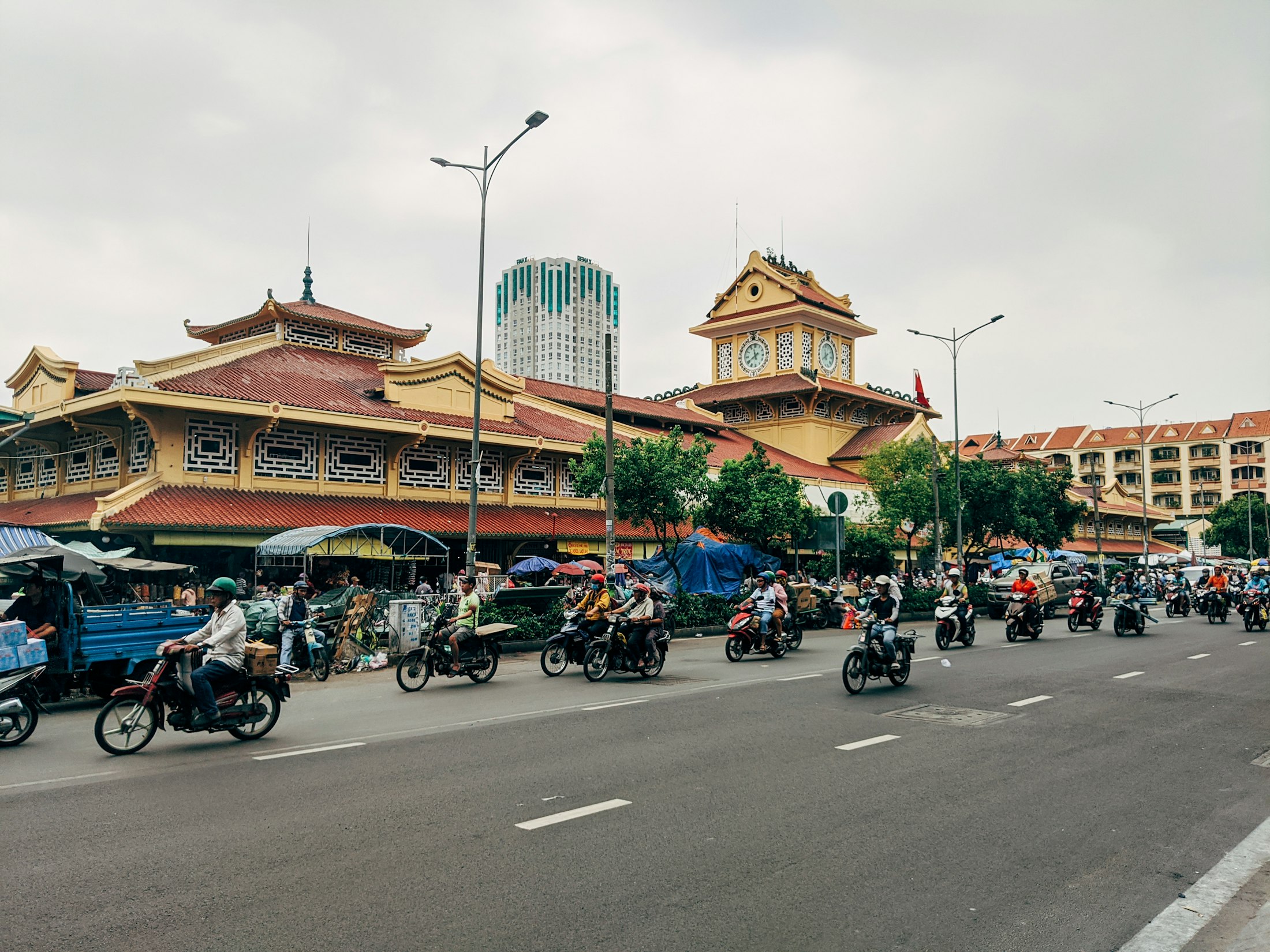
Bình Tây Market at 57A Tháp Mười street is Cholon's gravitational centre, and arriving before 7:00 a.m. lets you experience it as a functioning wholesale hub rather than a tourist landmark. The ground floor moves dried goods at industrial volumes — 20-kilo sacks of dried shrimp, towers of rice paper, barrels of fermented tofu — and the merchants communicate in rapid Cantonese-Vietnamese code-switching.
Head to the second floor's southeast corner, where a cluster of stalls sell medicinal soups and congee to market workers. The cháo lòng — offal rice porridge with quẩy crullers — is honest and restorative, costing around 30,000 VND. Eat standing if the stools are taken; nobody will judge you.
The market's architecture deserves a moment. Rebuilt after a 2016 fire, the exterior retains its 1920s Art Deco bones, and the central courtyard fountain features a dragon motif worth photographing from the upper balcony. The renovation was controversial locally, but the structure holds up.
Skip the ground-floor souvenir stalls near the main entrance — they're priced for tour groups and sell generic lacquerware available cheaper elsewhere. The real treasures are the dried herb and spice vendors along the market's western interior wall, where quality matches the apothecary street at lower prices.
Pro tip: Enter through the Phan Văn Khỏe side entrance to avoid the congested main gate. This drops you directly into the dried goods section, which is the most photogenic and least touristy quadrant of the market.
5. Mỹ Liên: The Dim Sum Restaurant Cholon Families Trust
For a more structured dim sum experience, walk to Mỹ Liên at 43 Nguyễn Trãi in the northern stretch of District 5. This Cantonese restaurant has served Cholon's Chinese-Vietnamese community since the 1980s, and at dawn it fills with extended families conducting breakfast as a multigenerational ritual. Reservations aren't taken; just arrive.
The chả giò rế — deep-fried taro-wrapped spring rolls with a latticed crust — are Mỹ Liên's signature, and they deserve their reputation. Order them alongside the xá xíu bao, char siu pork buns with a pillowy steamed exterior and a filling that skews sweeter than Cantonese standard. Both pair well with their robust chrysanthemum tea.
What elevates Mỹ Liên is its cart service. Unlike the alley stalls, here bamboo steam trays circulate on rolling carts pushed by women who announce each dish in Cantonese. You point, they stamp your card. The kinetic theatre of the cart system is increasingly rare in Ho Chi Minh City.
Budget around 150,000 to 250,000 VND per person for a thorough breakfast. The final bill arrives as a tally of stamped squares on a paper card — a system so analogue it functions as its own kind of heritage preservation.
Pro tip:Sit near the kitchen door on the left side of the dining room. The carts emerge from there, and you'll get first access to the freshest trays — especially the cheung fun rice noodle rolls, which go fast.
Stay in Ho Chi Minh City
Top-rated hotels near Ho Chi Minh City
Best locations · Verified reviews · Free cancellation
View deals
Expedia →6. Thien Hau Temple: Incense Coils and Stillness Before Nine
After eating your way through dawn, walk five minutes south to Thiên Hậu Temple at 710 Nguyễn Trãi. Dedicated to the Chinese sea goddess Mazu, this 1760s Cantonese temple is one of the oldest in the city, and visiting before 9:00 a.m. means encountering it in its devotional state — locals lighting joss sticks, not tour groups photographing them.
Look up immediately upon entering. The courtyard ceiling is strung with enormous spiral incense coils that burn for weeks, each dangling a red paper tag with the donor's wishes. The smoke creates a perpetual haze that softens the ornate ceramic friezes along the roofline into something almost impressionistic.
The main hall houses three Mazu statues behind glass, flanked by Quan Công and smaller protective deities. The craftsmanship of the gilded woodwork is extraordinary — specifically the carved door panels depicting scenes from Chinese maritime mythology. Take your time here; the details reward slow looking.
You may purchase a coil incense offering for around 50,000 to 200,000 VND depending on size. If you do, temple attendants will help hang it and attach your written wish. It's a genuine devotional act here, not a manufactured tourist ritual, so approach it with appropriate respect.
Pro tip: Visit on the 1st or 15th day of the lunar month for peak devotional activity — the temple fills with worshippers and fresh fruit offerings, and the incense smoke reaches its densest, most atmospheric intensity.
7. Closing the Morning: Cà Phê Sữa Đá on Triệu Quang Phục
End your Cholon dawn circuit on Triệu Quang Phục street, where a row of sidewalk coffee vendors set up around 7:00 a.m. The best of them — an unmarked cart near the intersection with Ngô Nhân Tịnh — uses a slow-drip phin filter over condensed milk, producing a cà phê sữa đá of uncommon richness. A glass costs 18,000 VND.
Pull up a low plastic stool and face the street. By this hour, Cholon has fully awakened — delivery bikes loaded with dried goods weave between buses, fabric merchants drag bolts of silk into shopfronts, and the sidewalk economy operates at full velocity. Your coffee is the punctuation mark.
This stretch of Triệu Quang Phục also houses several fabric and haberdashery wholesalers, if you have energy for browsing. The Vietnamese silk prices here significantly undercut the tourist shops in District 1, and the quality, particularly from shops between numbers 40 and 60, is reliably high.
By 9:30 a.m., the morning heat will start asserting itself. This is your cue to grab a taxi back to your hotel, or descend into the air-conditioned refuge of a District 5 bubble tea shop. You've earned the sugar.
Pro tip:If the coffee vendor offers cà phê trứng (egg coffee), say yes — it's uncommon this far south and suggests someone with Hanoian training. The foamed egg yolk top adds a custard richness that makes it worth the detour from tradition.
Essential tips
Set your alarm for 5:15 a.m. The apothecary street peaks between 5:45 and 6:30, and the best dim sum batches emerge before 7:00. By 8:30, you've lost the dawn advantage and gained the heat and crowds.
Carry at least 500,000 VND in small denominations. Almost nothing in early-morning Cholon accepts card payment, and breaking large notes at street stalls creates friction. ATMs along Châu Văn Liêm dispense from 5:00 a.m.
Book a Grab bike rather than a Grab car to reach District 5 before 6:00 a.m. — the narrow alleys around Hải Thượng Lãn Ông are inaccessible to cars, and morning traffic is light enough to make two wheels comfortable.
Wear closed-toe shoes with grip. Market floors are slick with condensation and spilled ice at dawn, and the temple courtyard tiles become slippery from incense ash. Sandals are a minor injury waiting to happen.
Basic Cantonese greetings go further than Mandarin here. A simple 'jo san' (good morning) at dim sum stalls and apothecaries signals cultural awareness and often unlocks warmer service and off-menu recommendations.
Ready to visit Ho Chi Minh City?
Book your hotel, flights, and activities through our Expedia-powered search.


