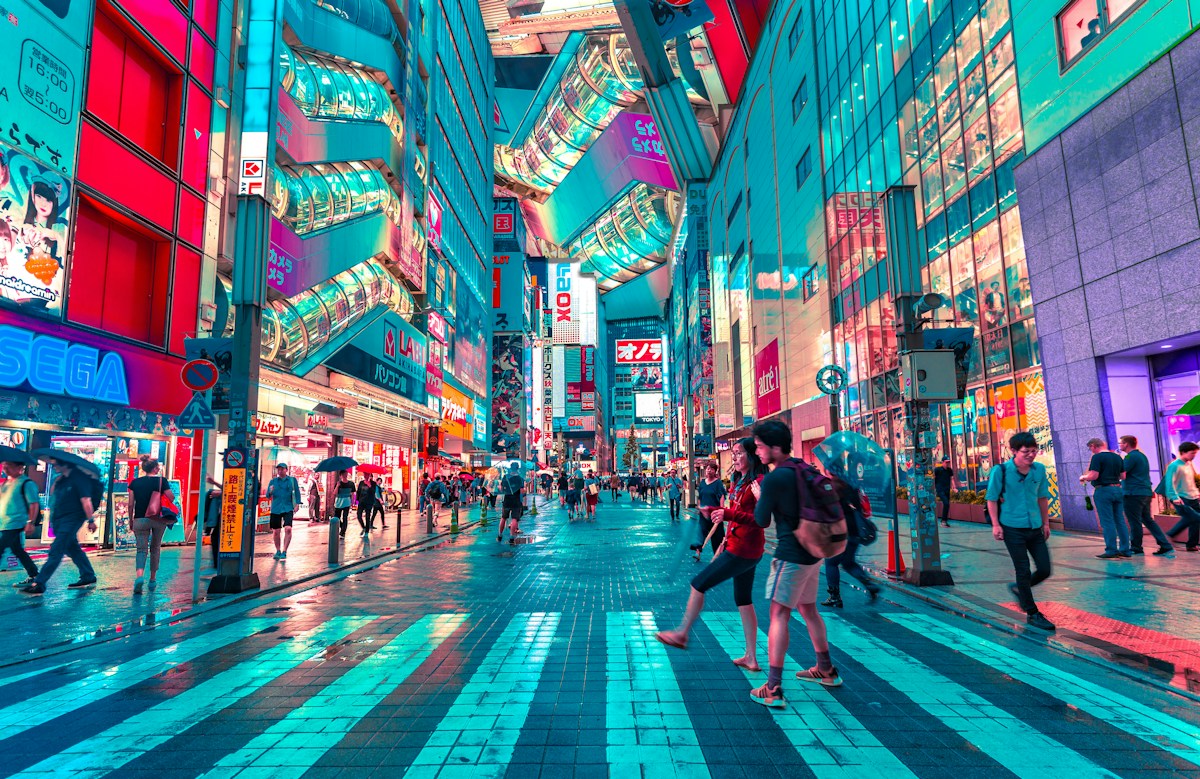
Tokyo holds its contradictions without apology
A city that has perfected the art of being ancient and relentlessly new at the same time — and never explains itself.
Advertisement
The city doesn't perform for you
Most great cities make a show of their greatness. Tokyo doesn't bother. It goes about its business with a kind of focused indifference to the visitor's gaze, and that indifference is, paradoxically, the most welcoming thing about it. We noticed this first at Yanaka Cemetery in the northeast of the city, where locals walk their dogs along the long central avenue of zelkova trees as if a foreigner with a guidebook and a vague expression is the most unremarkable thing in the world. The light through those trees in late afternoon is amber and granular, and you can hear almost nothing except the scratch of swept gravel. Nobody is performing Tokyoness for you here. The city simply continues.
Time doesn't move in straight lines here
Tokyo was rebuilt almost entirely after the firebombing of 1945, yet it carries age in ways that have nothing to do with old buildings. The feeling lives in repetition and ritual. At Kagurazaka, a neighborhood of narrow stone lanes once favored by geiko establishments, you will find yourself on a flagstone alley called Hyogo Yokocho so compressed that two people passing each other must turn sideways. The walls are close enough to touch on both sides. The smell is of damp stone and something faintly smoky from a restaurant kitchen behind a closed wooden door. Nothing about this alley is performing the past. It is simply a very old idea — the city as a series of private passages — that never got revised away.
Precision is not coldness
We sometimes mistake Japanese exactitude for emotional distance, and Tokyo corrects that misreading quietly, over and over. Sit at the cypress counter of Sushi Yoshitake in Ginza and watch the chef Masahiro Yoshitake prepare a piece of kohada — gizzard shad — which has been cured in vinegar for a duration he has spent years calibrating. He places it in front of you with a motion so economical it looks almost casual. The fish has the faint mineral brightness of something that came out of cold water that morning. This is not minimalism for aesthetic effect. It is the result of one person caring about one thing more than most of us care about anything.
Tokyo is a city that has thought carefully about how to live at enormous scale, and then acted on those thoughts.
The railway system is a philosophical statement
Tokyo has approximately 160 train lines operated by competing companies, and they run with a punctuality that the city treats as a baseline expectation rather than an achievement. To move through this system is to understand something about how Tokyo thinks: that infrastructure is a form of respect. We were traveling the Chuo-Sobu Line on a gray Wednesday morning, watching the city scroll past the window from Shinjuku toward Ochanomizu — a dense, low cityscape interrupted by rivers and sudden parks — and the train arrived at each station to within seconds. Nobody remarked on this. The doors opened precisely. The city held its shape.
What happens when a metropolis has good manners
Twenty-four million people live in greater Tokyo, and the noise this number suggests never quite materializes. The city has developed a collective agreement about public comportment that has no equivalent we've encountered elsewhere. Stand on the upper floor of the Tokyo Metropolitan Government Building observation deck in Shinjuku on a clear day, and the scale of what you're looking at is almost incomprehensible — a grey-blue grid extending forty kilometers in every direction, Fuji floating above its western edge like a rumor. Then go back down into the streets. Someone will pick up your dropped transit card and hand it back to you without making eye contact, as if drawing attention to your small misfortune would compound it. The city as a whole is extending that same courtesy.
Why we keep returning
We have been to Tokyo six times between the editorial team, and none of us can produce a fully satisfying explanation for why it exerts the pull it does. The food is extraordinary, yes. The design culture is serious in ways that reward sustained attention. But those are facts, not reasons. The real answer is harder to articulate. Tokyo is a city that has thought carefully about how to live at enormous scale, and then acted on those thoughts with patience and consistency over decades. Walking out of Nezu Shrine at eight in the morning — the stone fox guardians still wet from overnight rain, a single stick of incense burning at an offering box, the sound of the city starting up beyond the shrine wall — we felt what we always feel here: that we are somewhere that takes the ordinary seriously. That is, in the end, a rare thing.
Advertisement