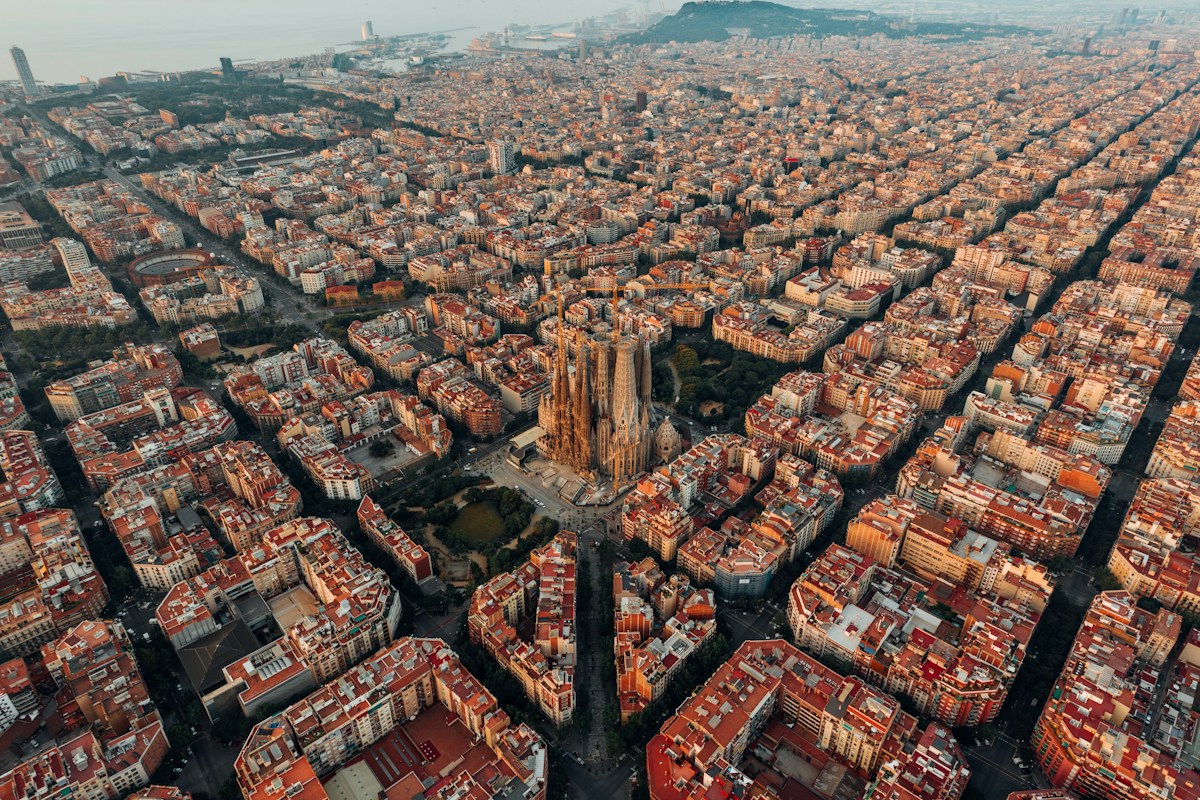
Barcelona keeps its secrets in plain sight
The city rewards those who stop performing tourism and simply pay attention to what's already there.
Advertisement
The city that refuses to be summarized
We have a rule at this desk: never trust a place that photographs too easily. Barcelona, to its credit, makes you work for the good stuff — not because it hides anything, but because it layers everything so thickly that first-time visitors tend to skim the surface and call it a week. The skyline that greets you from the Tibidabo funicular at dusk is not the city. It is an argument the city is making about itself, and whether you believe it depends entirely on how long you stay and how slowly you move.
What Gaudí actually built
Everyone arrives with expectations about the Sagrada Família, and almost everyone is caught off guard anyway. Not by its scale — photographs have done that work — but by the quality of light inside the nave on a late morning in July, when the east-facing stained glass throws pools of amber and cobalt across the stone floor that seem almost liquid. What Gaudí designed was not a building so much as a controlled atmosphere, and standing inside it, we find ourselves thinking less about architecture and more about the particular silence that falls over a crowd when it collectively decides to stop talking. That silence is the real achievement.
The market as daily infrastructure
Tourists treat the Mercat de Santa Caterina — the market in Sant Pere with the Miralles-designed mosaic roof — as an alternative to La Boqueria's crush. Locals treat it as a Tuesday. We prefer the local interpretation. Go around ten in the morning on a weekday and you will find fishmongers breaking down whole tuna with the practiced indifference of people who have done this ten thousand times, the smell of brine and cold stone hitting you the moment the sliding doors open. This is a place of infrastructure, not spectacle, and there is more to learn about Barcelona from watching a grandmother negotiate the price of gambas than from any guided tour.
Barcelona is not one city with a unified personality but several distinct places conducting an ongoing argument about what they owe each other.
The hour the city actually belongs to itself
Barcelona is a nocturnal city, but the hour we return to again and again is not midnight — it is nine in the evening in late summer, when the heat finally releases its grip and the Passeig del Born fills with the particular social confidence of people who believe, probably correctly, that they live somewhere worth living. Chairs scrape. Someone orders a vermut even though it is too late for vermut. The plane trees overhead hold the last light in their leaves like cupped hands. This is not a postcard moment; it is an hour that requires you to be present for it, and the city offers it every evening for free.
What the neighborhoods are actually arguing about
The tension between Barcelona and Madrid is well-documented. Less discussed is the tension between Barcelona's own neighborhoods, which is older and more interesting. Gràcia, the former independent municipality absorbed by the city in 1897 and still quietly aggrieved about it, operates on a slightly different emotional frequency from the Eixample blocks that surround it. Its squares — Plaça del Sol, Plaça de la Vila de Gràcia — feel like village squares that got stranded inside a metropolis and decided to make the best of it. Sit in one long enough and you begin to understand that Barcelona is not one city with a unified personality but several distinct places conducting an ongoing, low-volume argument about what they owe each other.
Why we keep coming back
We have been sending writers to Barcelona for years, and the city has never once given us the same story twice. That is rarer than it sounds. Most places, even great ones, eventually resolve into a fixed set of impressions. Barcelona resists resolution, partly because of its political complexity, partly because of what the sea does to the air and the light, and partly because a city that produced both Gaudí and the anarchist labor movement in the same historical breath has too many competing ideas about itself to ever fully settle. We mean that as the highest possible compliment. Come with time. Leave the itinerary loose. Pay attention to what happens in the gaps.
Advertisement