Barcelona refuses to be understood in a weekend
The city rewards those who slow down enough to notice what it's actually doing.
Advertisement
The grid is the argument
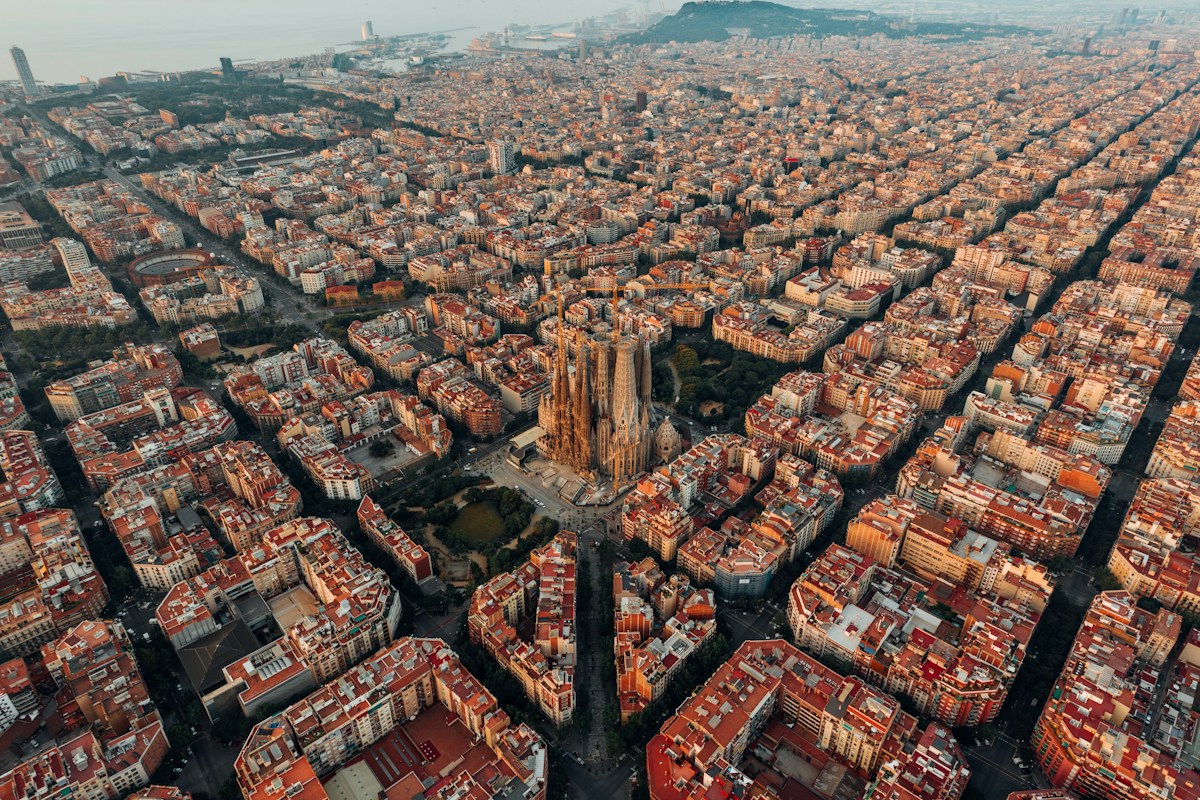
Ildefons Cerdà designed the Eixample in 1860 as a democratic experiment — equal blocks, chamfered corners to let light pool at intersections, a grid that refused to privilege one neighborhood over another. Walk it on a Tuesday morning and you feel the logic still working. The chamfers at the crossing of Carrer del Consell de Cent and Carrer de Girona are nothing special on paper, but stand there at 9 a.m. when the bakeries are open and the light comes in low from the east, and the whole system reveals itself. Barcelona did not grow accidentally. It was argued into existence, and the argument was about who deserves sunlight.
Gaudí is not the point, the obsession is
The Sagrada Família will confuse you the first time — too much information arriving at once, the stone almost biological, the nave somehow managing to feel both Gothic and entirely new. Most visitors walk through it once and file it under impressive. We'd suggest going back at dusk when the stained-glass windows on the western façade throw amber and gold across the central nave floor, and the tour groups have largely thinned. The building is not trying to be admired from a distance. It is trying to surround you. Gaudí worked on it for over forty years and never finished it. That incompleteness is the point — the city has always been more interested in the act of making than in arrival.
The market is not theater
La Boqueria on La Rambla has become a performance of itself, most of its stalls now aimed at tourists who want a photogenic smoothie. But walk through it rather than stopping in it, and continue another four minutes west to the Mercat de Sant Antoni, which completed a decade-long renovation in 2015 and returned to the people who actually use it. On a Saturday morning the surrounding streets fill with a secondhand book and vinyl market. Inside, a fishmonger named Manel has sold cockles and razor clams from the same spot for years. The smell is cold seawater and stone. Nothing is curated. People are doing their shopping.
Barcelona did not grow accidentally. It was argued into existence, and the argument was about who deserves sunlight.
The sea is an afterthought they're correcting
For most of its modern history, Barcelona turned its back on the Mediterranean. The waterfront was industrial, inaccessible, forgotten by the city that nominally faced it. The 1992 Olympics changed the geography — beaches were built, the Barceloneta neighborhood was reconnected, the Port Olímpic created — but the relationship between city and sea still feels like a reconciliation in progress. Stand on the Passeig Marítim at 7 a.m. before the heat arrives. The water is flat and the color of pewter and the palm trees cast long shadows across the promenade. Older residents swim from the breakwater. It doesn't feel like a resort. It feels like a city that is still deciding what the sea means to it.
Modernisme is everywhere you're not looking
Everyone comes for the Palau de la Música Catalana, and they should — the concert hall Lluís Domènech i Montaner completed in 1908 is genuinely overwhelming, the stained-glass skylight alone worth the entry fee. But Modernisme bled into everything. Pharmacy facades, lamp posts, the tiled floors of old apartment lobbies. The Farmàcia Bolós on Rambla de Catalunya has a mosaic exterior that stops people mid-stride without them always knowing why. The style was never reserved for monuments. It was a collective agreement that beauty belonged in the daily texture of life, not just in the places you paid to enter.
The evening meal is a structural feature
Dinner before 9 p.m. marks you as a visitor. This is not snobbery; it is biology. By the time Barcelona eats, the worst of the heat has broken and the streets have cooled and conversation becomes possible again. At a place like Bar Calders in the Sant Antoni neighborhood, the terrace fills slowly after 9:30 — vermut on the table, anchovies, bread with tomato — and the meal becomes less about the food than about the resumption of the day's real work, which is talking. The city organizes itself around that hour the way other cities organize around the morning commute. If you fight the timing, you miss the whole rhythm of the place.
Advertisement