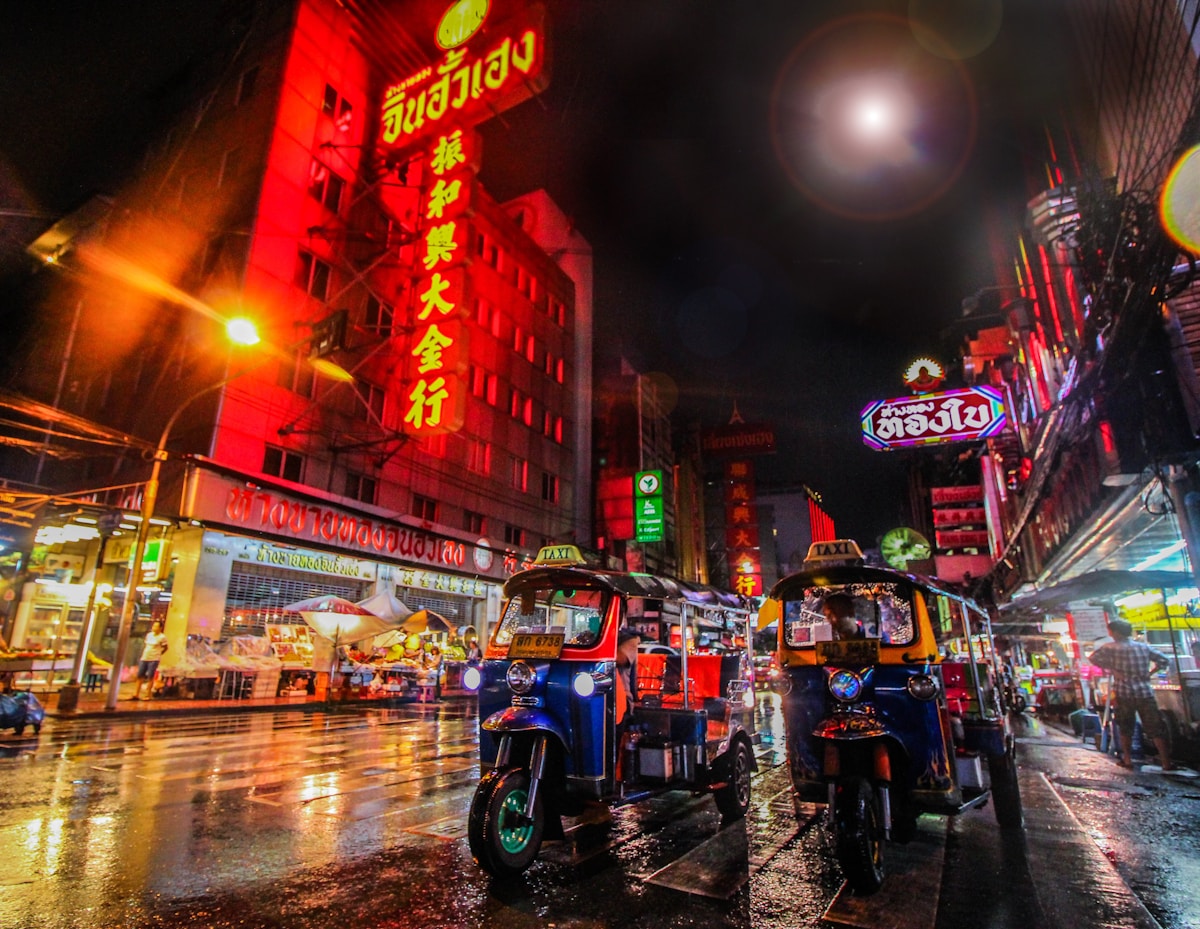
Bangkok rewards the patient traveler
Thailand's capital is not a city you decode on the first visit — and that's exactly the point.
Advertisement
The city doesn't meet you halfway
Bangkok has no interest in being easy. The skytrain deposits you into a corridor of malls and air-conditioned lobbies that could belong to any prosperous Asian city, and for a moment you wonder if you've misjudged the whole enterprise. Then the elevator opens onto street level and the heat arrives like a physical fact — wet, specific, carrying the smell of frangipani and diesel and something frying in oil that has been used all day — and the city becomes entirely itself. We've arrived here in June, when the monsoon is properly underway, and the afternoon rain comes down with such conviction that strangers crowd together under awnings without speaking, watching the gutters fill. There is an enforced intimacy to it. Bangkok makes its own schedule, and you adjust.
The river is the oldest argument for staying
Whatever brought the city here in the first place was the Chao Phraya, and the river still holds an authority that the expressways and the Skytrain have never quite displaced. Take the cross-river ferry from Tha Tien pier — not the tourist longtail, the orange-flag local ferry, twelve baht, standing room only — across to Wat Arun at dusk, when the prang is catching the last direct light and the porcelain mosaic work turns from white to something close to gold. The crossing takes four minutes. The ferryman doesn't look up. That indifference is the point: this is a commuter route, a piece of ordinary city infrastructure, and you are briefly inside it rather than watching it from outside. The temple on the other bank, seen from the water at that hour, is one of the more beautiful things we've encountered in twenty years of coming to this city.
Eating here is an act of faith in strangers
We've stopped trying to research our way through Bangkok's food and started trusting proximity and smell instead. At Jay Fai on Mahachai Road, where the cook still works the charcoal woks herself behind enormous goggles, you will wait a long time and spend more than you expect to for a crab omelette that arrives the color of old brass, crisp at the edges and molten at the center. It is worth both the wait and the expense. But the larger lesson Bangkok teaches is that the cook at the folding table outside your hotel at seven in the morning — the one with the single gas ring and the vat of broth she started before you were awake — is operating with the same seriousness. The food is the argument Bangkok keeps making, quietly, all day long.
Bangkok has no interest in being easy, and that is exactly its most reliable quality.
Temples require more than a morning
Wat Pho is one of the most visited places in the country, which means most people move through it quickly, photograph the reclining Buddha's mother-of-pearl feet, and leave. We've found that arriving when it opens at eight, before the tour groups have organized themselves, and simply sitting in the courtyard for a while changes the calculation entirely. The complex has ninety-one chedis. We've never counted them all. Monks cross between buildings in saffron that is almost too saturated to be a real color. There's the sound of a broom on stone somewhere behind a wall. The slowness of the place is not picturesque idleness — it is functional, purposeful, and it has been here in one form or another since the sixteenth century. A little humility about your itinerary is appropriate.
The neighborhoods shift faster than the guidebooks can track
Talat Noi, the old Chinese trading district along the river south of Chinatown, has been changing for the better part of a decade — small bars and design studios moving into shophouses that stored machine parts and rope a generation ago. The bones of the neighborhood predate all of it: the Kuan Iam Shrine at the end of a narrow soi has been receiving offerings since the nineteenth century, and on the morning we visited, an older woman was arranging oranges at the altar with the focused attention of someone who does this every day, because she does. The incense smoke went up into a ceiling stained a particular shade of amber that takes many years and many sticks to produce. Bangkok accumulates. That's what it does.
What the city asks of you, finally
We think Bangkok is best understood as a city that reveals itself proportionally to the time you give it — not the tourist sites, not the rooftop bars (though some of those are fine), but the slow exposure to a place that contains multitudes without curating them for export. Come in June when it rains. Ride the ferry. Eat the omelette. Sit in the courtyard until you stop thinking about what else you should be doing. The city will not tell you when you've understood it, because you won't, not fully. That is, in our experience, the only honest reason to keep coming back.
Advertisement