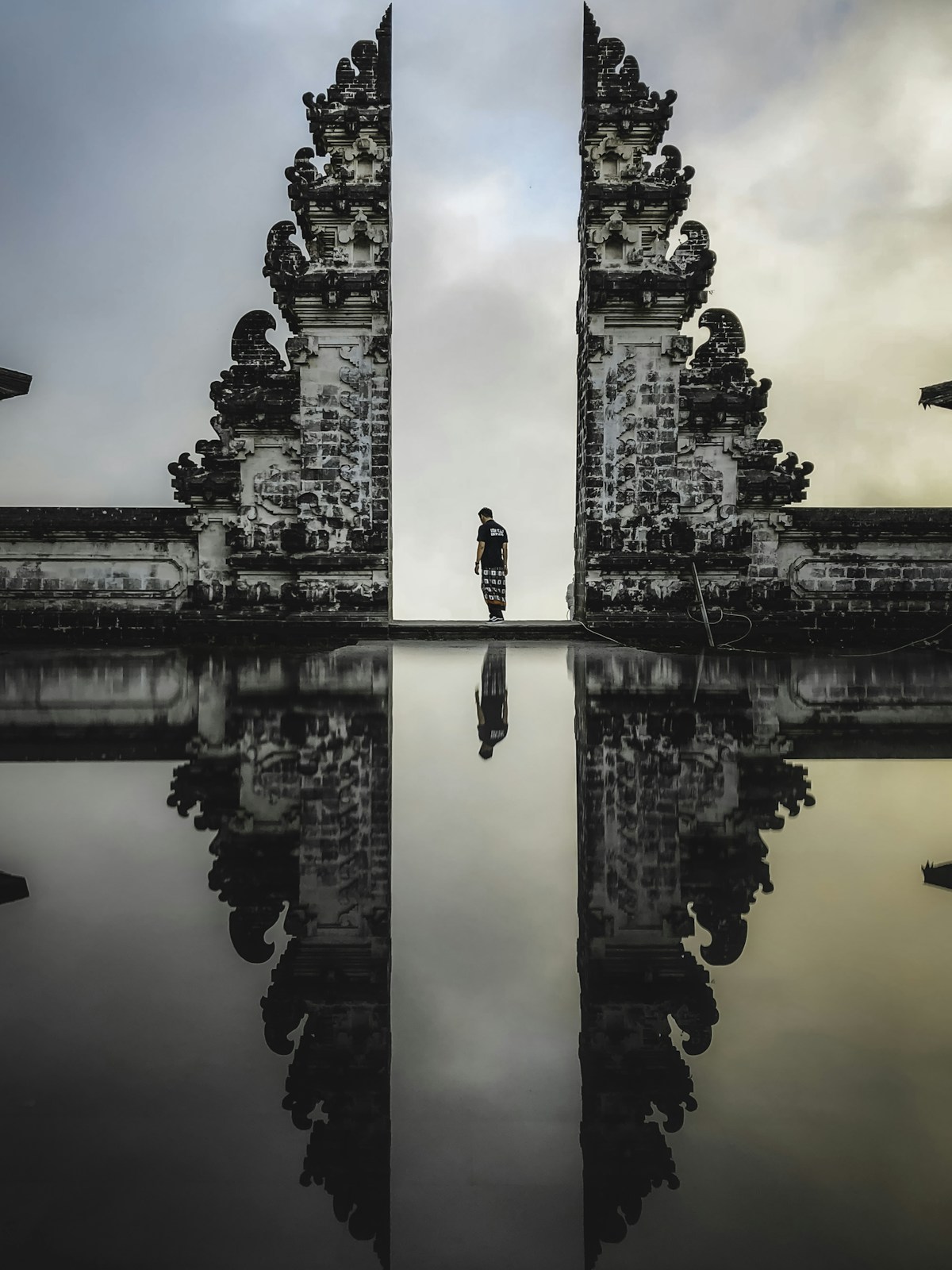
Bali keeps changing. the light never does.
Twenty years of tourist pressure haven't dulled the island's capacity to stop you cold.
Advertisement
What arrives before the chaos does
We always land at night. Ngurah Rai delivers you into warm, particulate air that smells of clove smoke and something floral you can never quite name — frangipani, probably, mixed with the incense burning at the small shrine beside the taxi rank. The chaos of Kuta is close, and we know it's there, but in that first dark minute outside the terminal there is a quality of stillness that the island keeps offering even when you least expect it. Bali has been written about so relentlessly for so long that it can feel pre-digested before you arrive. It isn't. The place still insists on itself.
The rice terraces ask you to slow your eyes
The Jatiluwih terraces in Tabanan regency are a UNESCO inscription that has somehow avoided becoming purely a backdrop for photographs, possibly because they are genuinely difficult to take in. The scale is wrong for a single frame. Sixteen hundred hectares of hand-cut paddies step down from the flanks of Batukaru in a green so saturated it reads almost false, especially in the hour after rain when the water lying in the newly planted fields mirrors a sky that is already trying to clear. The subak system — the nine-century-old cooperative irrigation network that maintains all of this — is still functioning, which means the landscape is a working document rather than a monument. Farmers move through it at their own pace and pay no attention to anyone standing at the viewing platforms with a phone raised.
Ubud is crowded and still worth your full attention
We are not going to pretend that central Ubud on a Saturday afternoon is a contemplative experience. Monkey Forest Road is loud, and the traffic on Jalan Raya Ubud moves with a kind of performative stubbornness. But the Puri Saren Agung — the royal palace at the main crossroads — holds evening dance performances in a torchlit courtyard that reframe everything around them. The Legong is precise to the point of severity: the dancers' eyes move in prescribed patterns, their fingers curve back at angles that suggest a different relationship between joints and intention than the one we were born with. The gamelan sits in a corner of the courtyard and fills the air with a metallic shimmer that you feel in your back teeth as much as you hear it. That combination, the formal geometry of the movement against the resonant clatter of the music, is not reducible to atmosphere. It is a specific argument about how the body should move through the world.
The daily offerings appear on sidewalks and dashboards. Nobody is making them for us.
The coast south of Candidasa rewards patience
The stretch of black-sand beach near Jasri, east of Candidasa, sees far fewer visitors than the Bukit Peninsula, partly because the surf is inconsistent and partly because the accommodation options remain modest. We went for the light. In the late afternoon, the volcanic sand holds heat and turns the low sun back at you in a way that makes the whole beach feel slightly overexposed, like a photograph taken without compensation. Outrigger fishing boats sit above the tide line in colors — cobalt, ochre, a particular dusty red — that the fishermen choose for reasons having nothing to do with aesthetics and everything to do with availability, which produces combinations no designer would have approved and which are consequently perfect.
The food is an argument, not a backdrop
Babi guling — the spit-roasted pork that appears at ceremonies and, increasingly, at dedicated warungs — is correctly famous. At Ibu Oka's original location on Jalan Suweta in Ubud, you eat at communal tables and receive a plate that contains at least four distinct preparations of the same animal: the crackling, the meat, the lawar, the offal minced with raw blood and toasted coconut. It is not a gentle introduction. The flavors are layered with turmeric and galangal and a shrimp paste earthiness that lingers considerably. The point is not heat, exactly, though there is heat. The point is density — the sense that someone has been thinking about this particular combination of flavors for a very long time and has arrived somewhere considered.
What the island is actually offering
Bali's longevity as a destination rests on something that doesn't photograph well: a culture that is still genuinely engaged with its own ceremonial life, to a degree that makes you feel like a passerby rather than the intended audience, which is the correct feeling to have. The daily canang sari offerings — small woven palm-leaf trays holding flowers, rice, and incense — appear on sidewalks, on dashboards, at the base of trees, and on the shrines that occupy a corner of every compound. They are made fresh each morning and left to be stepped over and rained on. Nobody is making them for us. That indifference is the most honest thing the island has to say, and it's worth traveling a long way to hear.
Advertisement