In This Guide
The air in Ban Xang Khong sits heavy and sweet in late May, carrying the wet-earth scent of mulberry bark soaking in tin basins outside wooden workshops. Three kilometres east of Luang Prabang's gilded temple circuit, this slender village stretches along the Mekong's high bank like a drying sheet of saa paper — pale, textured, catching light. Before the monsoon rewrites the river's margins entirely, this is the window to witness a craft tradition older than any night market stall.
This guide traces a single unhurried day through Ban Xang Khong and its quieter neighbour, Ban Xieng Lek, from early-morning bark pounding to a riverside supper of Mekong riverweed and laap. It matters because the village's mulberry paper workshops are thinning — younger artisans migrate to Vientiane, and tourist foot traffic rarely ventures past the first shopfront. What follows is a route into the deeper rooms, the family kitchens, and the specific hours when the work and the light align.
1. Morning Bark Pounding at Anousone's Workshop
Arrive by 7:30 a.m., before the heat stiffens. Anousone Khambay's family workshop sits midway along Ban Xang Khong's single lane, identifiable by the wooden frames leaning against the fence and the rhythmic thud of mallets on soaked mulberry bark. His mother, Bua, has been making saa paper here for over forty years. She works barefoot on a low platform, pulling fibres apart with practised hands.
The process is deceptively simple: stripped bark from poh saa trees is boiled for hours, rinsed, then beaten into a slurry that gets poured over mesh screens. Flower petals, fern fronds, and coloured thread are pressed into the wet pulp before the frames go out to dry in the sun. The entire cycle takes roughly five hours, weather permitting.
Anousone will walk you through each stage if you ask — he speaks clear English and charges nothing for the tour, though purchasing a sheet or two is the understood exchange. His signature product is a heavy-grade paper embedded with marigold petals, sold for around 30,000 kip per A3 sheet. You won't find this weight in the Luang Prabang boutiques.
Avoid the temptation to photograph Bua without greeting her first. A simple nop — palms together, slight bow — earns you unhurried access. She'll sometimes gesture for you to try the mallet yourself, and your clumsy strokes will make her laugh.
Pro tip: Ask Anousone about his naturally dyed sheets — indigo and jackfruit wood produce colours that synthetic dyes cannot replicate. He keeps these in a back room and rarely displays them unless prompted.
2. The Quieter Studios of Ban Xieng Lek
Continue east on foot for ten minutes past the village temple and you cross into Ban Xieng Lek, where a handful of families produce paper with less tourist infrastructure and more rawness. The road narrows to packed earth. Look for the house of Mrs. Khamla near the village well — her frames dry on bamboo racks beside a papaya tree and she specialises in paper lanterns rather than flat sheets.
Khamla's lanterns are cylindrical, reinforced with fine bamboo ribs, and intended for Boun Ok Phansa festival floats. She produces them year-round, stacking them in a dim front room that smells of wet pulp and woodsmoke. Each lantern takes a full day. She sells them for 50,000 to 80,000 kip, depending on size, and will custom-embed botanical elements if you wait.
This is also where you see the boiling stage clearly. An outdoor hearth with a blackened aluminium pot renders the bark soft enough to pull apart. The fire burns mulberry wood offcuts, closing the material loop entirely. It's unglamorous and slightly acrid, and it's the part most visitors never see because they stop at the first workshop.
Bring a small gift — instant coffee sachets or fresh fruit from the Phousi Market — rather than offering cash. The social contract here is older and more specific than transactional tourism allows.
Pro tip:Mrs. Khamla's daughter, Noy, occasionally runs natural dyeing workshops using turmeric and indigo for around 100,000 kip per person. Message ahead via the village shop's phone number, posted on the community board near the temple.
Stay in Luang Prabang
Top-rated hotels near Luang Prabang
Best locations · Verified reviews · Free cancellation
View deals
Expedia →3. Midday Retreat: Khmu Weaving and Cold Beerlao at the Village Edge
By 11 a.m. the sun has turned punishing. Walk back toward Ban Xang Khong's western entrance where a small open-sided sala serves cold Beerlao and sticky rice with jaew bong, a spicy chilli paste made from buffalo skin and galangal. There's no sign — look for the red cooler box and the woman with a weaving frame on her lap. Her name is Thong, and she's Khmu, not Lao Loum, a distinction she'll clarify quickly.
Thong weaves cotton scarves on a backstrap loom while selling drinks. Her patterns — geometric, earth-toned — differ markedly from the Lao silk tradition you'll see in the night market. A scarf takes her three days and costs 150,000 kip. She doesn't bargain, and the price is already generous.
Order the jaew bong with a plate of sticky rice and a large Beerlao. Sit on the low bench and watch the drying paper frames warp slightly in the heat. This is the day's necessary pause — the village empties between noon and two, and pressing onward in the midday glare will earn you nothing but sunstroke.
If you want a second dish, Thong sometimes has tam mak hoong — Lao-style green papaya salad with padaek fermented fish paste — made that morning. It's sharper and funkier than the Thai version and built for this heat.
Pro tip:Thong closes her cooler by 1 p.m. and naps. Arrive by 11:30 to guarantee cold drinks and the jaew bong before it runs out. She doesn't restock midday.
4. Afternoon Light at the Mekong Bluff
From Thong's sala, a narrow footpath drops through bamboo toward the Mekong bank. In late May, before the monsoon floods arrive, the river runs low and jade-coloured, exposing sandstone ledges and gravel beaches. This is the hour — around 3:30 p.m. — when the light turns copper and the paper frames along the upper path glow translucent.
Bring your camera here, not to the workshops. The backlit saa paper stretched on wooden frames against the river backdrop is the image that defines this village, and the afternoon angle makes it possible without harsh shadows. Locals are accustomed to photographers and generally indifferent, but stay on the path rather than wandering onto private drying grounds.
The bluff itself offers an unobstructed upstream view toward the Pak Ou confluence. Fishermen sometimes set nets from long-tail boats below, and in the pre-monsoon weeks, the water is clear enough to see the gravel riverbed from twenty metres above. It's a stillness that feels borrowed — within weeks, this bank will be submerged under a metre of brown floodwater.
Sit here long enough and you'll understand why the village hasn't moved in centuries. The elevation protects it from all but the worst floods, the eastern exposure catches morning light for drying, and the mulberry trees crowd the slopes behind. Geography dictated craft.
Pro tip: The sandstone ledge roughly 200 metres upstream from the main path makes the best vantage point for photographing long-tail boats against the far bank. Footing is uneven — wear shoes with grip, not sandals.
5. Mekong Riverweed and Laap: Supper at Khaiphaen Restaurant
Return to Luang Prabang proper by late afternoon and head to Khaiphaen, on Kingkitsarath Road in the old town. Named after the Mekong riverweed snack that defines Luang Prabang's culinary identity, this social enterprise restaurant serves the single best plate of khaiphaen in the city — sheets of dried riverweed fried with sesame and tomato, shatteringly crisp.
Order the khaiphaen as a starter, then follow with laap khao — a warm Luang Prabang-style minced pork salad enriched with toasted rice powder and fresh herbs including phak phaew, a tart leafy green you won't find outside northern Laos. Ask for it pet — spicy. The kitchen here doesn't dumb down for tourists, which is exactly the point.
Pair everything with a glass of lao lao, the local rice whisky. Khaiphaen infuses theirs with honey and galangal, served over ice in a short tumbler. Two glasses is the right number. The restaurant seats perhaps thirty across two floors, and the upstairs balcony overlooking the street is where you want to be. Book ahead during high season; in May, you'll have your pick.
Khaiphaen trains and employs former street youth, and the service reflects a genuine pride in what's on the plate. Your bill funds vocational training directly. Expect to pay around 120,000–180,000 kip for two courses and drinks — extraordinary value for this calibre of cooking.
Pro tip:Ask your server about the seasonal or naa dish — Khaiphaen rotates a weekly special based on what's available at the morning market. The bamboo shoot stew, when offered in May, is exceptional.
Stay in Luang Prabang
Top-rated hotels near Luang Prabang
Best locations · Verified reviews · Free cancellation
View deals
Expedia →6. Night Walk: The Monk's Trace Along the Peninsula
After supper, walk south along Sakkaline Road toward the tip of the peninsula where the Nam Khan meets the Mekong. By 8 p.m. the tourist foot traffic thins to almost nothing past Wat Xieng Thong, and the streetlights give way to temple lanterns and the occasional motorbike headlamp. The air has cooled to something bearable, carrying jasmine from monastery gardens.
This walk takes roughly twenty-five minutes at a slow pace. You'll pass darkened shopfronts, a few late noodle vendors, and the quiet compounds where monks have already retired. The absence of noise is the point — Luang Prabang after sundown belongs to a different temporal register than the day-market bustle suggests.
At the peninsula's tip, a small public area overlooks the confluence. The Mekong runs dark and wide to the right; the Nam Khan is narrower, faster, louder over its rocky bed. In May, fireflies sometimes pulse in the bamboo on the far bank. Sit on the low wall and let the day's textures settle — bark fibres, river light, sesame-fried riverweed, the sound of a mallet on wet pulp.
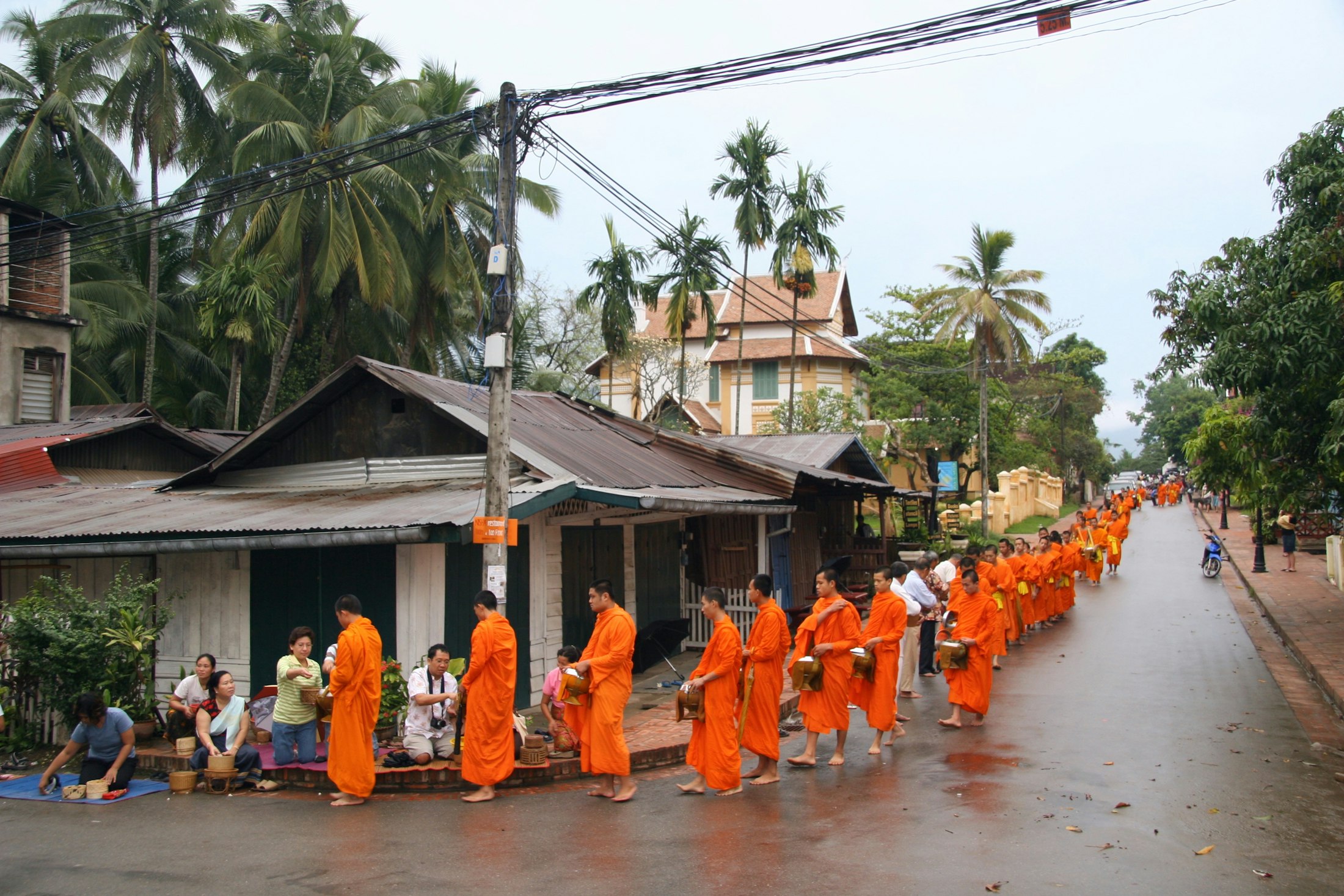
Return via the upper road past Wat Sop to complete the loop. Your guesthouse, wherever it is on the peninsula, is never more than fifteen minutes away. The alms-giving procession begins at dawn — if you intend to observe respectfully from a distance, set your alarm for 5:30 a.m. and stay behind the temple wall, not in the monks' path.
Pro tip: Carry a small headlamp for the final stretch past Wat Xieng Thong — the pavement is uneven and the street lighting ends abruptly near the confluence. Smartphone flashlights disturb the atmosphere; a red-mode headlamp does not.
Essential tips
Hire a tuk-tuk to Ban Xang Khong from the old town for 30,000–40,000 kip one way. Agree on a return pickup time or walk back along the river road in roughly 40 minutes. Cycling is feasible but the final stretch is uphill and exposed.
Carry small kip denominations — 10,000 and 20,000 notes — for village purchases. No workshop accepts cards, and breaking a 100,000 kip note in Ban Xieng Lek is nearly impossible. The nearest ATM is on Sisavangvong Road in the old town.
Late May sits on the monsoon's edge. Mornings are typically dry; afternoon squalls arrive by mid-June. Pack a compact rain shell and a dry bag for camera gear. If the rains come early, paper production pauses — call your guesthouse to confirm village activity before heading out.
Cover shoulders and knees in the villages, especially near temples. Ban Xang Khong's wat is active and monks pass through the main lane regularly. Lightweight linen trousers and a loose cotton shirt handle the heat without causing offence.
Mosquitoes intensify at dusk along the Mekong bank. Apply DEET-based repellent before the afternoon bluff visit and again before the night walk. Dengue risk rises sharply in pre-monsoon weeks — long sleeves at sunset are non-negotiable, not optional.
Ready to visit Luang Prabang?
Book your hotel, flights, and activities through our Expedia-powered search.


