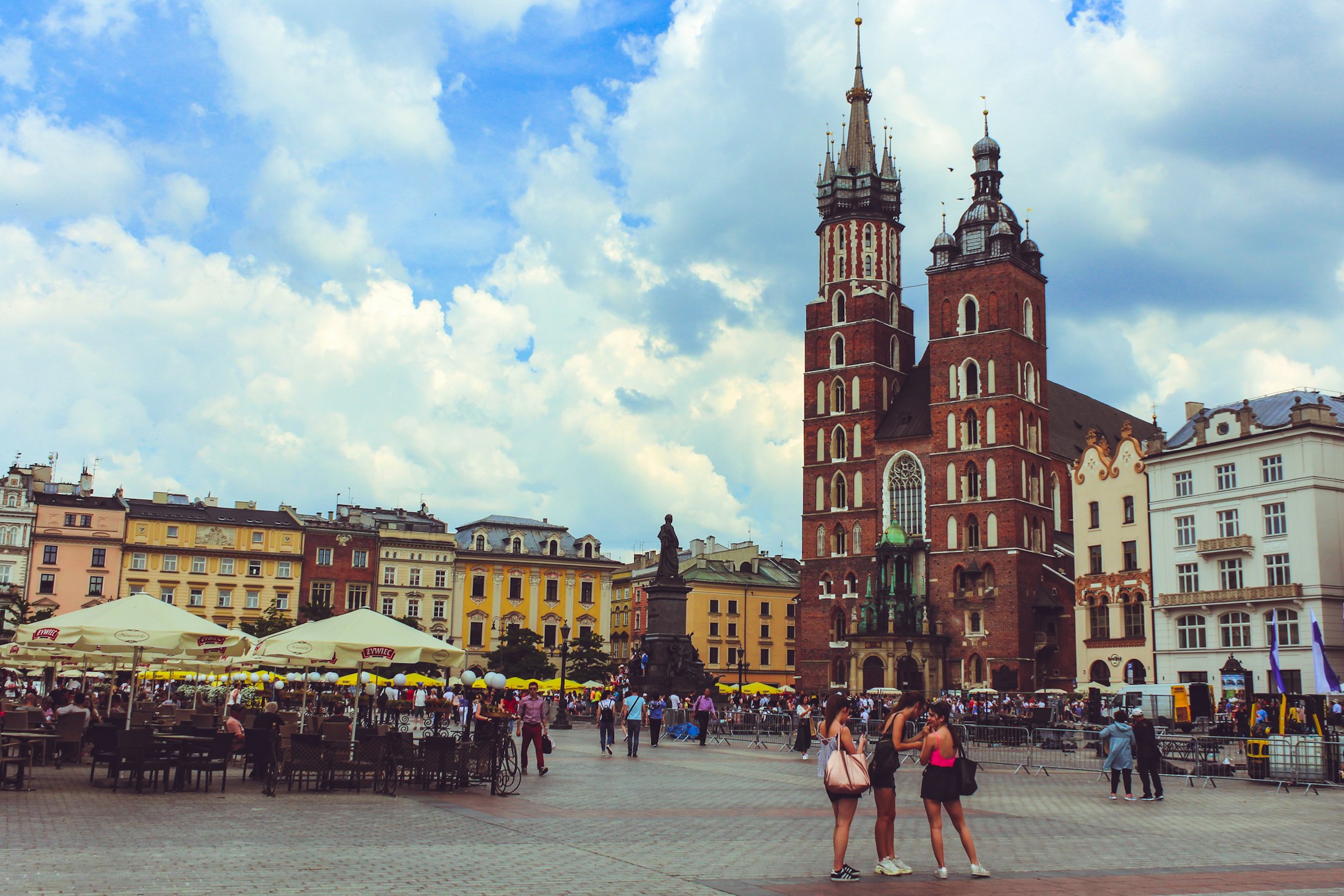
In This Guide
- 1.Arriving in the Socialist Utopia: Reading Plac Centralny
- 2.Bar Mleczny Ekonomiczny: The Last Honest Lunch in Kraków
- 3.The Secret Allotment Gardens of Nowa Huta
- 4.The Lord's Ark: Nowa Huta's Defiant Church
- 5.Nowa Huta Meadows: Kraków's Overlooked Green Lung
- 6.Stara Piekarnia and the New Wave of Nowa Huta Cafés
- 7.Walking the Ideal City: A Self-Guided Architecture Route
The morning light hits differently in Nowa Huta. It slides across vast socialist-realist façades, catches the limestone edges of arcaded walkways, and pools in the central meadow of Plac Centralny — a roundabout so grand it could swallow a small village. In May, the linden trees are frothing with new growth, elderly residents tend rose beds with surgical precision, and the district hums with a warmth that most tourists speeding toward Wawel Castle will never encounter.
This guide takes you deep into Kraków's planned socialist district — not for Soviet kitsch tourism, but for the living neighbourhood it has become. You'll eat at milk bars where a full lunch costs less than a flat white on the Main Square, slip through gates into allotment gardens exploding with May blossoms, and discover why Nowa Huta is quietly becoming the most compelling neighbourhood in one of Europe's most visited cities.
1. Arriving in the Socialist Utopia: Reading Plac Centralny
Start at Plac Centralny, the radial heart from which Nowa Huta's avenues fan outward like the fingers of an open hand. The district was designed in 1949 as a model workers' city, and the layout borrows unapologetically from Renaissance urban planning — think Versailles reinterpreted through Stalinist optimism. Stand at the centre and slowly turn. Every sightline is deliberate, every axis calibrated to make you feel like a citizen of consequence.
The architecture here is not the grey brutalism most visitors expect. These are handsome, arcaded apartment blocks in warm ochre and cream, built with genuine craftsmanship by the workers who would inhabit them. Look up at the decorative reliefs above doorways — sheaves of wheat, cogwheels, muscular figures — propaganda frozen in plaster, now simply part of the streetscape.
Walk east along Aleja Róż, the Avenue of Roses, where in May the namesake bushes are beginning their first flush. Residents sit on benches reading Gazeta Wyborcza, children cycle on wide pavements, and the absence of tourist infrastructure feels almost disorienting after central Kraków.
For context before your walk, stop at the Nowa Huta Museum at os. Słoneczne 16, where photographs and original apartment furnishings document the district's social experiment. Entry is twelve złoty, and the English-language panels are thorough without being overwhelming.
Pro tip: Visit Plac Centralny before 9 a.m. on a weekday morning. The light is extraordinary, the wide boulevards are nearly empty, and you can photograph the full radial symmetry without cars or crowds obstructing sightlines.
2. Bar Mleczny Ekonomiczny: The Last Honest Lunch in Kraków
Milk bars — bar mleczny — are Poland's subsidised canteens, relics of the communist era that survive because they remain genuinely essential. Bar Mleczny Ekonomiczny, inside a residential block at os. Złotego Wieku 12, is among the most authentic in Kraków. There is no English menu. There is no Instagram signage. There is a handwritten board, a queue, and food that arrives on heavy ceramic plates within minutes.
Order the pierogi ruskie — dumplings stuffed with potato and twaróg cheese, pan-fried until the edges blister — and a bowl of żurek, the sour rye soup served with half a hard-boiled egg and a chunk of white sausage. Together they will cost you roughly fourteen złoty, which at current exchange rates is about three euros. The żurek is especially good here, deeply fermented and slightly smoky.
The dining room is fluorescent-lit and linoleum-floored, shared with pensioners, construction workers, and the occasional university student. Etiquette is simple: know what you want before you reach the counter, pay immediately, bus your own tray. Lingering is acceptable; performative photography is not.
If Ekonomiczny is closed — hours can be erratic — walk ten minutes west to Bar Mleczny Centralny on os. Centrum C1. The placki ziemniaczane, crisp potato pancakes with a sidecar of sour cream, are the sleeper hit there.
Pro tip:Milk bars typically serve their best dishes between 11:30 a.m. and 1 p.m. Arrive after 2 p.m. and you'll find half the menu crossed out. Go early, eat like a local, and treat it as your main meal of the day.
Stay in Krakow
Top-rated hotels near Krakow
Best locations · Verified reviews · Free cancellation
View deals
Expedia →3. The Secret Allotment Gardens of Nowa Huta
Behind the monumental apartment blocks, accessed through unmarked gates and narrow passages between buildings, lie Nowa Huta's allotment gardens — działki. These small plots, some no larger than a generous living room, have been cultivated by residents since the 1950s. In May: cherry trees in full blossom, tulips rioting in every colour, runner beans spiralling up improvised trellises, tiny sheds painted in improbable blues and greens.
The largest concentration is found behind the blocks along os. Wandy and os. Na Skarpie, stretching toward the Nowa Huta Meadows. There are no official visiting hours and no entrance fee — these are private plots on communal land. Walk quietly, respect boundaries, and if a gardener waves you over, accept graciously. You may be offered tea, radishes, or a lengthy monologue about soil composition.
The gardens were originally allocated to steelworkers from the nearby Lenin Steelworks as a concession to rural nostalgia — many had been peasant farmers before the district recruited them. Today, the plots pass through families like heirlooms, and waiting lists for new allotments can stretch years.
May is unquestionably the finest month to visit. The lilac is at peak bloom, filling entire alleyways with perfume so dense it's almost narcotic. Apple and pear trees are covered in blossom. Elderly gardeners are out in force, turning soil, planting seedlings, and engaging in the gentle competitive surveillance that defines allotment culture everywhere.
Pro tip:Enter the allotment area behind os. Wandy 7 through the small metal gate between buildings. It's unlocked during daylight hours. Bring a Polish phrasebook — a simple 'dzień dobry' and a compliment about someone's roses opens every door.
4. The Lord's Ark: Nowa Huta's Defiant Church
The Arka Pana — Lord's Ark Church — at ul. Obrońców Krzyża 1 is one of the most extraordinary ecclesiastical buildings in Europe, and its backstory is as dramatic as its architecture. The communist authorities deliberately designed Nowa Huta without a single church, intending a godless workers' utopia. Residents, overwhelmingly Catholic, fought back for two decades. There were riots, hunger strikes, and a covert blessing of the site by the then-Bishop Karol Wojtyła — the future Pope John Paul II.
The church, finally completed in 1977, is a modernist masterpiece shaped like a ship's hull — hence the name. The exterior is clad in roughly two million pebbles, collected and donated by parishioners from rivers across Poland. Inside, the cavernous nave opens into a cascade of steel, concrete, and stained glass that feels more like a concert hall than a parish church.
Look for the tabernacle crafted from metal fragments donated by steelworkers, and the monumental figure of Christ made from shrapnel collected from Second World War battlefields. Every material in this building carries a story of resistance and devotion that predates the solidarity movements most history books focus on.
Visit on a weekday morning when the church is quiet. The interior light in May, filtered through the abstract stained glass, creates pools of cobalt and amber across the stone floor. Photography is permitted but keep your shutter silent during any ongoing prayer. A small English booklet is available near the entrance for a voluntary donation.
Pro tip:Attend the 7 p.m. Sunday Mass even if you aren't religious. The acoustics are phenomenal, the congregation fills the vast nave, and you'll witness the church functioning as the community anchor it was always intended to be.
5. Nowa Huta Meadows: Kraków's Overlooked Green Lung
East of the residential blocks, the landscape suddenly opens into the Łąki Nowohuckie — the Nowa Huta Meadows. This protected wetland stretches along the Dłubnia River and in May transforms into a wildflower prairie. Buttercups, cuckoo flowers, and marsh marigolds carpet the low-lying fields, and the birdsong is extraordinary: warblers, corncrakes, and the unmistakable drilling of lesser spotted woodpeckers.
A gravel path loops through the meadows, manageable in about ninety minutes at a contemplative pace. The ground can be soft after spring rain, so wear shoes that can handle mud. Benches are positioned at intervals, and there is precisely one small kiosk near the Przylasek Rusiecki end selling water and ice cream — do not count on it being open.
The meadows are best in early morning or late afternoon, when the low light gilds the grasses and the local dog-walking population thins. You are unlikely to see another tourist. Skip the overpriced Segway tours of Nowa Huta that depart from the Old Town — they barrel through in forty minutes and miss everything that matters. Come here on foot instead.
From the meadows, you can see the distant cooling towers of the former Lenin Steelworks — now ArcelorMittal — still operational and still employing thousands. Heavy industry and delicate wetland ecology, coexisting within a single sightline.
Pro tip:Download the Merlin Bird ID app before visiting. The meadows host over ninety bird species in spring, and the app's sound recognition feature will help you identify the warblers whose songs saturate the reed beds along the Dłubnia.
Stay in Krakow
Top-rated hotels near Krakow
Best locations · Verified reviews · Free cancellation
View deals
Expedia →6. Stara Piekarnia and the New Wave of Nowa Huta Cafés
Nowa Huta's café culture was, until recently, limited to grim institutional buffets and corner shops selling Nescafé from a jar. That is changing. Stara Piekarnia, at os. Centrum A8, occupies a former bakery and serves single-origin filter coffee, house-baked szarlotka, and natural wines by the glass — all inside a stripped-back space where the original tiled walls and bread ovens have been preserved.
Order the szarlotka — Polish apple cake — warm, with a scoop of homemade lody śmietankowe, a cream ice that tastes like frozen crème fraîche. The coffee is roasted by Kraków's Karma roastery, and the baristas know what they're doing. On a May afternoon, the courtyard tables catch the sun until nearly seven, and the crowd is a genuine cross-section: young architects, retired steelworkers, mothers with prams.
Łaźnia Nowa theatre at os. Szkolne 25 programmes experimental Polish theatre and hosts occasional open-air events in the surrounding courtyards. Check their schedule — in May, they often run site-specific performances that use the district's architecture as a stage set.
The milk bars and the speciality coffee shops coexist without irony, separated by a courtyard and sixty years of economic transformation. I'd argue Nowa Huta is more honest about Poland's layered identity than anywhere in Kraków's tourist centre, which has largely been sanded down into a backdrop for stag weekends.
Pro tip: Stara Piekarnia closes relatively early — usually 7 p.m. on weekdays, 5 p.m. on Sundays. Plan your coffee stop for mid-afternoon and pair it with a visit to the nearby Nowa Huta Cultural Centre to check gallery listings.
7. Walking the Ideal City: A Self-Guided Architecture Route
Nowa Huta rewards careful walking more than any other district in Kraków. Begin at Plac Centralny and take Aleja Solidarności northward, noting how the buildings transition from ornamental socialist classicism — pilasters, cornices, decorative ironwork — to the starker prefabricated panels of the 1960s and 70s. This architectural timeline is legible on every block and tells the story of a utopian project slowly losing funding and faith.
Pause at os. Szklane Domy, the Glass Houses estate, where an experimental 1960s housing project attempted to bring modernist transparency to workers' housing. The large windows and open-plan layouts were revolutionary for their time. Today the blocks look weathered but retain a geometric elegance, and the mature trees planted at their construction now form a dense canopy overhead.
Continue to the Combinat Gate — the main entrance to the former steelworks — at the eastern end of Aleja Solidarności. The monumental gate, flanked by administrative buildings in stripped Stalinist classical style, is where thousands of workers once streamed in for shift changes. It is also where, in 1988, strikes erupted that contributed directly to the fall of communism.
The full walk takes roughly two and a half hours without stops. Wear comfortable shoes — Nowa Huta's scale is generous and the distances between landmarks are real. Carry water, because cafés are sparse between the residential zones and the industrial fringe.
Pro tip: Grab the free Nowa Huta walking map from the tourist information point on os. Centrum — it marks buildings by construction date and architectural style, turning an aimless stroll into a genuinely informative urban history lesson.
Essential tips
Take tram lines 4 or 10 from Kraków's Old Town directly to Plac Centralny — the ride takes about 25 minutes and costs 4.60 zł for a single ticket bought from the machine on board. Validate immediately upon boarding.
English is not widely spoken in Nowa Huta's milk bars and older shops. Learn basic Polish phrases: 'poproszę' (please/I'd like), 'dziękuję' (thank you), and 'rachunek' (the bill). Effort is always appreciated and frequently rewarded with better service.
Carry cash in small denominations. Many milk bars and kiosks do not accept cards, and the nearest ATMs are clustered around os. Centrum. A full day in Nowa Huta — food, museum, transport — can cost under 80 złoty per person.
Be thoughtful about photographing residents, especially in the allotment gardens and milk bars. These are private spaces in a neighbourhood that has spent decades being exoticised by tour groups. Ask permission, or focus your lens on architecture and landscape.
May weather in Kraków swings between 22°C sunshine and sudden cold rain. Layer a light waterproof over a T-shirt, and carry a compact umbrella. The meadows and allotments offer no shelter when a downpour arrives.
Ready to visit Krakow?
Book your hotel, flights, and activities through our Expedia-powered search.


