In This Guide
- 1.The Attarine Medersa: Where Perfume Gave a School Its Name
- 2.Mustapha Blaoui's Workshop: A Distillation in Real Time
- 3.Lunch at Café Clock: Rose Harissa and Camel Burger
- 4.The Henna Souk's Secret Apothecaries
- 5.Hammam Sidi Aziz: Bathing in Orange Blossom
- 6.The Jnan Sbil Gardens at Dusk: Where Perfumers Sourced Jasmine
- 7.Sourcing Authentic Rose Products to Bring Home
In May, when the Dadès Valley rose harvest floods Moroccan souks with fragrant petals, something quieter happens inside the medina of Fez. Steam drifts from copper stills tucked behind unmarked doors, carrying the scent of damask rose, orange blossom, and bitter herbs through alleyways too narrow for sunlight. This is the season when the city's last traditional perfumers — attarine — begin their most important distillations, working with methods unchanged since the Marinid dynasty.
This guide traces a route through Fez el-Bali following that rose-scented steam to the workshops, hammams, and gardens where traditional perfumery still breathes. You'll meet artisans who measure ingredients by intuition rather than formula, discover where to find genuine rose absolutes before middlemen dilute them, and learn why May represents both the peak and potentially the twilight of a craft that once defined this city's intellectual identity. Consider it a sensory map for a tradition running out of time.
1. The Attarine Medersa: Where Perfume Gave a School Its Name
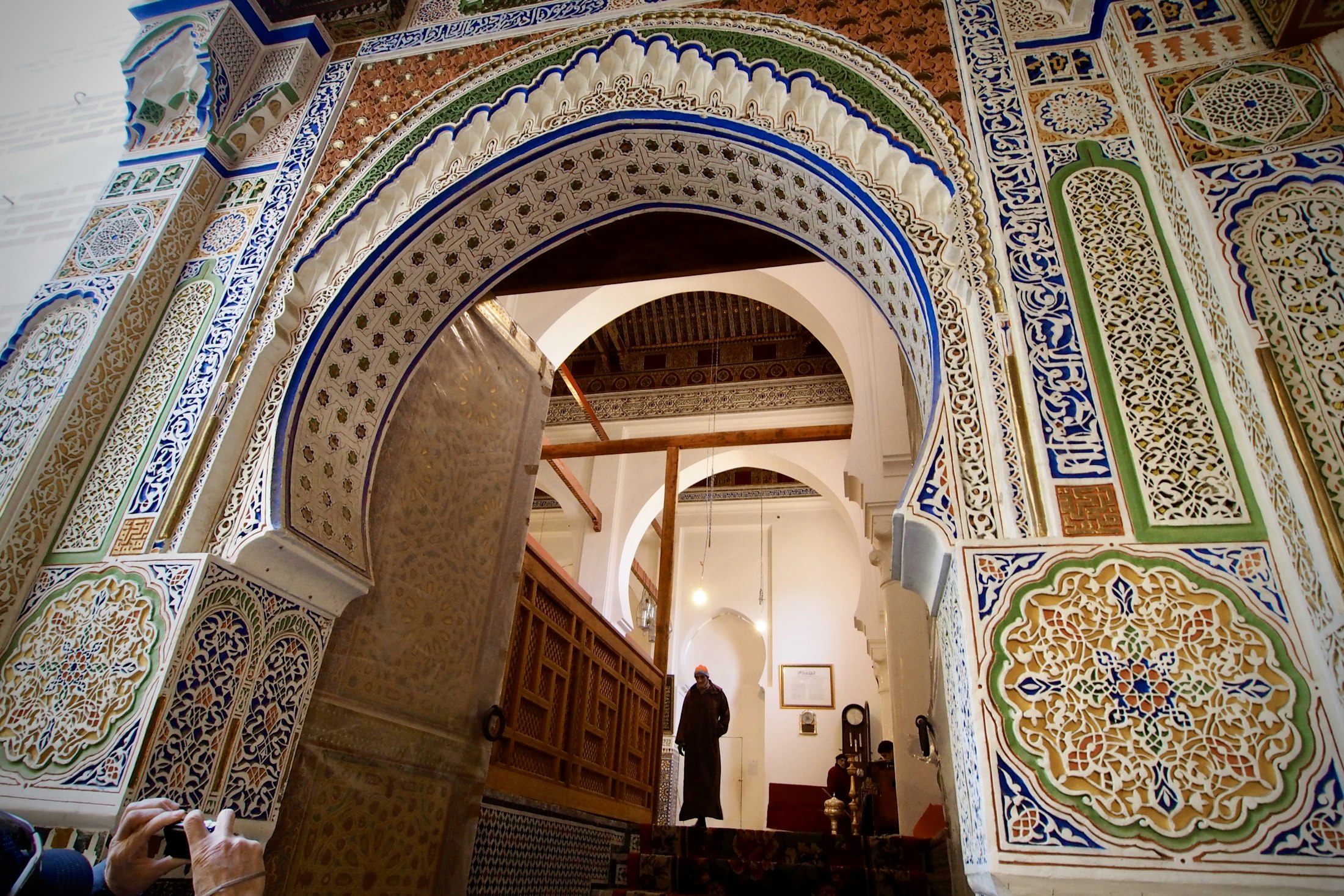
Start where the word itself lives. The Attarine Medersa, just steps from the Qarawiyyin Mosque on Derb el-Attarine, takes its name from the spice-and-perfume merchants who once dominated this exact stretch. In May, the courtyard's carved cedarwood still releases resinous warmth in afternoon heat, a scent the 14th-century builders deliberately engineered into the architecture.
Pay the 30-dirham entry fee early, before 9:30 AM, when you'll have the zellige-tiled courtyard nearly to yourself. Stand at the central fountain and look up — the geometric stucco work above was designed to catch and circulate air downward, functioning as an aromatic ventilation system when incense burned during lectures below.
The street outside once housed over forty attarine shops. Today, three remain. The most authentic is the unmarked stall of Haj Mohammed Benchekroun, identifiable by the blackened copper alembic visible through the doorway. He speaks limited French but will gesture you inside if you approach with patience rather than a camera.
Don't purchase anything on this first stop. You're calibrating your nose here. Smell the cedar, the residual frankincense embedded in old plaster, the distant thread of rose. This sensory baseline will help you detect synthetic imposters later in the day when vendors in the main souk offer suspiciously cheap rose oil.
Pro tip:Ask any shopkeeper on Derb el-Attarine for 'ma ward beldi' — local rosewater — rather than 'ma ward.' The word 'beldi' signals you know the difference between artisanal and industrial product, and prices drop accordingly.
2. Mustapha Blaoui's Workshop: A Distillation in Real Time
Deep in the Seffarine quarter, where coppersmiths hammer cauldrons into shape, Mustapha Blaoui runs what may be Fez's last full-cycle perfume atelier. His workshop on Derb Seffarine has no sign — look for the green door adjacent to the bronze-workers' fondouk. In May, he distills fresh roses delivered overnight from Kelaat M'Gouna, and the steam billowing from his rooftop is visible from the tanneries below.
Mustagha works with a traditional copper alembic called an inbiq, the same Arabic root that gave English the word "alembic." He charges nothing to watch but expects you to sit quietly through the process. A single distillation takes roughly four hours. The first extraction, called the "head," is discarded. The "heart" — collected in small glass vials — is what you want.
A 10-milliliter vial of his pure rose absolute costs 400 dirhams, roughly €37. This sounds steep until you understand that it takes approximately four thousand kilograms of petals to produce one kilogram of rose oil. The commercial "rose oil" sold on Talaa Kebira for 50 dirhams is almost certainly diluted with geranium or synthetic linalool.
Mustagha's wife serves mint tea with orange-blossom water during the wait. Accept it. Refusing hospitality here closes doors — literally. He'll share stories about his grandfather supplying the royal palace in Rabat, and about the apprentice who never came, which is the real story of this craft's disappearance.
Pro tip:Visit Mustapha between 7 and 10 AM when distillation is most active. Afternoons are for blending, which is private. Bring cash — he doesn't accept cards and won't negotiate on rose absolute, though orange-blossom water has flexible pricing.
Stay in Fez
Top-rated hotels near Fez
Best locations · Verified reviews · Free cancellation
View deals
Expedia →3. Lunch at Café Clock: Rose Harissa and Camel Burger
After a morning of concentrated scent, you need grounding food. Café Clock at 7 Derb el Magana in the Talaa Kebira neighbourhood has been a medina institution since 2006. Its rooftop terrace overlooks the tiled rooftops of Fez el-Bali, and in May, the bougainvillea along the stairwell is at full violet intensity.
Order the camel burger — it's the dish that made this place famous, and it's genuinely good: spiced ground camel meat with harissa mayo on a house-baked bun. More relevant to your rose trail, ask for the seasonal rose harissa on the side. It appears only in May and June, when proprietor Ahmed uses fresh petals folded into house-fermented chili paste.
The café also hosts occasional storytelling nights and music sessions, but at lunch it functions as a calm decompression chamber between medina excursions. The rooftop gets direct sun from noon, so grab the corner table near the tiled wall for shade. A burger, rose harissa, and fresh orange juice runs about 90 dirhams.
Before leaving, check the small noticeboard by the entrance. Café Clock occasionally posts notices for perfume workshops and herb walks led by local herbalists. These aren't tourist packages — they're informal arrangements organized through the café's community connections, and they cost a fraction of what riads charge for similar experiences.
Pro tip:Ask the staff if Khalid, the café's longtime cultural coordinator, is available. He maintains an informal directory of medina artisans and can arrange private visits to workshops that don't appear on any map or blog.
4. The Henna Souk's Secret Apothecaries
Most visitors pass through the Henna Souk — Souk el-Henna near Place Seffah — looking at cosmetic stalls without realizing what sits behind them. The three apothecary shops at the souk's southern wall are among the oldest continuously operating herbalist-perfumers in North Africa. The central one, run by the Filali family, has operated since approximately 1930.
In May, the Filali shop stocks dried rosebuds from the current harvest alongside amber, musk deer substitutes made from botanical compounds, and oud chips from Southeast Asia that arrive through trading networks predating colonial borders. The elderly proprietor blends custom attars — oil-based perfumes — on request. Tell him a mood or memory, not a brand name, and he'll build something remarkable.
A custom 15-milliliter attar blend costs between 200 and 600 dirhams depending on ingredients. Oud raises the price significantly. Stick to rose-and-sandalwood or rose-and-amber bases for the best value. He applies the blend to your wrist and inner elbow and insists you walk the medina for thirty minutes before deciding — wise advice, since top notes fade and the real character emerges with body heat.
Avoid the stalls selling pre-packaged "Moroccan perfume" in decorative bottles near the souk entrance. These are invariably synthetic fragrance dissolved in carrier oil, manufactured in Casablanca. The genuine apothecaries keep their products in plain glass bottles behind the counter, not on display.
Pro tip:Bring a plain cotton handkerchief to test scents. Skin chemistry varies, but fabric gives a neutral read. The Filali shop respects this practice and will apply samples to your cloth without hesitation — it signals you're a serious buyer.
5. Hammam Sidi Aziz: Bathing in Orange Blossom
No rose-steam itinerary is complete without a hammam, and the one that matters for this trail is Hammam Sidi Aziz in the Ziat neighbourhood, a ten-minute walk from Bab Boujloud. This is a functioning public hammam, not a spa — it costs 20 dirhams entry, and you bring your own savon beldi and towel, or buy them at the door for another 15.
In May, the hammam keeper adds orange-blossom water to the final rinse buckets. It's a seasonal tradition, not a tourist amenity, and the fragrance mixing with eucalyptus steam in the hot room is extraordinary. Women's hours are morning until 1 PM; men take over from 2 PM to closing around 9 PM. Arrive just after opening for the cleanest water and the fullest steam.
Hire a tayeb — a scrub attendant — for 50 dirhams plus tip. The kessa-glove exfoliation removes dead skin you didn't know existed and opens your pores to absorb the orange-blossom rinse. After scrubbing, the tayeb applies ghassoul clay mixed with rosewater, a combination that leaves your skin impossibly soft and faintly perfumed for hours.
The cool room afterward is where conversation happens. Moroccan men use hammam time to discuss business, family, and politics. If your Arabic or Darija is limited, a smile and the word 'bikhir' (I'm well) covers most exchanges. You'll leave smelling like the medina's memory of itself — warm stone, rose, orange blossom, and clean sweat.
Pro tip:Bring flip-flops — the marble floors are hot in the steam rooms and slippery when wet. Locals wear cheap plastic sandals bought from the 5-dirham stalls on Talaa Sghira. Don't bring valuables; use the hammam's basic locker.
Stay in Fez
Top-rated hotels near Fez
Best locations · Verified reviews · Free cancellation
View deals
Expedia →6. The Jnan Sbil Gardens at Dusk: Where Perfumers Sourced Jasmine
End your trail outside the medina walls at the Jnan Sbil gardens, Fez's oldest royal gardens, adjacent to Bab Boujloud. Restored in 2011 with Millennium Challenge funding, these gardens were historically where the city's attarine sourced night-blooming jasmine, which was blended with rose to create the classic Fassi perfume profile. In May, the jasmine begins its first flush.
Walk the central bamboo-lined canal to the far end, where an old irrigation system still feeds citrus groves and jasmine hedges. In late afternoon, around 5:30 PM, the temperature drops just enough for jasmine to release its scent. Sit on the stone bench near the southern wall and breathe. You've spent the day learning the individual notes — here they converge naturally.
The gardens are free to enter and open until 6:30 PM in May. They're popular with Fassi families, university students, and elderly men playing cards on blankets. You'll be conspicuous as a tourist, but untroubled. This is genuinely public space, used as it was intended.
Before leaving, notice the massive Atlas cedar near the entrance. Its wood is the same species carved into the Attarine Medersa's walls centuries ago. The scent connection is circular — cedar was the base note on which Fez's entire perfume tradition was built, and here it stands alive, resinous, and unhurried.
Pro tip:If jasmine is your target scent, return at 8 PM and stand outside the garden's locked western gate. Night-blooming jasmine peaks between 8 and 11 PM, and the fragrance drifts through the iron railings into the street with remarkable intensity.
7. Sourcing Authentic Rose Products to Bring Home
After a full day calibrating your nose, you're now equipped to buy intelligently. Return to the main commercial artery of Talaa Kebira the following morning, specifically to the shop of Herboriste Al Karaouine at number 54, near the entrance to the Qarawiyyin complex. This family-run herbalist stocks verified distillates and labels origin clearly — something virtually no other medina vendor does.
Buy rosewater in glass, never plastic. Plastic leaches into the hydrosol within weeks and flattens the scent profile. A 250-milliliter glass bottle of single-origin Kelaat M'Gouna rosewater costs approximately 80 dirhams here. It should be faintly pink and smell vegetal-sweet, not candy-like. If it smells like Turkish delight, it's synthetic.
For concentrated rose absolute, the benchmark test is simple: place a single drop on white paper. Pure rose absolute from damask petals leaves a faint residue that evaporates completely within twelve hours. If an oily stain remains, the product is cut with carrier oil. Mustapha Blaoui's product passes this test; most souk offerings do not.
Consider also buying ghassoul clay from the Filali apothecary, pre-mixed with dried rose petals. It travels well, costs about 40 dirhams for a generous bag, and makes a far more thoughtful gift than the mass-produced argan oil sets stacked at every tourist-facing shop in the medina. Pack it in your checked luggage wrapped in a plastic bag to prevent spillage.
Pro tip: Moroccan customs allows up to 200 milliliters of essential oils per passenger without declaration. Keep purchases under this threshold and pack them in checked baggage — airline liquid restrictions apply to carry-on, and security at Fez-Saïss airport is thorough.
Essential tips
Fez in May averages 26°C but medina alleyways trap heat. Carry water constantly, wear breathable layers, and plan indoor visits — workshops, hammams, medersas — for the 12–3 PM peak. Mornings and late afternoons are for walking.
Scent fatigue is real after three or four concentrated smelling sessions. Sniff the inside of your own elbow between stops to reset your olfactory baseline — it's a trick borrowed from professional perfumers and genuinely works.
Carry small bills: 10, 20, and 50 dirham notes. Most artisan workshops, hammams, and apothecaries are cash-only. The BMCE ATM just inside Bab Boujloud is reliable and dispenses 100-dirham notes.
Download Maps.me offline maps before entering the medina — Google Maps is unreliable inside Fez el-Bali's labyrinth. Pin each destination in advance. When lost, walk downhill — gravity leads to the Qarawiyyin Mosque, the medina's geographic center.
Always ask before photographing artisans or their workshops. A respectful 'Mumkin tsawwer?' (May I photograph?) in Darija opens doors. Photographing without permission, especially inside someone's workspace, will end your visit immediately.
Ready to visit Fez?
Book your hotel, flights, and activities through our Expedia-powered search.